Album-preservation-minded organisers
If the albums hold valued photographs, label placement matters as much as the wording. The Library of Congress advises marking photographic housing materials rather than the photographs.


For album covers, spines and storage boxes, a tape-based label maker can produce clear organisation labels, but check the tape width and material for the surface you intend to label. Choose app-based editing if coordinated layouts matter most, or a handheld keyboard if you would rather work without a phone. Keep ordinary adhesive labels off the photographs themselves: the Library of Congress advises marking their housing materials instead.
If the albums hold valued photographs, label placement matters as much as the wording. The Library of Congress advises marking photographic housing materials rather than the photographs.
You want titles, dates or themes that remain legible as you handle albums, drawers and boxes. Brother describes abrasion resistance for its laminated P-touch TZe labels; that claim concerns the labels, not their suitability for contact with photographs.
You would rather compose a coordinated set of album labels on a phone than type each one on a handheld keyboard. Brother describes Bluetooth app-based design for its P-touch CUBE range.
Decide where each label will go before comparing tape materials, label size and ways to enter text.
| Concern | What to check | Who this matters to |
|---|---|---|
| Contact with photographs | Choose an exterior or other housing location for ordinary tape labels. If a material will touch a photograph, check its specified contact use. | I want to identify a valued album without attaching adhesive to its photographs. Around 42% of consumers put preservation-safe placement and materials first. |
| Readable exterior labels | Check the exact label material, print method and tape width against the intended spine, cover or box. | When I pull albums from a shelf and handle them regularly, I need their titles to remain readable. Keeping exterior labels legible is the primary concern for around 33% of consumers. |
| Ease of designing labels | Decide between a built-in keyboard and app-based editing; check device compatibility if you want to use a phone. | For a coordinated album series, I want to make and revise layouts without slowing down the sorting. Around 25% of consumers prioritise convenient, creative label design. |
The Library of Congress advises against using self-adhesive tape and other adhesives on photographs; it recommends marking housing materials instead.
Put an ordinary label-maker label on the album exterior, spine, box or divider. For anything that will touch a photograph, check the material specification for that use.
Print methods and label materials differ. DYMO notes that extended exposure to direct sunlight or fluorescent light can darken or fade direct-thermal labels.
For an exterior label you intend to keep, check the exact print method, tape construction and expected storage conditions rather than relying on the word “inkless”.
A tape width that works for a narrow spine may not suit a larger cover title, and cartridge families are model-specific.
Measure the usable area, then check the machine’s supported widths, compatible cassette or roll, power arrangement and design-device requirements.
An incompatible cartridge can leave you with supplies you cannot use in the chosen machine.
Brother’s P-touch range includes compact Bluetooth models for phone-designed labels and laminated tape options for exterior organisation labels.
The LabelManager 280 offers a handheld QWERTY approach for entering album and storage labels without relying on a phone.
Epson’s LabelWorks LW-600P illustrates a wider thermal-transfer tape option for album exteriors.
This portable label maker is a choice to consider for labels on album exteriors or craft-room storage. Check its compatible rolls and the intended surface before buying.
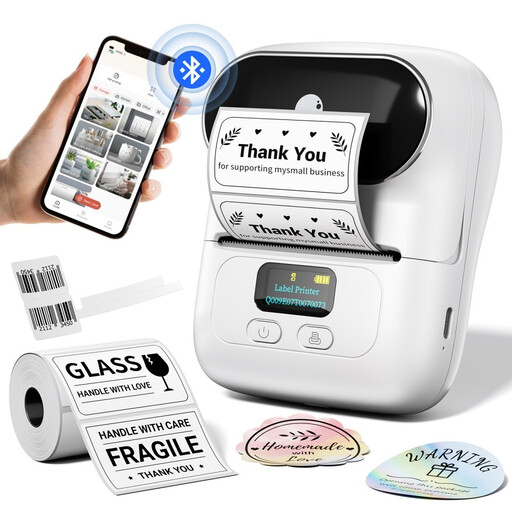 No image available
Consider it for labels on album covers or storage boxes, rather than on photographs. Measure the label area and confirm that compatible rolls and their adhesive suit the intended exterior surface; check the label material if long-term readability is important.
No: keep an ordinary self-adhesive label off the photograph. The Library of Congress advises marking housing materials instead, so use the album exterior, spine or storage box for the label.
It is worth considering when you need a durable exterior label, provided the tape fits the machine and the spine. Brother states that its laminated P-touch TZe labels resist water, sunlight, chemicals and abrasion; DYMO notes that extended direct-sunlight or fluorescent-light exposure can darken or fade direct-thermal labels. Neither point establishes that a label is suitable for direct contact with photographs.
Match the cassette or roll family and width to the exact label-maker model before buying. Measure the album’s label area as well: a compatible tape may still be too narrow or wide for the title you want to make.