Who is choosing?
The reason for changing a child’s usual drink determines which label matters most.
Families considering lactose-free dairy
If lactose is the concern but milk proteins are tolerated, lactose-free cow’s milk offers a familiar format for cereal, drinks and recipes. Gloucestershire Hospitals NHS Foundation Trust distinguishes lactose intolerance from cow’s-milk allergy; a suspected allergy calls for a different choice.
Households requiring gluten-free food
For someone with coeliac disease or another strict gluten-free requirement, check the claim on the individual drink. A lactose-free label answers a different question and does not, by itself, establish gluten-free status.
Parents planning familiar meals
A change of milk need not be the response to ordinary fussy eating. NHS guidance recommends continuing to offer a variety of foods without pressure and checking the labels of ingredients used in family meals.
What should you check?
Start with the dietary reason for the change, then check allergens and the drink’s stated uses before adding it to a familiar meal.
Lactose-free cow’s milk
Consider it: When lactose is the concern, milk proteins are tolerated and the eater already accepts dairy milk in familiar foods.
Check first: It still contains milk, and its lactose-free label does not establish an explicit gluten-free claim.
Gluten-free dairy-free soya drink
Consider it: When both lactose avoidance and an explicit gluten-free claim matter, provided soya is suitable for the eater.
Bear in mind: It contains soya and may taste or behave differently from cow’s milk in a familiar recipe.
| Priority | What to check | Your needs |
|---|
| Lactose |
Check whether the drink is labelled lactose-free and whether it contains milk. Waitrose & Partners lists whole milk and lactase enzyme in Arla LactoFREE Whole Milk Drink and states that it contains less than 0.03% lactose. |
Milk is already part of our meals, but lactose is the reason we are considering a change. |
| Gluten-free claim |
For strict gluten avoidance, look for an explicit claim on the current product. The Food Standards Agency states that food labelled gluten-free must contain no more than 20 mg/kg gluten as sold. |
I need the particular drink we buy to carry a gluten-free claim; its lactose-free wording is not enough. |
| Allergens |
Read the current ingredients and allergen information. Lactose-free cow’s milk still contains milk; dairy-free alternatives can contain other allergens, such as soya or almond. |
If milk protein, soya or almond is a concern in our household, I need a drink that suits the individual eater. |
| Familiar meals |
Check the drink’s stated uses against the cereal, drinks or recipes you plan to make. M&S describes uses for its lactose-free milk in cereal and hot drinks; Waitrose & Partners describes uses for Alpro Soya No Sugars in cereal and savoury dishes. |
For a selective eater, I would rather keep familiar meals recognisable while meeting the actual dietary requirement. |
Brand references for checking labels
These retailer and product examples show where the dairy choices differ; a retailer’s lactose-free category does not certify every item as gluten-free.
Arla LactoFREE
A lactose-free cow’s-milk range with whole and semi-skimmed options listed by UK grocers.
- Waitrose & Partners lists whole milk and lactase enzyme in Arla LactoFREE Whole Milk Drink, with less than 0.03% lactose.
- That drink contains milk and is not suitable for milk allergy, according to its Waitrose & Partners listing. Check the current pack for any gluten-free claim needed.
Tesco
Its lactose-free milk category lists own-label dairy drinks alongside Arla LactoFREE products.
- Tesco Groceries lists own-label skimmed and semi-skimmed lactose-free dairy drinks as well as Arla whole and skimmed drinks.
- Use the individual product’s current label, rather than its category placement, to check a strict gluten-free requirement.
Sainsbury’s
Its lactose-free category includes own-label dairy drinks and Arla LactoFREE.
- Sainsbury’s lists own-label whole, semi-skimmed and skimmed lactose-free dairy drinks.
- A category listing does not establish an explicit gluten-free claim for each drink; check the chosen product.
M&S
Its own-label lactose-free cow’s milk includes whole and semi-skimmed products.
- M&S describes its whole milk for cereal and hot drinks; its semi-skimmed product lists milk and lactase enzyme among its ingredients.
- M&S states that its lactose-free products are not suitable for dairy allergy or galactosaemia. Check the individual pack if an explicit gluten-free claim is required.
Waitrose
Its lactose-free category lists Arla cow’s-milk drinks alongside plant-based alternatives.
- Waitrose & Partners lists Arla whole and semi-skimmed lactose-free milk drinks and oat and soya alternatives in the category.
- Check each drink’s own ingredients, allergens and claims; the category does not make every listed product gluten-free.
Joybuy drink options
These plant-based drinks are options to consider when a dairy-free alternative fits the meal. Compare their stated dietary claims, allergens and intended uses against the current pack; they are not lactose-free cow’s milk.
 No image available
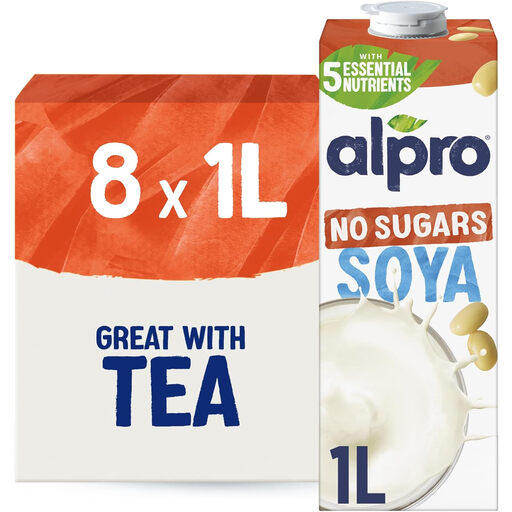
Alpro Soya No Sugars Long Life Drink, 8 x 1L
Consider this soya drink for cereal or savoury meals when a dairy-free alternative is needed. Its product information describes it as lactose-free and gluten-free; check the current pack’s claim and soya allergen information for the intended eater. The listed bundle contains eight 1L cartons.
View on Joybuy
 No image available
Alpro Almond No Sugars Long Life Drink, 8 x 1L
This almond drink is described for cereal and hot drinks where a dairy-free option suits the meal. Its product information states lactose-free and gluten-free claims; check the current pack for those claims and its almond allergen information. The listed bundle contains eight 1L cartons.
View on Joybuy
 No image available
Alpro Barista Coconut Long Life Drink, 8 x 1L
This drink’s stated use focuses on hot or iced coffee, so check whether it suits the family meal you have in mind. Its product information describes it as lactose-free and gluten-free; check the current pack and its soya and coconut ingredients. The listed bundle contains eight 1L cartons.
View on Joybuy
Common questions
Is lactose-free cow’s milk suitable for a cow’s-milk allergy?
No. Lactose-free cow’s milk still contains milk proteins: the Arla LactoFREE and M&S product listings identify milk, and Gloucestershire Hospitals NHS Foundation Trust distinguishes milk allergy from lactose intolerance. Seek clinical advice if an allergy is suspected rather than treating lactose-free dairy as milk-free.
Does lactose-free milk automatically meet a gluten-free requirement?
No. The lactose-free claim does not establish the drink’s gluten-free status. For strict gluten avoidance, check the current product for an explicit gluten-free claim; the Food Standards Agency states that food labelled gluten-free must contain no more than 20 mg/kg gluten as sold.
Which drink should I use in a fussy eater’s familiar meals?
Choose a drink that meets the eater’s dietary requirements, then check its stated use in the meal you plan to serve. M&S describes its lactose-free dairy milk for cereal and hot drinks where milk is suitable; Waitrose & Partners describes a gluten-free Alpro soya drink for cereal and savoury dishes where soya is suitable. NHS guidance also recommends continuing to offer a variety of foods without pressure.
Should I remove lactose from a child’s diet without advice?
Speak to an appropriate healthcare professional before making a restrictive change for suspected lactose intolerance. Coeliac UK advises against removing lactose before that conversation because it could reduce calcium intake.
How long can lactose-free milk be kept after opening?
Follow the instructions on the particular pack. M&S states that its lactose-free whole milk should be refrigerated at 0°C to +5°C and consumed within three days of opening; those instructions should not be assumed for other drinks.


