Vegan empty nesters replacing dairy
Look for a drink labelled vegan rather than relying on “lactose-free”. If it will replace milk regularly, compare calcium, vitamin D, iodine and protein on the exact pack.


Choose lactose-free cow’s milk if you want dairy without lactose and do not need a vegan product or have a milk allergy. If vegan suitability matters, choose a drink labelled vegan, then compare the exact product’s nutrients, allergens and storage instructions. A lactose-free label alone does not tell you which type of drink is in the carton.
The choice starts with whether you need to avoid lactose, avoid animal-derived ingredients, or both.
Look for a drink labelled vegan rather than relying on “lactose-free”. If it will replace milk regularly, compare calcium, vitamin D, iodine and protein on the exact pack.
Lactose-free cow’s milk remains a dairy option for tea, cereal or cooking when a vegan product is not required. NHS guidance distinguishes lactose intolerance from food allergy; lactose-free dairy is not a substitute for someone with a milk allergy.
If calcium and vitamin D are important considerations, check the exact plant drink’s nutrition panel and consider it alongside the rest of the diet. The NHS identifies plant drinks with added calcium as one possible calcium source; fortification varies by product.
Decide whether dairy is acceptable first. Then compare labels and pack formats within the route that meets that requirement.
| Priority | What to check | Your needs |
|---|---|---|
| Vegan suitability | Look for an explicit vegan label and read the ingredients. Tesco’s lactose-free skimmed dairy drink contains milk; GOV.UK explains that vegan labelling means animal-origin ingredients were not intentionally used. | I want to avoid dairy ingredients, not just lactose. A lactose-free cow’s-milk drink will not meet that requirement. |
| Nutrition | Compare calcium per 100ml and check vitamin D, iodine, vitamin B12, protein and sugars on each product. The NHS identifies calcium-fortified plant drinks as a calcium source; fortification is product-specific. | If a plant drink will replace milk in my daily routine, I want to know what the carton provides rather than assume soya, oat, almond and pea drinks are alike. |
| Allergens | Check milk ingredients on lactose-free dairy drinks and read allergen and precautionary statements on plant drinks. GOV.UK says vegan labelling does not guarantee the absence of animal-origin ingredients through cross-contact. | A milk allergy calls for a different check from lactose intolerance. I cannot treat either “lactose-free” or “vegan” as an allergy-safety guarantee. |
| Pack use | Compare pack size, unopened storage and instructions after opening. Tesco specifies three days after opening for its lactose-free skimmed drink; the listed Alpro soya and Mighty Pea drinks specify refrigeration and use within five days. | In a smaller household, I need a carton or multipack I can use while following its storage instructions. |
Lactose-free dairy drinks still contain cow’s milk. Tesco and M&S both list milk ingredients in their lactose-free products.
For a vegan purchase, look for a vegan label and check the ingredient list rather than choosing by the lactose-free wording alone.
GOV.UK explains that vegan labelling does not rule out cross-contact with animal-origin ingredients. It is not the same as an allergen-free claim.
If a milk allergy is relevant, read the allergen declaration and precautionary statements on the exact pack.
Added calcium and other nutrients differ between products. The NHS identifies plant drinks with added calcium as a calcium source, but that does not establish the content of every carton.
Compare the nutrition panels of the drinks you are considering, including calcium per 100ml and any listed vitamin D, iodine and protein.
Opened-pack instructions differ: Tesco specifies three days for its lactose-free skimmed drink, while the cited Alpro soya and Mighty Pea drinks specify five days under refrigeration.
Choose a pack size that fits how quickly your household uses it, and follow the instructions on that pack.
These ranges include different types of drink; a retailer’s lactose-free category is not a vegan designation for every product in it.
A lactose-free cow’s-milk range, rather than a vegan milk alternative.
Its lactose-free skimmed dairy drink provides an example of why the ingredient list matters.
Its lactose-free browsing range places dairy drinks alongside plant-based options.
Its lactose-free cow’s milk and Plant Kitchen milk alternatives are distinct product types.
Its Alpro Soya No Sugars listing illustrates a vegan, fortified plant-drink option.
These plant-based options are relevant if you want to avoid dairy. Compare their ingredients and pack sizes with your needs; lactose-free cow’s milk remains a separate choice for shoppers who do not require a vegan drink.
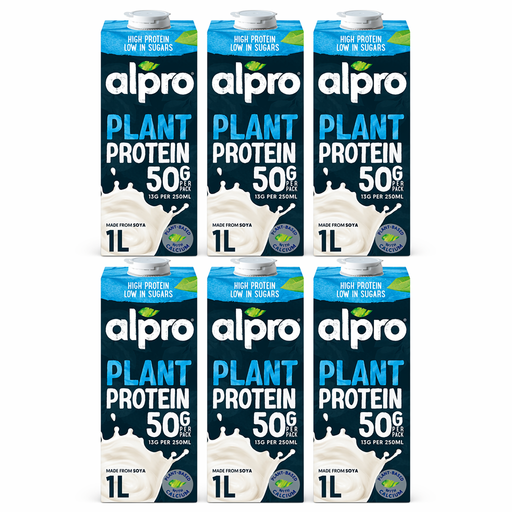 No image available
Consider this plant-protein option if you want a vegan drink. Confirm the quantity represented by “6” before ordering, and check the pack for allergens, calcium content and storage instructions.
 No image available
A soya-based option for shoppers choosing a vegan drink. The 8 x 1L format makes it worth checking how much your household will use; read the pack’s soya-allergen, nutrition and opened-carton instructions.
 No image available
An oat-based alternative when you prefer that ingredient to soya. Check the exact pack’s allergen declaration and nutrient values, and consider whether an 8 x 1L multipack fits your household’s use.
 No image available
An almond-based alternative for a dairy-free choice. Read the almond-allergen information and compare nutrients on the pack; check that the 8 x 1L quantity suits how quickly you use it.
No. Removing or reducing lactose does not remove the cow’s-milk ingredients: Tesco lists milk in its lactose-free skimmed drink, and M&S lists milk and cream in its lactose-free whole milk. Choose a drink labelled vegan if avoiding animal-derived ingredients is the requirement.
No: lactose intolerance and milk allergy are different, as the NHS explains. M&S specifically states that its lactose-free milk products are not suitable for people with a dairy allergy.
No. GOV.UK explains that vegan labelling does not guarantee the absence of animal-origin ingredients through cross-contact. If a milk allergy is relevant, read the allergen declaration and any precautionary statements on the exact product.
Compare calcium per 100ml, vitamin D, iodine, vitamin B12, protein and sugars on the products you are considering. The NHS identifies calcium-fortified plant drinks as a calcium source, but the nutrient content of one soya, oat, almond or pea drink cannot be assumed for another.
Match the carton or multipack to how much you use, then follow its instructions after opening. Tesco specifies three days for its lactose-free skimmed dairy drink; the cited Alpro soya and Mighty Pea listings specify refrigeration and use within five days.