What should you check before buying?
Start with the baby’s age and the reason for avoiding lactose or milk, then check whether the product is intended for food preparation or infant feeding.
| Priority | What to check | Your needs |
|---|
| Age and use |
Check whether you need milk for cooking or mixing into food, or a main milk feed. NHS guidance permits cow’s milk in food from around 6 months; it must not replace breast milk or first infant formula as the main drink before age 1. |
I’m preparing weaning foods, but still need an appropriate main milk feed for a baby under 12 months. |
| Milk protein |
Read the ingredients and allergen statement for milk and milk-derived ingredients. Cambridgeshire and Peterborough Children’s Health says a cow’s-milk-free diet avoids proteins such as whey and casein; a lactose-free claim does not establish that they are absent. |
If milk allergy is suspected or diagnosed, I need to follow the baby’s feeding plan rather than substitute lactose-free dairy. |
| Lactose and ingredients |
Check the lactose claim on the exact product and whether its ingredients remain dairy-based. Tesco Groceries lists whole milk and lactase enzyme for Arla LactoFREE Whole Milk Drink 1L and states less than 0.03% lactose. |
I need to reduce lactose while knowing whether the food still contains cow’s milk. |
| Introducing foods |
For foods that can trigger allergic reactions, NHS guidance says to introduce them one at a time and in very small amounts from around 6 months so a reaction is easier to spot. Follow individual clinical advice where an allergy is already suspected or diagnosed. |
When introducing a milk-containing food, I want to be able to identify a possible reaction. |
| Carton instructions |
Check the current pack’s ingredients, allergen wording, use-by date and storage or preparation instructions before serving. For infant formula, check that the specific product fits the baby’s clinical feeding plan. |
I need the instructions and allergen details for the carton I will actually use. |
Brand and retailer references
These references help distinguish lactose-free dairy products from milk-free choices; they do not indicate that any listed dairy milk suits a baby with cow’s-milk protein allergy.
Arla LactoFREE
A lactose-free cow’s-milk range; the whole milk drink listed by Tesco Groceries is a dairy product.
- Tesco Groceries lists whole milk and lactase enzyme for Arla LactoFREE Whole Milk Drink 1L and states less than 0.03% lactose.
- Because it contains milk, this product is not a milk-free choice.
Sainsbury’s Everyday
Sainsbury’s lists an own-label lactose-free whole dairy drink.
- The listed ingredients include cow’s milk, reconstituted lactose-reduced milk and lactase enzyme.
- Its cow’s-milk ingredients make it unsuitable for a cow’s-milk-free diet.
M&S Made Without
M&S lists a Made Without Lactose Whole Milk product.
- M&S explicitly states the allergy limitation on its product page.
- M&S says its lactose-free products are not suitable for dairy allergy or galactosaemia.
Tesco
Tesco Groceries lists Arla LactoFREE and Tesco own-label lactose-free dairy drinks.
- Its Arla LactoFREE whole milk listing identifies the milk ingredient and lactose claim.
- A lactose-free category listing does not establish that a product is milk-free; check each carton.
Waitrose
Waitrose & Partners lists lactose-free dairy milk alongside plant-based drinks.
- Its category listing includes Arla LactoFREE Whole Milk Drink and oat drinks as distinct products.
- Being listed in the same category does not make lactose-free cow’s milk suitable for a milk-free diet.
A Joybuy infant formula option
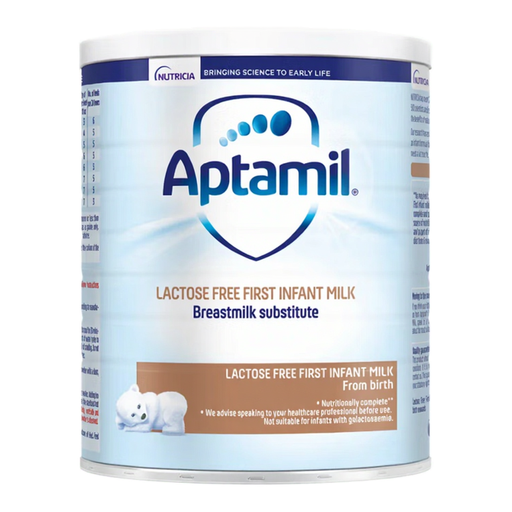
This option is a lactose-free infant formula for a baby whose lactose needs are being managed under medical supervision. It is not an ordinary lactose-free cow’s-milk drink for mixing into weaning food, nor is it milk-free.
 No image available
Aptamil Lactose Free Baby Milk Formula Powder From Birth, 400g
This lactose-free infant formula is relevant when a baby’s lactose issue is being managed under medical supervision. Its product information identifies calcium caseinate from milk and fish oil, so it is not a milk-protein-free option. Confirm that this specific formula fits the baby’s clinical feeding plan, and follow the current carton’s allergen and preparation instructions.
View on Joybuy
Questions about milk during weaning
Can I use lactose-free cow’s milk during baby-led weaning?
From around 6 months, cow’s milk can be used in cooking or mixed with food if the baby can have dairy. NHS guidance says it must not replace breast milk or first infant formula as the main drink before age 1.
Is lactose-free cow’s milk suitable for a baby with milk allergy?
No, not when the baby needs to avoid cow’s-milk protein. Cambridgeshire and Peterborough Children’s Health explains that a milk-free diet avoids proteins including whey and casein; lactose-free dairy does not remove that requirement. Follow the baby’s clinical feeding plan.
Does “lactose-free” mean “dairy-free”?
No. A lactose-free cow’s-milk product remains dairy-based: Tesco Groceries, for example, lists whole milk in Arla LactoFREE Whole Milk Drink. Read the ingredients and allergen statement rather than relying on the lactose-free claim alone.
How should I introduce a milk-containing food?
NHS guidance says to introduce foods that can trigger allergic reactions one at a time and in very small amounts from around 6 months, making a reaction easier to spot. If milk allergy is already suspected or diagnosed, follow the baby’s clinical advice instead of trialling a milk-containing food on your own.
Can a plant-based drink replace infant milk before age 1?
Not as the main milk feed. NHS guidance identifies first infant formula as the suitable alternative to breast milk during the first 12 months; babies following a milk-free feeding plan need an appropriate infant-feeding option guided by their clinicians.


