
24/7 Customer Support

Free returns

Same-day & Next-day Delivery

Quality Guaranteed

Unlock Your Welcome Offers: FREE Delivery | Up to 80% OFF | Free 30-day JoyPlus trial
Download the APP
Navigating a foreign country, closing an international business deal or even just ordering a coffee can quickly become challenging when you don't speak the local language. A modern language translator device promises to break down these barriers. However, the market is filled with gadgets that over-promise and under-deliver, leaving many UK buyers with little more than a costly paperweight.
As the Joybuy Product Recommendation Officer, my role is to help you see past the marketing clutter. Before you invest, let's look at the common pitfalls that can lead to a poor purchase and what to look for instead.
Many shoppers are drawn in by impressive-sounding features, only to be disappointed by real-world performance. Here are three frequent issues to watch out for:
translator for travel must have functional offline capabilities.two way language translator voice support for only a dozen core languages, with the rest limited to less practical text input or single-word photo translation.translation earbuds require you to constantly pull out your phone to manage a clunky app, defeating the purpose of a seamless experience. A short battery life can leave you stranded without a communication tool when you need it most.To avoid these pitfalls, focus your attention on a few key specifications. These are the non-negotiable features that determine whether an AI translator will be a helpful companion or a frustrating gadget.
This is arguably the most critical feature for any serious traveller. An offline translator works without an internet connection by using pre-downloaded language packs.
The right choice depends entirely on how you plan to use it. Each format offers distinct advantages for different scenarios.
Pocket Translator: These are dedicated, all-in-one units like an electronic voice translator. They often feature a screen, a built-in microphone and speaker and sometimes a camera for photo translation. They are excellent for clear, back-and-forth conversations with strangers, as you can simply pass the device back and forth. They are also typically more straightforward to use without needing a paired smartphone.Translation Earbuds: These offer a more discreet and personal experience. They function like regular Bluetooth earbuds for music and calls but integrate with a smartphone app to provide real time translator capabilities. They are ideal for business meetings or one-on-one conversations where you want the translation delivered directly to your ear.A versatile device should offer multiple ways to translate.
real time translator, capturing spoken words and providing an audio translation. Look for devices with sensitive microphones that can function in moderately noisy environments.Based on these practical criteria, we have identified several models that are well-suited for different types of users in the UK.
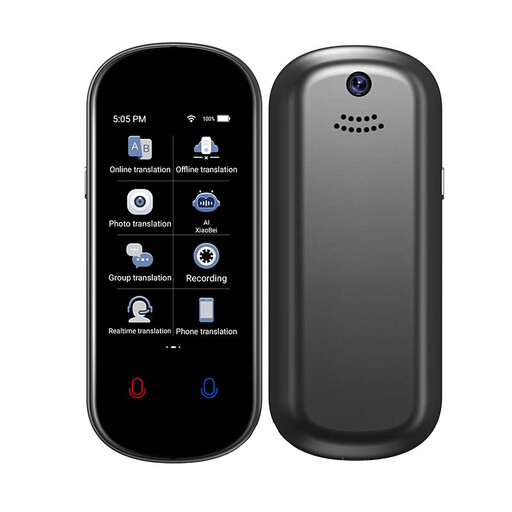
Why This Fits Their Persona: This user needs a reliable, standalone tool that works anywhere. The Rexsun Z2 is a dedicated pocket translator that doesn't depend on a smartphone for its core functions, making it perfect for navigating airports, hotels and markets where Wi-Fi is unreliable.
It directly counters the "online-only" trap by offering 17 offline languages for voice translation and 41 for photo translation, ensuring functionality without data.
Its all-in-one design with voice, photo and text modes in a durable metal body makes it a robust and versatile travel companion.

Why This Fits Their Persona: A business user needs discretion, versatility and efficiency. These earbuds allow for seamless switching between taking calls, listening to music and engaging in a translated conversation, all while maintaining a professional appearance.
It avoids the "clunky app" issue by integrating an intuitive LCD touch screen on the charging case, allowing for direct control of translation and other functions without constantly reaching for a phone.
The combination of Active Noise Cancellation (ANC) and a long 40-hour total battery life makes it a high-performance tool for focus and communication during long workdays and travel.
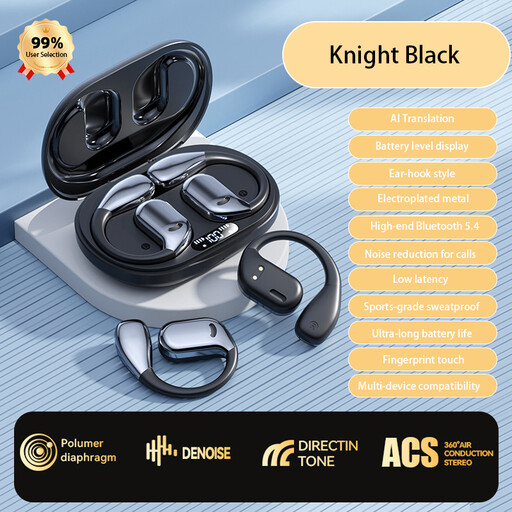
Why This Fits Their Persona: Language learners and those needing a simple tool for occasional use require a functional, affordable and unobtrusive solution. These in-ear buds provide a low-cost entry into real-time translation for practising conversation or navigating daily life in a new city.
While it relies on an app, its value proposition is clear. It avoids the trap of being an overpriced, underperforming gadget by offering a huge range of app-supported languages at an accessible price point for casual users.
The discreet, lightweight in-ear design and simple touch controls make it easy to use for both translation and everyday audio listening without drawing attention.
We have compiled a complete, real-time list of products that fully satisfy these strict selection criteria and UK safety regulations.
Not necessarily. It depends on the type of device. Standalone pocket translator models, like the Rexsun Z2, operate independently and do not require a smartphone for their translation functions. However, translation earbuds almost always require a connection to a smartphone, as they rely on a companion app to process the translation.
Modern AI translator technology has become remarkably accurate for conversational language. They are generally very effective for travel, ordering food, asking for directions and holding informal business discussions. However, they are not intended for situations requiring 100% precision, such as translating legal contracts, medical diagnoses or highly technical documents. Always use a professional human translator for such critical tasks.
Online translation uses powerful, cloud-based AI engines and requires an active internet connection. This method typically supports more languages and may offer slightly higher accuracy for complex sentences. Offline translation uses language packs stored directly on the device. While the number of supported languages is smaller, it is an essential feature that ensures your device remains functional when you have no access to Wi-Fi or mobile data.