
24/7 Customer Support

Free returns

Same-day & Next-day Delivery

Quality Guaranteed

Unlock Your Welcome Offers: FREE Delivery | Up to 80% OFF | Free 30-day JoyPlus trial
Download the APP
Working from the road, managing a family's devices on a long trip or simply needing to keep your tech powered between meetings has become a modern necessity. Yet, the standard car charger often falls short, struggling to power anything more demanding than a smartphone. If you've ever watched your laptop battery drain faster than your in-car adapter can charge it, you understand the need for a more powerful solution.
A high-performance laptop car charger is no longer a niche accessory; it's an essential tool for professionals, commuters and families across the UK. This guide is designed to help you navigate the technical specifications and find a reliable cigarette lighter adapter that can handle your laptop, tablet and phone simultaneously, without cluttering your console.
Selecting the right charger involves more than just picking one with the right plug. To ensure you get a device that meets your needs, consider these key factors.
The single most important factor for charging a laptop is wattage. A standard 12W car charger is fine for a phone, but a laptop, such as a MacBook or a high-performance Windows model, typically requires between 65W and 100W for effective charging.
Look for a 100W car charger that supports the PD car charger (Power Delivery) protocol. Power Delivery is a charging standard that uses USB-C connections to negotiate and deliver higher levels of power to your devices safely. Without PD support, even a high-wattage charger will not be able to fast-charge your laptop.
In an increasingly connected world, a single-port charger is rarely enough. A multi port car charger allows you to power several devices at once. Pay close attention to the types of ports offered. For modern electronics, at least one USB C car charger port is essential, as this is the standard for most new laptops, tablets and smartphones. A combination of USB-C and USB-A ports offers the most versatility, accommodating both new and older devices.
Plugging a high-power device into your car's electrical system requires a focus on safety. A well-made charger should have built-in protections against over-current, over-voltage and overheating. Look for products with CE and RoHS certifications, which indicate compliance with UK and European safety and environmental standards. Materials like zinc alloy or fire-retardant PC plastic contribute to better heat dissipation and overall durability, ensuring the charger remains a reliable part of your travel kit.
Here are a few standout options that address the needs of today's power-hungry road users.
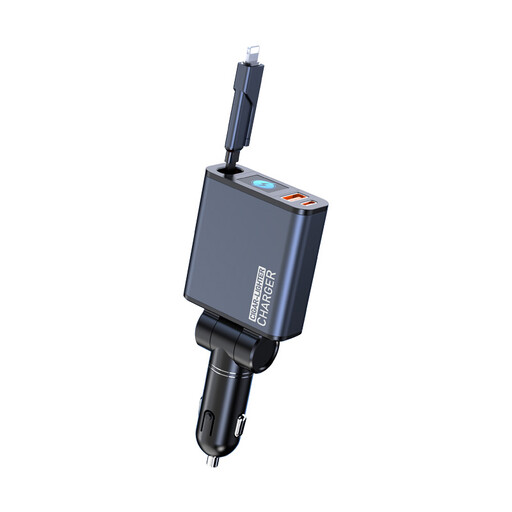
Why It Stands Out: The ATSHARK K006S is built for convenience and power. Its most notable feature is the dual 90cm retractable fast-charge cables, which eliminate dashboard clutter and the need to carry extra wires. With a total output of 160W, it can comfortably power multiple devices at once.
Pros:
Who is it for? This is an excellent choice for families or professionals who prioritise a clean, organised vehicle interior and need a single solution for charging phones, tablets and a laptop without a mess of cables.

Why It Stands Out: For those who need maximum power, the ACEFAST B14 delivers. It boasts a massive 165W total output and, crucially, a dedicated USB-C port capable of delivering 100W on its own. This makes it a formidable car charger for MacBook Pro models and other demanding laptops. The integrated OLED display provides real-time voltage and power monitoring.
Pros:
Who is it for? This charger is aimed at tech-savvy road warriors and professionals who rely on multiple high-power devices and appreciate having detailed, real-time information about their charging performance.
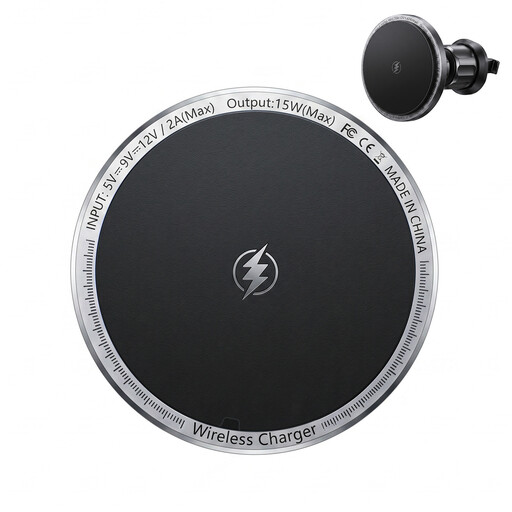
Why It Stands Out: While not a primary laptop charger, the Rexsun model offers a different kind of convenience. It is a magnetic wireless charger and phone mount designed for MagSafe-compatible iPhones (12 series and newer). It provides a secure, one-handed solution for mounting and charging your phone, keeping your view unobstructed.
Pros:
Who is it for? This is ideal for iPhone users who want a dedicated, hands-free charging mount for their phone. It pairs well with a more powerful multi-port charger, freeing up a port while providing a seamless user experience.
If these specific models don't quite fit your needs, or if you would like to browse a wider selection of charging solutions for your vehicle, you can explore our full range of Type 1 car charger options to find the perfect match for your devices and car.
1. Can any USB-C car charger power a laptop? Not necessarily. While the plug might fit, charging a laptop requires both high wattage (typically 65W-100W) and support for the Power Delivery (PD) protocol. A standard USB C car charger designed for phones usually outputs 15W-30W and will not be powerful enough to charge a laptop, especially while it is in use.
2. Is it safe to leave a high-power car charger plugged in all the time? Modern, certified chargers are designed with safety features to prevent overcharging and short-circuiting. However, some may draw a very small amount of power from your car's battery even when not in use. As a general good practice, it is wise to unplug the charger if you plan to leave your vehicle parked for several days. It is also recommended to plug in your sensitive electronics, like a laptop, only after the car engine has started to avoid any potential power surges.
3. What is an E-Marker cable and do I need one? An E-Marker is an electronic chip inside a USB-C cable that communicates its capabilities (like its maximum power and data speed) to the charger and the device. For charging at speeds above 60W (up to 100W or more), a 100W-rated E-Marker cable is required. Using a standard, non-rated cable with a 100W car charger will limit the power output to 60W for safety. Some chargers, like the ATSHARK K006S, conveniently include one.