Buy a USB-C dock if the printer is mainly for the laptop connected at one desk and you also want convenient access to other local peripherals. A dock does not make a USB-only printer independently available to everyone: for regular multi-user printing, use the printer’s Ethernet or Wi-Fi connection if it has one, or consider sharing it from a Windows device that can remain on and connected to the network. Before buying a dock, check the laptop’s USB-C capabilities, the printer cable, available USB data ports and any charging requirement.
Who is this setup for?
Small teams keeping a USB-only printer
If several Windows users need the existing printer, the decision is about shared access as well as the physical USB connection. Microsoft Support says sharing from a primary Windows device requires that device to be powered on, connected to the network and configured for printer sharing.
Laptop users at a fixed desk
If one laptop regularly uses the printer alongside a keyboard, mouse or other peripherals, a compatible dock or adapter can keep those local connections at the desk. It does not remove the need for a separate arrangement if colleagues must also print.
IT teams equipping shared desks
For desks used with different laptops, check host compatibility and the features the office will actually manage. Lenovo documents USB-C protocol requirements for its ThinkPad Universal USB-C Dock; features available with one laptop should not be assumed to work with every other model.
What matters when choosing a connection?
Decide how people will reach the printer before choosing desk hardware: a dock handles a laptop’s local connections, while printer networking or a configured host handles access for other users.
Printer connected to the network
Choose when: Several people need to print independently and the printer has Ethernet or Wi-Fi that can be used on the office network.
Trade-off: The printer needs network setup and suitable drivers, but print access need not depend on one docked laptop remaining on.
USB printer shared from Windows
Choose when: The office wants to keep a USB-only printer and can designate a Windows device to host it.
Trade-off: Microsoft Support says the primary device must remain powered on and network-connected, with printer sharing enabled. A dock can connect the printer to that device, but cannot replace it as the host.
Direct connection through a dock
Choose when: One compatible laptop needs the USB printer and other local peripherals at its workstation.
Trade-off: One host cable can simplify desk connections, but it does not give other users independent access to the printer.
| Concern |
What to check |
Who this matters to |
| Access for several users |
Check whether the printer has Ethernet or Wi-Fi. For a USB-only printer shared through Windows, confirm that a designated host can stay on and connected to the office network. |
If colleagues need to print without waiting for my laptop to be docked, the printer connection must work for the whole team. Around 38% of consumers put independent multi-user access first. |
| Laptop and dock compatibility |
Match the exact laptop’s USB-C capabilities and charging needs to the dock; reserve a compatible USB data port for the printer cable. |
When I connect my laptop at the desk, I need the printer and any required charging or display connection to work with that model. Compatibility is the primary concern for around 31% of consumers. |
| Managed desks |
Check wired-network requirements and the dock maker’s documented support for the laptops and management features in use. |
Equipping several workstations means I need a setup IT can maintain across the office’s laptops. Around 16% of consumers chiefly prioritise managed deployment. |
| One-cable desk setup |
Count the printer and other peripherals that need data ports, then check which display, Ethernet and charging connections the desk uses. |
At a desk I use repeatedly, I want to reconnect local devices without plugging in each cable. Desk convenience comes first for around 15% of consumers. |
Mistakes to avoid
-
Expecting a dock to share the printer by itself
A USB printer connected to a dock is attached to the laptop using that dock. A colleague’s access still needs the printer’s own network connection or a configured sharing host.
Check the printer for Ethernet or Wi-Fi before buying desk hardware to solve a multi-user printing problem. If it is USB-only, decide whether a designated host is practical.
-
Choosing by port count alone
Plenty of sockets do not establish that a particular laptop can use the dock’s intended charging or display functions. The printer also needs an available data-capable port that fits its cable.
Compare the exact laptop model and dock specifications, including USB-C protocol and power requirements, before choosing where each peripheral will connect.
-
Relying on a laptop that leaves the office
Under Microsoft Support’s Windows printer-sharing requirements, other users depend on the primary device being powered on and connected to the network.
If host sharing is necessary, agree which managed device will host the printer and how it will remain available. Otherwise, consider the printer’s own Ethernet or Wi-Fi connection where supported.
Printing can be interrupted when the host laptop is asleep, disconnected or taken away.
Relevant dock brands
These product lines offer points of comparison for a laptop workstation; their inclusion does not establish that a particular model suits every laptop or provides printer sharing.
Lenovo
The ThinkPad Universal USB-C Dock 40AY0090UK is a reference point for a desk needing multiple USB connections and wired networking. Lenovo UK lists five USB-A ports across USB 2.0 and USB 3.2 generations, a USB-C port and Gigabit RJ45.
- Lenovo documents USB-C protocol requirements for its dock range, giving IT teams a starting point for checking individual laptops.
- A USB printer connected to the dock still needs a separate arrangement for access by other users; confirm any required functions on non-Lenovo laptops.
HP
HP’s USB-C Dock G5 is relevant when comparing a workstation dock with USB peripheral connections and wired Ethernet.
- HP lists four USB-A connections and RJ45 connectivity for the USB-C Dock G5.
- HP specifies host USB-C requirements, including DisplayPort Alt Mode for the relevant functionality. Check the exact dock variant, laptop and required power connection.
Dell
Dell’s WD22TB4 is a Thunderbolt 4 docking option to investigate for desks using compatible laptops.
- Dell Technologies describes the WD22TB4 as connecting peripherals to a system through a Thunderbolt 4 Type-C interface.
- Check the intended laptop’s Thunderbolt support and the dock’s model-specific functions rather than assuming compatibility from the connector shape.
Joybuy options for a single-laptop desk
These USB-C hubs, adapters and docks are options for connecting a printer locally to one laptop alongside other desk peripherals. Choose the connections your laptop and printer cable require; arranging shared printing for colleagues is a separate decision.
 No image available
Baseus Metal Gleam Series II 10-in-1 USB hub, Cosmic Black
Consider this for one laptop using a USB printer alongside other local accessories; it does not independently share the printer with colleagues.
The listed connections include one USB-A 10Gbps port, two USB-A 480Mbps ports, a USB-C 10Gbps port, RJ45, two HDMI outputs and a USB-C PD connection. Check the laptop’s support for the connections you intend to use.
Joybuy
 No image available
V7 V7UC-U3CRJ45HDVG-BLK USB-C adapter
This is a local printer connection to consider when two USB ports also leave enough room for the desk’s other peripherals; shared printing requires a separate setup.
The product name lists dual USB 3.0 ports, Gigabit Ethernet, HDMI, VGA and 100W Power Delivery. Check the laptop’s USB-C capabilities and power needs before relying on those functions.
Joybuy
 No image available
USB-C multiport adapter with 2 HDMI, DP and 4 USB ports
The stated USB ports make this an option for a printer and other devices connected to one laptop, not a way to put the printer on the network.
The product name specifies two USB 3.0 ports, two USB 2.0 ports, two HDMI outputs, DisplayPort, RJ45, PD, SD/TF and audio. Check the laptop’s compatibility and the printer cable before purchase.
Joybuy
 No image available
Mokin 2USBC to TB+ adapter with USB and HDMI
Consider it for a printer used by the connected laptop when its remaining ports suit the other devices at that desk. It does not provide independent printer access to the office.
The product name lists two USB-A 3.0 ports, one USB-C 3.0 port, SD/TF and HDMI specified at 4K 60Hz. Confirm the upstream connection against the exact laptop model.
Joybuy
 No image available
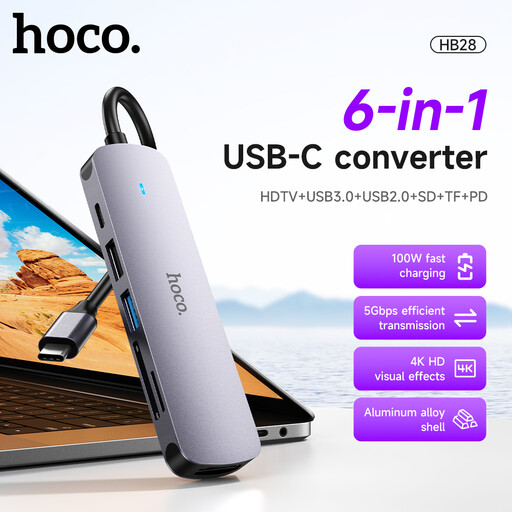
HOCO HB28 USB-C converter, Metal Grey
This compact adapter is an option when a printer and one other USB peripheral need local connections to the same laptop. It does not share a USB-only printer by itself.
The product name lists one USB 3.0 port, one USB 2.0 port, an HDTV output, SD/TF and PD. Check that those ports, the printer cable and the laptop’s USB-C connection meet the desk’s needs.
Joybuy
Common questions
Will a USB printer plugged into a dock work for everyone in the office?
Not by itself: the printer is connected to the laptop using the dock. For Windows sharing, Microsoft Support says a primary Windows device must stay powered on and connected to the network with printer sharing enabled. If the printer has Ethernet or Wi-Fi, connecting it to the office network may better suit people who need to print independently.
How do I connect a USB printer through a dock on Windows?
Connect the printer to a compatible downstream USB data port, connect the dock to the laptop and turn the printer on. Microsoft Support says a directly connected printer normally installs automatically; if it does not appear, check Windows printer settings and the printer’s installation requirements.
What should I check before buying a USB-C dock for the printer desk?
Check the exact laptop’s USB-C or Thunderbolt capabilities, its charging requirement, the printer cable and the number of free USB data ports after other peripherals are connected. Lenovo and HP document host requirements for their dock functions, so a USB-C-shaped socket alone does not establish that every advertised function will work.


