What matters when choosing
For one laptop moving between mobile use and a desk, decide whether your primary need is the display arrangement, a ready-to-use desk connection or a compact set of ports to carry.
Compact USB-C adapter
Choose it when: You usually connect one monitor and a limited set of accessories at different locations.
Trade-off: You have less room for permanent connections and may need a separate charger for power pass-through.
Powered desk dock
Choose it when: You want regularly used displays and peripherals to remain connected at a home or office desk.
Trade-off: It takes desk space, while USB-C, USB4 or Thunderbolt capability and the laptop’s display limits still govern what works.
Separate accessories
Choose them when: Your laptop already has suitable ports and you only need one or two desk connections.
Trade-off: You may have more cables to reconnect each time you sit down.
| Concern |
What to check |
Who this matters to |
| External displays |
Check the exact laptop model’s supported display count and modes, then compare them with the dock outputs and monitor inputs. Apple Support says a Mac’s external-display support depends on its model. |
If I need separate working space across external screens, I do not want two connectors that only duplicate the same picture. Around 42% of consumers put display compatibility first. |
| Charging and a ready desk |
Compare the laptop’s charging requirements with the dock’s documented power delivered to the host. Check whether the quoted figure changes by laptop model. |
At my regular desk, I want charging and frequently used peripherals connected without rebuilding the setup each day. For around 33% of consumers, that one-cable arrangement is the primary need. |
| Portable expansion |
List the devices you must connect at once, then check the adapter’s port types and the host connection’s required functions. |
When I work in different places, I would rather carry a small adapter for my limited set of connections than leave a large dock in my bag. Compact expansion comes first for around 25% of consumers. |
Joybuy product choices
These choices cover USB-C desk connections and multiport adapters for moving a laptop between locations. Match each product’s stated connections to your laptop and intended monitor setup; the list is not a recommendation to replace separate accessories when your existing ports meet your needs.
 No image available
Targus USB-C Universal Dual HDMI 4K Docking Station, 100W PD pass-through
Consider this for a desk where two HDMI connections and laptop charging pass-through are priorities.
The title specifies dual HDMI 4K outputs and 100W power-delivery pass-through. Check the laptop’s USB-C video support and independent-display limit, and confirm whether a suitable power adapter is included.
Joybuy
 No image available
V7 V7UC-U3CRJ45HDVG-BLK USB-C adapter
Consider this for a compact desk connection when you need video, wired networking and USB accessories.
The title lists 4K HDMI, VGA, Gigabit Ethernet, dual USB 3.0 ports and 100W power delivery. If you need two independent external displays, confirm its simultaneous-output behaviour; also check your laptop’s USB-C video capability.
Joybuy
 No image available
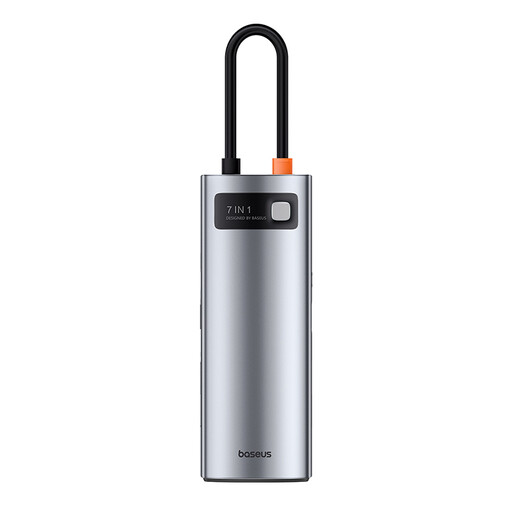
Baseus Metal Gleam Series seven-port USB-C hub, grey
Consider this when a portable hub suits your laptop-to-desk routine better than a permanently connected dock.
It is identified as a seven-port USB-C hub. If laptop charging or an external monitor is essential, check the required charger and the laptop’s supported USB-C video mode against the intended setup.
Joybuy
 No image available
MOVESPEED DK5A1 10-in-1 USB-C docking station
Consider this for one external display alongside USB devices and memory cards, provided your laptop supports video through its host connection.
The title specifies HDMI 4K at 60Hz, USB-C at 10Gbps, USB-A at 10Gbps or 5Gbps, SD/TF card access at 160MB/s and 3.5mm audio. Check laptop charging separately: a USB-C power output does not establish charging pass-through to the laptop.
Joybuy
 No image available
USB-C multiport adapter with 2 HDMI, DisplayPort and RJ45
Consider this when you need several types of desk connection, particularly wired networking and USB peripherals.
The title also lists two USB 3.0 ports, two USB 2.0 ports, PD, SD/TF and audio. Before choosing it for several monitors or laptop charging, confirm its simultaneous-display modes, power-delivery rating and host-port requirements.
Joybuy
Frequently asked questions
What should I check on my laptop before buying a dock?
Check the exact model’s host-port functions, external-display limit and supported display modes, plus whether it accepts USB-C charging. For a Mac, Apple Support directs users to the model’s Display Support or Video Support specifications; the number of external displays depends on the Mac model.
When is a compact multiport adapter enough?
A compact adapter can be enough for one external monitor and a small set of accessories rather than a permanently connected desk. Check its video output, available ports and any charging pass-through against your laptop and the devices you will connect simultaneously.
Will a dock let my laptop run more independent monitors?
Not merely because the dock has more video outputs: check the laptop model’s supported display configuration first. Microsoft Support notes that a splitter may duplicate a signal instead of producing two independent desktops.
Do all USB-C cables support a dock’s video and charging features?
No. USB-C connections can differ in their data, video and power capabilities, and Microsoft Support warns that not all USB-C-compatible cables support every feature. Use a cable specified for the dock functions you intend to use.
What if a dock stops detecting a display or peripheral?
Start by checking the cable connections, selected monitor input and laptop updates. For a supported Surface Dock, follow Microsoft’s model-specific firmware guidance; for another dock, use its manufacturer’s documented update process.


