Space-limited video callers
If the webcam and a few everyday accessories are your main connections, assess a compact dock first. Check that its ports accommodate your devices and that your laptop supports the functions you want to use.


Choose a compact USB-C dock if the webcam and a few accessories are your main connections and desk space is tight. A desktop USB-C dock makes more sense when you also need several peripherals, displays or laptop charging; consider Thunderbolt when a compatible laptop and wider expansion needs justify it. Before buying, check the laptop port, the dock’s USB and charging connections, and any hub guidance for your webcam.
If the webcam and a few everyday accessories are your main connections, assess a compact dock first. Check that its ports accommodate your devices and that your laptop supports the functions you want to use.
If you leave the webcam connected alongside a keyboard, mouse, display or wired network, a desktop USB-C dock may bring those connections together. Match its charging capability to your laptop rather than assuming one cable will provide every function.
If the webcam is part of a wider display and peripheral setup, a Thunderbolt dock is worth assessing when your laptop supports Thunderbolt. Its additional connections are less relevant if you only need a camera and basic accessories.
Choose when: You want to connect a webcam and a few accessories without dedicating much desk space to the dock.
Trade-off: A compact model may rely on your existing charger for power pass-through and leave fewer ports for later additions.
Choose when: Your webcam stays connected alongside several peripherals, displays or a wired network.
Trade-off: Allow space for the dock and its power arrangement; a stated charging output does not guarantee your laptop will charge at its usual rate.
Choose when: A Thunderbolt-compatible laptop also needs wider display or peripheral expansion beyond the webcam.
Trade-off: It adds a compatibility and setup consideration that a basic webcam connection alone may not justify.
| Concern | What to check | Who this matters to |
|---|---|---|
| Laptop and webcam compatibility | Check the laptop’s USB-C video and charging capabilities against the dock’s requirements, and read the webcam maker’s hub guidance. | If I rely on one connection for calls, I need the camera to work consistently and the laptop port to support the dock functions I intend to use. Around 42% of consumers put compatibility and connection reliability first. |
| Desk space and cables | Compare the dock’s dimensions and cable placement with the available space; check where the webcam cable will plug in. | With little room around my laptop, I want the dock to keep adapters and cables manageable rather than move the clutter elsewhere. Desk space is the main concern for around 33% of consumers. |
| Charging and expansion | List the USB devices, displays and network connections you need; compare the dock’s power delivery and display requirements with your laptop. | If my webcam shares a fixed desk with several devices, I need enough suitable connections without giving up the charging arrangement I use. Wider desk connectivity comes first for around 25% of consumers. |
A USB-C connection alone does not establish whether the laptop can send video to a display or receive charging through the dock.
Check the laptop manual for the video capability required by your chosen dock, such as DisplayPort Alt Mode, USB4 or Thunderbolt, and confirm USB Power Delivery if charging matters.
Hub behaviour can matter for cameras: Logitech warns that using a hub with its BRIO webcam can affect signal integrity and performance.
Check guidance for your webcam model. If it becomes unreliable through a dock, try a direct laptop connection and use the dock for other peripherals.
Power pass-through may depend on an external charger, while what comes in the box varies by product.
Check the dock’s power requirements and box contents against your laptop charger before ordering.
You may need to keep your laptop charger connected to the dock or obtain a suitable separate charger.
Electrical equipment supplied in Great Britain is subject to product-safety requirements; clear product and supplier details help you identify the equipment if a safety concern arises.
Keep the product details and documentation, and consult the official GOV.UK product-safety alerts and recalls service if you have a concern.
Lenovo’s ThinkPad Universal USB-C Dock is a reference point for a fixed desk with a webcam and several other connections.
Kensington offers both a compact mobile-dock example and a larger desktop-dock example for different desk layouts.
Dell’s WD22TB4 illustrates the Thunderbolt route when a webcam is part of a more extensive fixed-desk setup.
These USB-C adapters and docks offer different port layouts for a webcam on a small desk. Compare their laptop and webcam compatibility, charging arrangements and physical fit before choosing; a port list alone cannot establish that your camera will work reliably through a dock.
 No image available
Consider this adapter if you need a webcam connection alongside another USB accessory on a small desk.
The product name specifies two USB 3.0 ports, HDMI, VGA, Gigabit Ethernet and 100W Power Delivery. Confirm whether HDMI and VGA can operate simultaneously if you need both displays.
 No image available
Consider this for a fixed desk where the webcam shares the laptop connection with displays and other accessories.
The product name specifies dual HDMI and 100W Power Delivery pass-through. Check the laptop’s video support and whether a suitable external power adapter is included.
 No image available
Consider its USB connections when a webcam needs to share a dock with several accessories.
The product name lists USB-A 10Gbps and 5Gbps connections, USB-C 10Gbps, 4K 60Hz HDMI, SD/TF and 3.5mm audio. Check host video requirements before relying on HDMI, and confirm laptop charging separately if needed.
 No image available
Consider this port layout if the webcam needs to share an adapter with other USB devices and desk connections.
The product name lists two USB 3.0 ports, two USB 2.0 ports, two HDMI connections, DisplayPort, RJ45, PD, SD/TF and audio. Check video operating limits and power pass-through against your laptop before relying on those functions.
 No image available
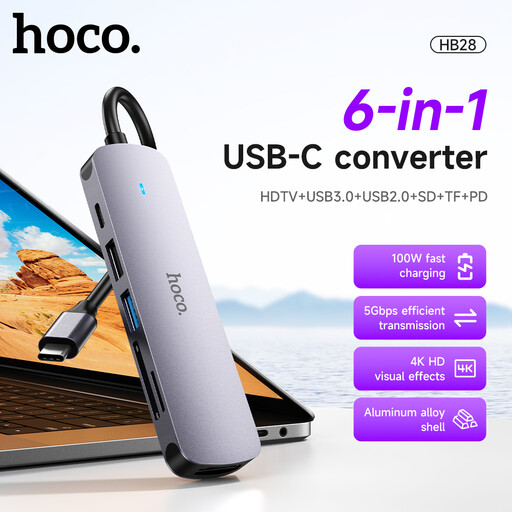
Consider this adapter if you want a webcam connection and only a small number of other wired accessories.
The product name lists USB 3.0, USB 2.0, HDTV, SD/TF and PD connections. Check the laptop’s display capability and the adapter’s charging limits if you plan to use either function.
No: the connector alone does not establish which video or charging functions the laptop supports, and webcam behaviour through a dock can vary. Check the laptop’s specifications against the dock’s requirements and read the webcam maker’s hub guidance; Logitech cautions against hub use with its BRIO where possible.
Use the dock if your webcam works reliably through a suitable USB port. If it disconnects or behaves unpredictably, try a direct laptop connection as a troubleshooting step; Logitech warns that a hub can affect signal integrity for its BRIO webcam.
Compare the dock’s stated USB Power Delivery or pass-through capability with your laptop’s charging requirements, and confirm that the laptop supports charging through that port. Also check whether the required charger is supplied or whether you will use your existing one.
For a dock supplied in Great Britain, check that the product and supplier are identifiable and keep its documentation. The Office for Product Safety and Standards describes requirements for electrical equipment placed on the GB market; consult the official GOV.UK product-safety alerts and recalls service if a safety concern arises.