First-time job applicants
If you mainly draft, proofread, save and email a covering letter and CV, concentrate on a usable document setup rather than performance intended for gaming or media production.


For writing a covering letter, choose a laptop with a keyboard and screen you can use comfortably, enough memory for your browser and document editor, and access to the software you need; gaming-level performance is not the priority. A compact 14-inch model suits writing away from a desk, while a larger Full HD screen gives you more room to work with a letter and job listing. If you are considering Windows on ARM, check your required apps and peripherals before buying.
If you mainly draft, proofread, save and email a covering letter and CV, concentrate on a usable document setup rather than performance intended for gaming or media production.
If you compare vacancies, revise multiple versions and upload attachments, consider the space available for browser tabs and documents, as well as how you will store your files.
If applications travel with you, check the laptop’s weight, screen size and practical charging arrangements alongside typing comfort.
Start with the screen and keyboard you will use to write and proofread, then check document capability, portability and any software or peripherals your applications require.
| Concern | What to check | Who this matters to |
|---|---|---|
| Writing comfort and readability | Check the exact screen size and resolution, anti-glare treatment and keyboard layout. A Full HD display is worth considering if you often view a letter beside a job listing. | I want to proofread longer drafts without struggling to see my document or type comfortably. Around 44% of consumers put writing comfort and readability first. |
| Core document capability | Confirm the document software you plan to use, memory for your usual browser and editor, and enough storage for files you keep locally. Check separately whether a Microsoft 365 subscription is included. | If I mostly write, save and send applications, I would rather meet those needs than choose a machine for heavier tasks. Around 33% of consumers prioritise core document capability. |
| Mobility and compatibility | Check weight, charging and required ports. For Windows on ARM, confirm specialist apps, accessibility tools and printer support with their suppliers. | When I write away from home or rely on a particular device or app, carrying the laptop and using my existing setup matter most. Roughly 23% of consumers make mobility or compatibility their primary concern. |
For covering letters, a processor label does not tell you whether the screen, keyboard and software setup will suit daily writing.
Compare the exact display, memory, storage, keyboard layout and operating system before deciding whether extra processing capability matters to you.
HP Store UK lists a 1366 × 768 display for one 14-inch entry model, while the Lenovo UK and Acer United Kingdom configurations considered here list 1920 × 1080 displays. That difference matters when you want room for a document and a vacancy listing.
Check the resolution of the exact laptop, not just its screen size or product family.
ASUS describes features of the Vivobook Go 14 E1404G range using 'up to' specifications; an individual model need not have every listed maximum.
Match the full model number to its display, memory, storage and keyboard details before buying.
Lenovo’s IdeaPad Slim 3 name covers different configurations: the Lenovo UK model 82XQ01TFUK and Joybuy model 83N30029UK have different listed processors, memory and storage.
Use the complete model or part number when comparing listings; a shared family name does not establish an exact match.
The IdeaPad Slim 3 range includes conventional Windows configurations for applicants who prefer a larger screen for document work.
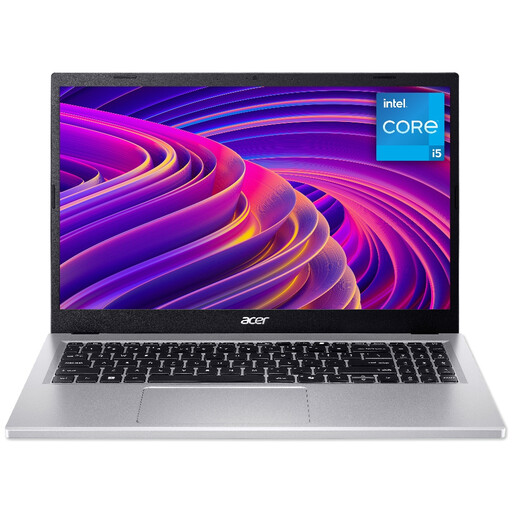
The Aspire Go range includes 15.6-inch Windows laptops with document-oriented storage and a choice of ports.
The Vivobook Go 14 E1404G range is relevant if a smaller laptop is more useful to you than a larger document workspace.
These models cover larger-screen laptops for writing and reviewing documents, plus a compact Windows on ARM option. Choose by your typing and screen needs, then check the exact configuration and any software requirements.
 No image available
Consider this larger-screen model if you want space to review a covering letter alongside other material.
The title lists a 1920 × 1080 display, Intel Core i5-13420H, 8 GB RAM and 512 GB SSD. Confirm the exact configuration and keyboard layout before buying.
 No image available
This is another larger-screen option for drafting letters and reviewing job listings.
The title lists a 1920 × 1080 display, AMD Ryzen 3 7320U, 8 GB RAM and 256 GB SSD. Check the exact configuration and keyboard layout, particularly if you keep many attachments locally.
 No image available
Consider its 15.3-inch screen if you prefer a larger workspace for documents and browser windows.
The title lists AMD Ryzen 5 7535HS, 24 GB DDR5 RAM, 512 GB PCIe SSD and Windows 11 Home. Confirm the keyboard layout. Battery-life descriptions differ within the listing, so clarify expected runtime if you will write away from a socket.
 No image available
This 15.6-inch model may suit someone who expects to keep numerous application documents and attachments on the laptop.
The title lists Intel Core 5 120U, 24 GB RAM and a 1 TB SSD. Check the screen and keyboard specifications of the exact configuration. A stated standby figure should not be treated as document-work battery runtime.
 No image available
The 14-inch format is worth considering if you write applications away from a fixed desk.
The title lists a Snapdragon X processor, 16 GB RAM and 512 GB SSD. This is a Windows on ARM model: Microsoft advises checking required specialist apps and driver-dependent peripherals. Confirm your printer, accessibility tools and keyboard layout before buying.
No: drafting and emailing a covering letter do not, by themselves, call for a gaming or creator laptop. Prioritise a keyboard and screen you find comfortable, then check memory and software against the other tasks you expect to do.
It can, provided the exact laptop meets the requirements for the version you intend to use. Microsoft Support lists Windows 11, a 1.6 GHz or faster two-core processor and 4 GB RAM among the requirements for Microsoft 365 for home; also check whether you need a subscription, a web app or another document editor, as the laptop purchase does not necessarily include one.
It can be suitable if your document apps and required peripherals work on that particular setup. Microsoft Support says Microsoft 365 apps have native Arm64 versions and that most Windows apps can run on Windows 11 ARM-based PCs, but you should check specialist software, accessibility tools and printer support with their suppliers before buying.