Home workers with a regular desk
A fixed display can give documents and browser windows more room. Check its footprint, laptop connection and adjustment range so it fits your workstation.


Choose a fixed monitor if your laptop stays at a regular desk and you want a larger screen for documents and study; choose a portable second screen if it needs to move between workspaces. Before buying either, check that your laptop can drive the display through the intended connection. For a USB-C setup, confirm video support and charging separately; if you plan to use multiple displays, check your laptop model’s display limits too.
The right format depends chiefly on where you use your laptop and how much room the screen can occupy.
A fixed display can give documents and browser windows more room. Check its footprint, laptop connection and adjustment range so it fits your workstation.
A compact desktop monitor may suit a small permanent desk; a portable screen makes more sense if the workspace changes regularly. Which? distinguishes smaller screens for limited spaces from larger home-office displays.
If you want one connection for video and possibly charging or peripherals, check the exact laptop port and monitor functions. The USB-C connector alone does not establish which functions will work.
Choose it when: You work or study mainly at one desk and want a larger screen that stays set up.
Trade-off: The screen and stand occupy desk space, so check the footprint and viewing position before choosing a size.
Choose it when: Your second screen needs to move between temporary workspaces.
Trade-off: It offers a smaller physical display than a typical fixed desk monitor; a USB-C model also needs a compatible laptop video connection.
| Priority | What to check | Your needs |
|---|---|---|
| Video compatibility | Match the laptop’s video output to a monitor input or compatible adapter. For USB-C video, confirm the port’s documented capability; for multiple displays, check the laptop model’s supported display count, resolution and refresh rate. | I want the added screen to work through the connection I plan to use. Apple says external-display limits vary by Mac model and by display resolution and refresh rate. |
| Screen position | Check the stand’s height and tilt range, its desk footprint and any mounting requirements. The UK Health and Safety Executive advises placing the top of the screen around eye level and the screen about an arm’s length away. | My screen needs to fit the desk at a comfortable viewing position, rather than leaving me working around a stand that cannot be adjusted enough. |
| Size and workspace | Measure the available desk space and compare screen size with resolution. Joybuy Insights describes 22- and 24-inch monitors as options for compact desks, while a 27-inch screen provides more physical workspace. | If the screen stays on a small desk, I need room for the display as well as my keyboard and other work. If I carry it between locations, a smaller portable format may matter more. |
| Charging and peripherals | For a one-cable setup, check USB-C video support, the monitor’s power-delivery rating and whether the laptop accepts charging through that port. Check hub and Ethernet connections separately if you need them. | I would like fewer desk cables, but I still need to know whether the intended connection can carry video and meet my laptop’s charging needs. |
A USB-C connector does not, by itself, establish either capability. Lenovo specifies DisplayPort Alt Mode and power-delivery support for the ThinkVision M14’s one-cable laptop arrangement.
Check the exact laptop port, the monitor’s USB-C video requirements, its charging output and the cable needed before relying on one connection.
A different cable, adapter or dock may be needed if your intended connection does not match the equipment.
A screen and its stand need enough space for a usable viewing position. The UK Health and Safety Executive advises a screen position around an arm’s length away, with its top near eye level.
Measure desk depth and the stand footprint. If height adjustment matters, check the supplied stand or confirm mounting compatibility before choosing an alternative support.
A separate stand or arm may be necessary if the supplied stand cannot provide the position you need.
A portable screen favours a compact format, while a fixed monitor offers a different range of screen sizes and stand arrangements. The smaller display may not meet your needs for a permanent workspace.
If you rarely move the screen, compare fixed monitors with the inputs and adjustments you need before prioritising portability.
These model examples illustrate different connection and placement choices; their specifications should not be assumed to apply across a brand’s range.
Dell UK specifies HDMI, DisplayPort and USB-C DisplayPort Alt Mode connections for the Pro 24 Plus USB-C Hub Monitor P2425HE.
The ThinkVision M14 is a 14-inch Full HD mobile monitor for extending or duplicating a compatible laptop display.
ASUS describes the VA24ECPSN business monitor as a USB-C laptop-docking option with video and data connections.
These options include fixed monitors for a regular desk and a portable screen for a workspace that moves. Check each model’s connections and placement against your laptop and desk.
 No image available
A fixed-display option for a regular laptop desk, with an IPS WUXGA display. If you intend to use USB-C for video or charging, confirm the laptop’s port capability, charging needs and required cable.
 No image available
A fixed IPS QHD screen to consider when adding a display at a regular desk. Check the intended video connection and whether the model’s USB-C configuration meets any charging or peripheral needs.
 No image available
A fixed IPS WQHD option for a laptop desk. Measure the available space and check the laptop’s video connection; if charging through the monitor matters, confirm its power-delivery rating against the laptop’s requirements.
 No image available
A portable FHD second-screen option for a laptop workspace that changes location. Before relying on a USB-C video connection, confirm that the laptop port supports DisplayPort Alt Mode and check the model’s required connection.
 No image available
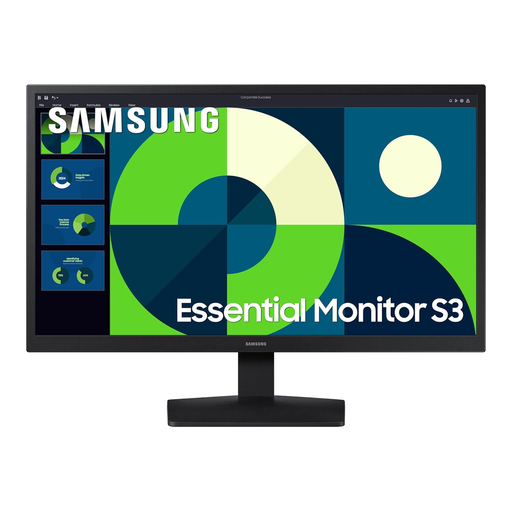
A fixed-screen option for a regular laptop desk. Check that its inputs match your laptop or intended adapter, and that its stand allows the viewing position you need.
No: the connector shape alone does not guarantee video output. Check the laptop’s specifications for a documented video capability that matches the monitor; for example, Lenovo says the ThinkVision M14’s one-plug arrangement requires USB-C with DP 1.2 Alt Mode and PD 2.0.
It can if the monitor provides the required USB-C video and power-delivery functions and the laptop supports them through its port. Compare the monitor’s charging output with your laptop’s requirements: Dell UK specifies up to 90W for the P2425HE, while ASUS specifies up to 65W for the VA24ECPSN.
Check the exact Mac model before planning a multi-screen setup. Apple says the number of simultaneous external displays depends on the model and on each display’s resolution and refresh rate.
The UK Health and Safety Executive advises placing the top of the screen around eye level and the screen about an arm’s length away. Check that the monitor’s stand and your desk allow that position; for prolonged laptop use, its guidance also recommends a separate keyboard and mouse so the laptop screen can be raised.