What to check before buying
The right route depends on what the laptop can output, not just how many sockets appear on a dock. Check the host connection first, then the screen arrangement and the connections you want to leave on the desk.
Native USB-C, USB4 or Thunderbolt dock
Consider when: The laptop’s specified port supports video and its documented display configuration covers your intended screens.
Accept: Connector shape and dock output count alone do not establish display support; charging also depends on the laptop and dock specifications. Microsoft Learn notes that a USB4 system’s graphics hardware can limit available display streams.
USB-A or USB-C DisplayLink device
Consider when: An older or mixed-port laptop needs additional productivity displays and supports the particular device and its software.
Accept: Software requirements and charging vary by model. Plugable says macOS DisplayLink use requires DisplayLink Manager and permissions, and warns that protected-video playback can be affected.
Direct display connection
Consider when: One external screen and a laptop’s existing HDMI, DisplayPort or verified USB-C video output meet the desk’s needs.
Accept: Displays and peripherals may each need a connection. A USB-C video adapter still needs video capability on the laptop port, as Microsoft Learn’s USB-C guidance explains.
Monitor-input or KVM switching
Consider when: A work laptop and another computer share screens; consider a KVM if the keyboard and mouse must switch too.
Accept: Each computer still needs a compatible video connection and sufficient display support. Switching equipment cannot create an output the laptop does not have.
| Concern |
What to check |
Who this matters to |
| Laptop video and display support |
Check the exact port’s video capability and the laptop’s supported number and modes of simultaneous external displays against the dock requirements. |
I need to know that my laptop can drive the screens I plan to connect before choosing a dock. Around 40% of consumers put that compatibility question first. |
| Usable screen workspace |
Compare one-screen and two-screen layouts with the desk width, monitor inputs and a comfortable viewing position. |
When I work across documents and calls for long periods, I want enough screen space without crowding the desk. For around 30% of consumers, workspace is the primary concern. |
| Charging and peripherals |
Match the dock’s host charging arrangement to the laptop’s requirements, then check the USB, network and other connections you use. |
I want to reconnect my screens and desk devices without handling several cables each time. That convenience comes first for around 20% of consumers. |
| Older-laptop connections |
For a USB-A or mixed-port laptop, check the exact DisplayLink device’s host and operating-system support, software requirements and charging arrangement. |
My older laptop needs a workable route to an external display even without display-capable USB-C. Around 10% of consumers primarily need to resolve that connection problem. |
Joybuy products for USB-C desk setups
These USB-C docks, adapters and hubs are options for connecting displays and desk peripherals to a laptop with the required video capability. Compare their stated connections with your laptop’s display and charging requirements; the DisplayLink and switching routes discussed above call for different product checks.
 No image available
Targus USB-C Universal Dual HDMI 4K Docking Station, 100W Power Delivery Pass-Thru
Consider this dock for a two-monitor desk if the laptop supports the required USB-C video connection and simultaneous displays.
The named configuration has dual HDMI 4K connections and 100W Power Delivery pass-through. Check the laptop’s supported display modes, charging requirement and power-supply arrangement before buying.
Joybuy
 No image available
V7 V7UC-U3CRJ45HDVG-BLK USB-C Adapter
Consider this adapter for one external display alongside wired networking and USB peripherals, rather than a two-screen extended setup.
Its named connections include 4K HDMI, VGA, Gigabit Ethernet, two USB 3.0 ports and 100W Power Delivery. The product information specifies single-display use; confirm the laptop’s USB-C video and charging compatibility.
Joybuy
 No image available
AJAZZ AKP01E 8-in-1 USB-C Hub
Consider this hub if you want to assess a multi-connection desk arrangement, but establish the exact laptop and display modes before relying on a multi-screen setup.
The product name identifies 4K projection and TF/SD card slots. Check host and operating-system support, the resolution and refresh rate available for each intended display, and the laptop charging arrangement.
Joybuy
 No image available
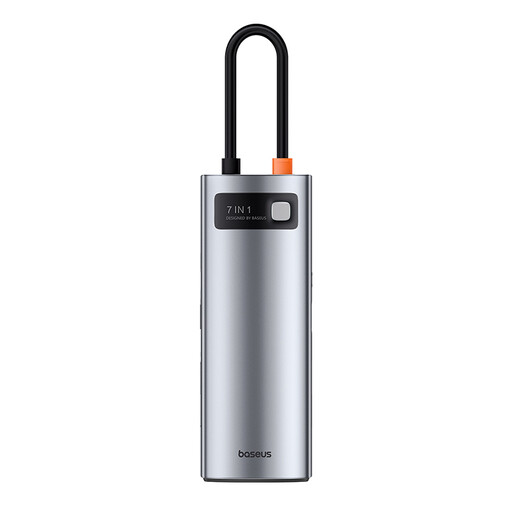
Baseus Metal Gleam Series USB-C Seven-Port Hub, Grey
Consider this hub for a desk needing one external display and peripheral connections, provided the laptop’s USB-C port carries video.
The product information describes one HDMI output and says a separate power supply is needed to charge a laptop. It also says the SD and TF card slots cannot be used simultaneously.
Joybuy
 No image available
USB-C Hub with 2 HDMI, DisplayPort, USB, RJ45, PD, SD/TF and Audio
Consider this hub when you need several desk connections, but check the laptop and hub documentation before planning simultaneous external displays.
The named connections include two USB 3.0 and two USB 2.0 ports. Confirm the supported display modes and host charging arrangement; the product information says its SD and TF slots cannot be used simultaneously.
Joybuy
Questions about monitors and docks
Does every USB-C laptop port work with a monitor?
No. Video over USB-C depends on the capabilities of the particular port, not its shape. Microsoft Learn describes DisplayPort Alternate Mode as one way a supported USB-C connection carries video, so check the laptop’s exact port specification before choosing a dock or adapter.
Why might a two-output dock run only one extended screen?
The laptop may not support the display streams required for both outputs in the intended configuration. Microsoft Learn notes that GPU limits can apply even on USB4 systems; compare the laptop’s simultaneous-display specifications with the dock’s host requirements.
Can a laptop without USB-C use external displays?
It may be able to use an existing display output or a compatible USB-A DisplayLink device. StarTech.com documents USB-A DisplayLink products, but the exact device’s operating-system, software and display limits still need checking; do not assume that a USB-A connection also charges the laptop.
Does DisplayLink require software on a Mac?
Yes, for the macOS DisplayLink-controlled displays covered by Plugable’s guidance: DisplayLink Manager and the required permissions must be set up. Check the chosen device’s macOS support and whether protected-video playback matters to your work.
What matters besides getting the screens connected?
Plan a desk arrangement that lets you use the screens comfortably over sustained work. The Health and Safety Executive advises that home workers using display-screen equipment should be able to achieve a comfortable, sustainable posture; screen placement and available desk space matter alongside port compatibility.


