
24/7 Customer Support

Free returns

Same-day & Next-day Delivery

Quality Guaranteed

Unlock Your Welcome Offers: FREE Delivery | Up to 80% OFF | Free 30-day JoyPlus trial
Download the APP
For professionals, digital nomads and frequent travellers, a laptop running low on battery is more than an inconvenience—it's a barrier to productivity. Being tethered to a wall socket isn't always an option when you're on a train, between flights or working from a café. A reliable laptop power bank provides the freedom to work and stay connected from anywhere.
However, the market is filled with options, and not all portable chargers are created equal. Choosing the wrong one can mean slow charging, insufficient power or incompatibility with your devices. This guide is designed to cut through the clutter, offering practical advice to help you select a power bank that truly meets the demands of your high-powered devices.
Before diving into specific products, it's important to understand the key features that separate a standard phone charger from a capable laptop power bank.
A standard power bank might offer 10-15W, which is fine for a smartphone but insufficient for a laptop. To effectively charge a modern laptop, you need a model that supports USB-C Power Delivery (PD) with a high wattage output. For ultrabooks like a MacBook Air, look for at least 45W. For more demanding machines like a MacBook Pro portable charger, you should aim for 65W to 100W. A fast charging power bank for laptop will significantly reduce downtime and keep you productive.
Capacity, measured in milliampere-hours (mAh), determines how much energy the power bank can store. While a 10,000mAh unit is ample for phones, a laptop requires a high capacity portable charger of 20,000mAh or more to provide a substantial charge.
It's also crucial to consider air travel regulations. Most airlines, following Civil Aviation Authority (CAA) and TSA guidelines, restrict batteries to 100 Watt-hours (Wh) in carry-on luggage. A 20,000mAh power bank typically falls around 74Wh, making it a safe, TSA approved power bank for your travels.
Consider the devices you carry. A good laptop power bank should offer multiple ports (usually a mix of USB-C and USB-A) to charge your laptop, phone and tablet simultaneously. For maximum convenience, some models now include a power bank with built in cables, eliminating the need to carry a separate tangle of wires.
Here are our recommendations for portable chargers that deliver on performance, capacity and convenience.
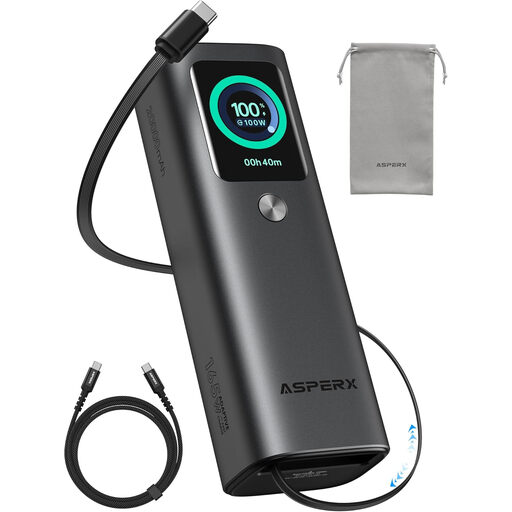
Why It Stands Out: This AsperX model is a powerhouse designed for users with demanding charging needs. Its standout feature is the massive 165W total output, which can deliver up to 100W from a single port—enough to fast-charge a MacBook Pro—while simultaneously powering other devices. The integrated retractable cables and premium aluminium construction set it apart from plastic alternatives.
Pros:
Who is it for? This is an ideal solution for the tech-savvy professional or digital nomad who relies on multiple high-power devices and values the convenience of an all-in-one charging solution without extra cables.

Why It Stands Out: While not intended for laptops, the Anker Nano Power Bank is an excellent companion for your other essential devices. Its key advantage is its ultra-compact size and the clever, foldable built-in USB-C connector. It plugs directly into the bottom of your phone or tablet, providing a quick power boost without any cables.
Pros:
Who is it for? Perfect for daily commuters, students or anyone needing a lightweight, emergency power source for their phone. It serves as a great secondary charger to complement a larger laptop power bank.

Why It Stands Out: The Lofree power bank merges style with functionality. Its refined, minimalist design is complemented by a unique warm LED ambient light feature. With a 10,000mAh capacity and 22.5W fast charging, it offers a solid balance of power and portability for charging phones, earbuds and other personal devices.
Pros:
Who is it for? The style-conscious user who wants a reliable and aesthetically pleasing power bank for their daily essentials. It's a great fit for handbags and is ideal for commuting, travel and daily use.
If these recommendations don't quite fit your needs, or if you're searching for essential accessories like high-speed wall chargers or durable cables to complete your setup, we invite you to browse our wider selection.
Explore our full range of computer cable adapters to find the perfect components for your mobile office.
1. Can any power bank charge a laptop? No. Laptops require a power bank with both a high power output (in Watts) and sufficient capacity (in mAh). To charge a laptop, you need a model specifically designed for this purpose, typically offering at least 45W-65W output via a USB-C Power Delivery (PD) port. Always check the product specifications to ensure laptop compatibility.
2. How many mAh do I need for a laptop power bank? A high capacity portable charger of at least 20,000mAh is recommended for charging a laptop. This capacity can generally provide around one full charge for an ultrabook (like a MacBook Air) or a significant power boost for a more powerful device (like a 16-inch MacBook Pro).
3. Are laptop power banks allowed on flights in the UK? Yes, they are generally permitted in carry-on luggage, provided they adhere to airline regulations. The universal limit is 100 Watt-hours (Wh) per battery. A 20,000mAh power bank (approximately 74Wh) is well within this limit, making it a flight-safe TSA approved power bank. However, it is always a good practice to confirm the specific policy with your airline before travelling.