
24/7 Customer Support

Free returns

Same-day & Next-day Delivery

Quality Guaranteed

Unlock Your Welcome Offers: FREE Delivery | Up to 80% OFF | Free 30-day JoyPlus trial
Download the APP
Nothing disrupts a productive day quite like a laptop battery icon turning red when you are miles from a wall socket. For professionals, students and travellers across the UK, staying connected is not a luxury; it is a necessity. A dead laptop during a client meeting, an important lecture, or a long-haul flight can be more than just an inconvenience.
As a Joybuy Product Recommendation Officer, my role is to help you find practical solutions for your everyday tech challenges. This guide is designed to cut through the clutter and help you choose a reliable laptop power bank that fits your specific needs, ensuring your devices stay powered wherever you are.
Selecting the right power bank for a laptop is more complex than choosing one for a phone. Here are the key factors to consider to ensure you get a device that delivers.
Capacity, measured in milliamp-hours (mAh), tells you how much energy a power bank can store. For a laptop, you should look for a high capacity power bank, typically 20,000mAh or more, to get at least one full charge.
However, the most critical figure for air travel is watt-hours (Wh). UK and international aviation rules generally restrict power banks in checked luggage and limit those in carry-on to 100Wh. Most reputable brands will clearly state the Wh rating, so always check for a flight-approved power bank if you are a frequent flyer.
A standard USB port is not enough to charge a laptop. You need a USB C power bank that supports Power Delivery (PD), a fast-charging standard that can negotiate higher power outputs.
Check the wattage (W) of the power bank’s USB-C port. To effectively charge a modern laptop, such as a MacBook Pro or Dell XPS, you will need an output of at least 45W. For the fastest charging speeds, look for models offering 65W, 100W, or even higher. A fast charging power bank with multiple high-wattage ports allows you to power your laptop and other devices simultaneously.
Consider features that make life easier. A power bank with a built in cable means one less thing to remember (or lose). Digital displays that show remaining capacity and charging speed are also incredibly useful. Finally, look for durable materials like aluminium alloy, which not only feels more premium but also helps dissipate heat more effectively than plastic, protecting the battery and your devices.
Here are a few standout options that cater to different needs, from ultimate convenience to maximum power.
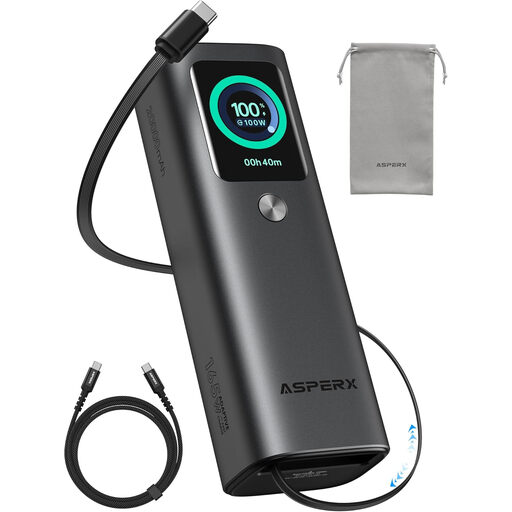
Why It Stands Out: This model’s main appeal is its innovative design. The built-in retractable USB-C and Lightning cables eliminate the need to carry separate cords, offering a truly all-in-one charging solution. According to AsperX, the design was influenced by feedback from a large user base to solve the common problem of tangled or forgotten cables.
Pros:
Who is it for? The daily commuter, mobile professional, or anyone who values convenience and wants to minimise the number of accessories they carry.
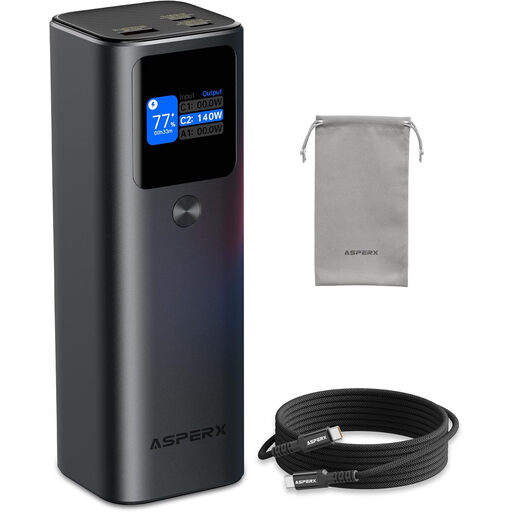
Why It Stands Out: This power bank is engineered for the serious traveller. It packs a massive 27,600mAh capacity into a flight-approved 99.36Wh package. Its standout feature is the powerful single-port output, which can deliver up to 140W, making it an ideal power bank for MacBook Pro (16-inch) and other high-performance laptops that require significant power.
Pros:
Who is it for? Digital nomads, business travellers and power users who need to keep high-performance laptops and multiple devices running for extended periods away from a power source.

Why It Stands Out: While not designed to fully recharge a large laptop, this Duracell power bank earns its place for portability and reliability. Its slim, lightweight profile makes it easy to slip into a pocket or small bag, serving as an excellent companion for topping up your phone, tablet, or providing an emergency boost to a smaller, less power-intensive ultrabook.
Pros:
Who is it for? The daily commuter or student who primarily needs a reliable charger for their phone and tablet but appreciates having a lightweight backup for other small devices.
If the models above do not quite match what you are looking for, or if you need a charger specifically for other devices, there is a wider world of portable power to explore. For a broader selection of charging solutions suitable for different needs, you might find the right fit in our Tablet Charger category.
Yes, you can, but with restrictions. Power banks must be carried in your hand luggage, not in checked baggage. The key limit is the capacity, which must not exceed 100Wh. All the laptop-specific power banks recommended here are designed to be flight-approved.
This depends on your laptop's battery size. As a general rule, a 20,000mAh power bank can provide approximately one full charge for a 13-inch laptop like a MacBook Air. For larger, more powerful laptops like a 16-inch MacBook Pro, you will want 25,000mAh or more to get a significant charge.