
24/7 Customer Support

Free returns

Same-day & Next-day Delivery

Quality Guaranteed

Unlock Your Welcome Offers: FREE Delivery | Up to 80% OFF | Free 30-day JoyPlus trial
Download the APP
For professionals, creatives and frequent travellers, a laptop running low on battery is more than an inconvenience—it's a workflow killer. Finding a reliable laptop power bank that can keep up with high-performance devices like a MacBook Pro can be a challenge. With a market full of technical jargon and competing claims, it's difficult to know which portable charger will actually deliver the power you need.
This guide is designed to cut through the clutter. As the Joybuy Product Recommendation Officer, my role is to provide clear, practical advice to help you choose the right charging solution. We will explore the key features to look for, from capacity and charging speed to flight compliance and present a few standout options for your consideration.
Before diving into specific products, understanding a few key technical points will help you make an informed decision.
While many power banks advertise their capacity in milliamp-hours (mAh), the most accurate measure for comparing laptop chargers is watt-hours (Wh). This figure tells you the total energy stored. Crucially, for anyone who travels by air, aviation authorities like the UK's CAA have strict rules. A flight approved power bank must typically be under 100Wh. Anything larger may require special airline approval. Always carry power banks in your hand luggage, never in checked baggage.
The wattage (W) of a power bank determines how quickly it can charge your devices. A standard phone charger might offer 20W, but a power-hungry laptop requires significantly more. For a MacBook Pro power bank, look for an output of at least 65W. For the fastest possible speeds, a 140W portable charger utilising the PD 3.1 (Power Delivery) standard is the current benchmark, capable of rapidly charging even the most demanding laptops.
A modern setup rarely involves just one device. A good fast charging power bank should be a USB C multi-port charger, allowing you to power your laptop, phone and tablet simultaneously. Additionally, look for products built with Gallium Nitride (GaN) technology. A GaN charger UK model is typically smaller, lighter and more energy-efficient than traditional silicon-based chargers, generating less heat while delivering high wattage.
Here are a few charging solutions that align with the needs of today's mobile professionals, selected for their performance, features and build quality.
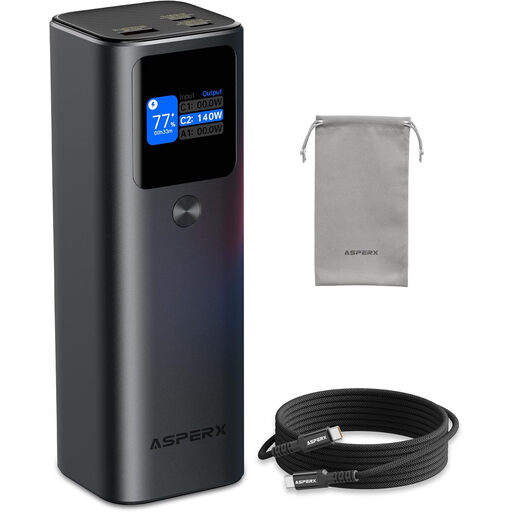
Why It Stands Out: This model focuses on delivering maximum power and capacity within a durable, premium package. Its 99.36Wh capacity sits just under the 100Wh flight limit, making it an ideal travel companion for long-haul journeys. The ability to output up to 140W from a single port makes it one of the few portable options that can fast-charge a 16-inch MacBook Pro at near-native speeds.
Pros:
Who is it for? The digital nomad or business traveller who needs to power a high-performance laptop and other devices for extended periods away from a wall socket.
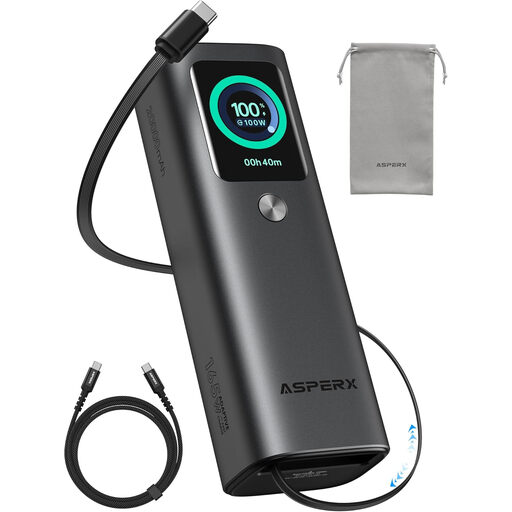
Why It Stands Out: This power bank is engineered for ultimate convenience. Its standout feature is the built-in retractable USB-C cable, eliminating the need to carry or potentially forget separate charging cords. Despite its compact form, it still packs a powerful punch with a total output of 165W and the ability to fast-charge two laptops simultaneously.
Pros:
Who is it for? The minimalist professional or daily commuter who values portability and convenience above all, and wants to eliminate cable clutter from their bag.
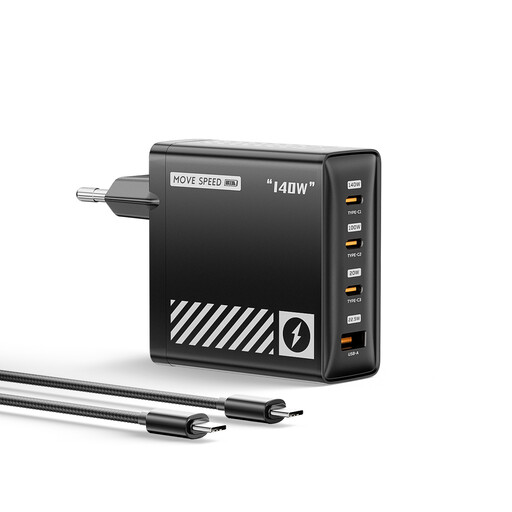
Why It Stands Out: This is not a power bank, but a powerful wall charger that serves as an excellent hub for your tech ecosystem. Using advanced GaN technology, it delivers an impressive 140W of power in a body that is significantly smaller than Apple's equivalent charger. With four ports, it can replace a bag full of individual adapters, making it perfect for a tidy desk or a light travel pack.
Pros:
Who is it for? The home office worker, student or traveller who wants a single, powerful wall charger to handle all their devices, from their laptop to their phone and earbuds.
Optimising your mobile toolkit goes beyond just power. For those who value precision and creativity on the go, from digital artists to presenters, exploring other innovative tools can complete your setup. Discover our curated selection of advanced tech gadgets, including high-precision air pens, to enhance your workflow.
In line with international standards, power banks carried on flights departing the UK must generally be under 100Wh. Some airlines may grant permission for batteries between 100Wh and 160Wh, but you must seek approval beforehand. Anything over 160Wh is typically forbidden. The AsperX 27,600mAh model, at 99.36Wh, is designed specifically to meet this requirement.
While most USB-C power banks can technically connect to a MacBook Pro, the charging performance will vary dramatically. A low-wattage power bank (e.g., 20W-30W) will charge the laptop extremely slowly, or may only be able to slow the battery drain while it's in use. For effective charging, a MacBook Pro power bank should offer at least 65W output. For fast charging, 100W or more is recommended.
A GaN charger offers several distinct advantages over traditional silicon-based chargers. Gallium Nitride is a more efficient material, which means less energy is lost as heat. This allows manufacturers to build chargers that are significantly smaller, lighter and run cooler while delivering the same or even higher wattage. This makes a GaN charger UK model an excellent choice for a powerful and portable USB C multi-port charger.