
24/7 Customer Support

Free returns

Same-day & Next-day Delivery

Quality Guaranteed

Unlock Your Welcome Offers: FREE Delivery | Up to 80% OFF | Free 30-day JoyPlus trial
Download the APP
As a Joybuy Product Recommendation Officer, my role is to help you navigate the complex world of high-performance electronics. When it comes to choosing a large format multicolour 3D printer, the market is filled with impressive specifications and bold claims. However, for advanced enthusiasts and small businesses in the UK, a misstep can lead to a very expensive dust collector. This guide will help you identify the crucial features that matter and avoid the common pitfalls that lead to buyer's remorse.
Before looking at what to buy, it's vital to understand what to avoid. Many promising-looking machines fall short in real-world use due to a few common overstatements in their marketing.
To make an informed decision, focus on these non-negotiable specifications. They are the foundation of a reliable and capable machine.
Build Volume and Frame Integrity: When you're looking for a printer for large-scale projects or 3D printer for prototyping, the build volume is a primary concern. However, this must be supported by a sturdy gantry system and, ideally, diagonal support rods. This construction minimises vibration and Z-wobble, ensuring dimensional accuracy on prints that take up the full height of the build chamber.
Intelligent Multi-Colour System: A true 8-colour 3D printer system goes beyond simply holding multiple spools. Look for an integrated unit that actively manages filaments. Key features include a sealed, heated enclosure for filament drying (crucial for materials like PETG and TPU), automatic filament loading and unloading and tangle detection. This level of integration is what separates a professional tool from a hobbyist gadget.
Genuine High-Speed Capability: A genuine high speed 3D printer relies on more than powerful motors. To print fast without sacrificing quality, it needs a suite of intelligent features. This includes advanced auto levelling that maps the bed at multiple points, vibration compensation to counteract ringing at high speeds and pressure advance/flow calibration to ensure clean corners and consistent extrusion.
We have matched some of the leading models to specific user profiles to help you find the right fit for your needs.
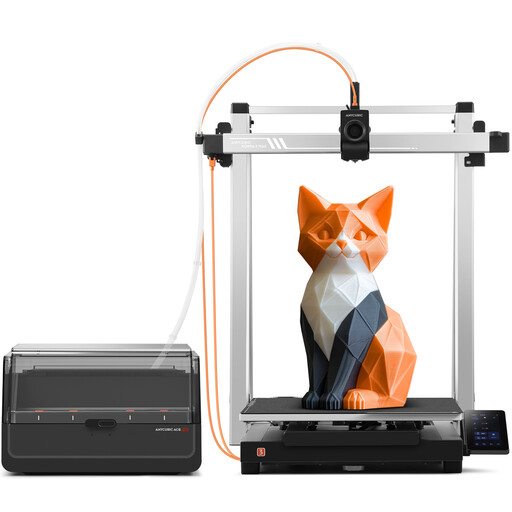
Why This Fits Their Persona: For small-scale production or creating full-size prototypes in the UK, the enormous 420×420×500mm build volume is a significant asset. Paired with the ACE Pro system for up to 8-colour printing, it enables the creation of complex, functional parts or vibrant models in a single run.
It directly counters the large volume illusion with a rigid gantry and LeviQ 3.0 auto-levelling. It solves the multi-colour muddle with the ACE Pro's integrated drying and anti-skip features and addresses the speed trap by providing a high recommended speed (300 mm/s) backed by AI detection and flow calibration.
Offers a rare combination of a massive 88L build volume with a seamless, integrated 8-colour printing system. The inclusion of a filament drying box is a major benefit for print quality and reliability.
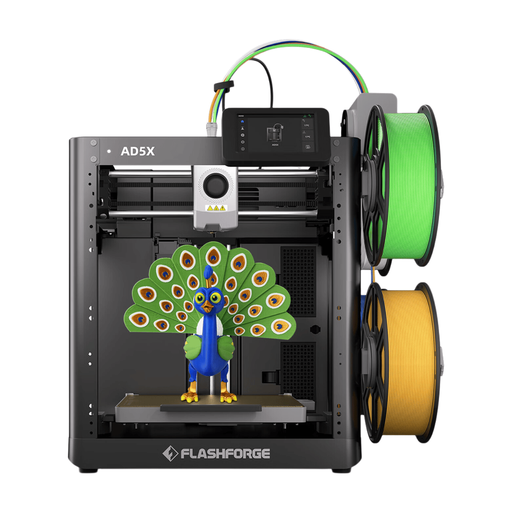
Why This Fits Their Persona: This printer is for the advanced hobbyist who wants high-speed, multi-colour printing without dedicating an entire workbench to it. The 220x220x220mm build volume is ample for most projects and its 4-colour capability and fast Core XY motion system deliver impressive results in a much smaller footprint.
The inherently stable Core XY structure is well-suited for its high-speed claims, minimising vibration. The 1-click auto levelling is highly effective for its bed size, ensuring reliability and removing a common point of failure for users who just want to print.
Delivers high-end features like 600 mm/s speed and 4-colour printing in a compact, accessible package. The interchangeable nozzles (from 0.25mm to 0.8mm) add a layer of versatility for balancing detail and speed.
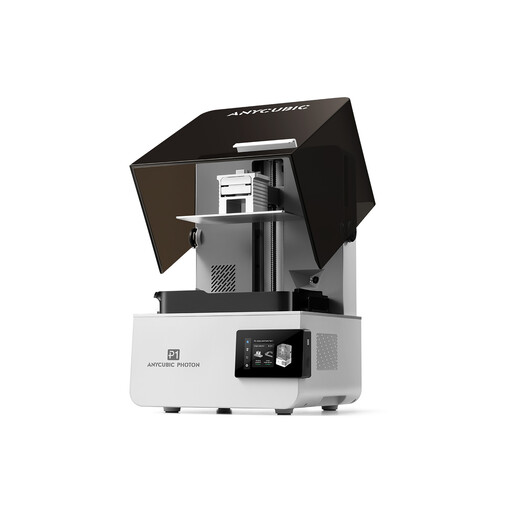
Why This Fits Their Persona: For users creating miniatures, jewellery or engineering components where microscopic detail is paramount, resin printing is the superior technology. This printer offers an exceptional 14K resolution (16.8 × 24.8 μm), producing smooth surfaces and details that FDM printers cannot replicate.
This choice sidesteps the common FDM pitfalls by focusing on a different technology for a specific outcome. Instead of balancing speed and size, the priority is resolution. Its industrial-grade ball screw Z-axis and precision-ground build plate ensure print reliability and dimensional accuracy, which are the key failure points in resin printing.
Delivers professional-grade print resolution for exceptionally detailed models. The Wave Release Technology and high light uniformity (>92%) improve success rates and ensure consistent quality across the entire build plate.
We have compiled a complete, real-time list of products that fully satisfy these strict selection criteria and UK safety regulations.
When planning your setup, consider more than just the printer's footprint. A machine like the Anycubic Kobra 3 Max measures 706 × 640 × 753 mm, but you will also need clearance for ventilation, access for maintenance and space for the multi-material system, which typically sits beside the printer. Most importantly, you need a sturdy, level table that can support the machine's weight (around 20 kg or more) without wobbling during fast print movements.
Modern systems have significantly streamlined the process. An integrated unit like the Anycubic ACE Pro provides a guided setup, automatic filament loading and features like tangle detection to minimise user intervention. Routine maintenance involves keeping the filament dry (a good system will include a drying function), periodically cleaning the nozzle and purge wiper and ensuring the filament tubes are unobstructed. While more involved than a single-colour printer, it is designed to be manageable for a dedicated enthusiast.
Beyond the initial purchase, the primary ongoing cost is filament. Multi-colour prints will consume more material than single-colour prints due to the purging process required to switch colours, although efficient systems are designed to minimise this waste. You should also budget for consumables like spare nozzles, replacement PEI build sheets and potentially cleaning solutions for resin printers. Finally, for very large and long prints, the electricity consumption of a powerful machine with a large heated bed can be a consideration.