For survival horror in a dim room, consider OLED if deep blacks matter most. If a panoramic view is the priority, a curved ultrawide needs enough desk space and a PC suited to its native resolution; for console-and-PC use, a 16:9 4K monitor is a more straightforward format, provided its HDMI modes support what you intend to play. These priorities can overlap, so check the exact screen rather than choosing by size alone.
Who is this for?
Dark-room horror players
You mainly play cinematic survival horror in a dim room and put dark-scene contrast, HDR presentation and motion high on your list. OLED models from LG UK and Dell UK are relevant screens to compare, but their formats and input modes differ.
Wide-screen PC players with room to spare
You want a wide field of view and have space for the monitor and its stand. Samsung UK lists a 57-inch curved Dual UHD model; its resolution makes PC capability as important to check as desk dimensions.
Console-and-PC players
You want one screen for a PS5 or Xbox Series X and a PC. PlayStation UK and Xbox Support UK describe 4K output at 120Hz, making the monitor’s actual HDMI input modes and supported variable refresh rate, or VRR, worth checking.
What matters when choosing?
For large-screen survival horror, settle the screen’s place on your desk and its connection to your gaming device alongside your preferences for dark-scene contrast and HDR.
| Concern | What to check | Who this matters to |
|---|
| Dark scenes and HDR |
Compare the exact panel and HDR specification; for an LCD screen, check its local-dimming design. |
If torch-lit rooms and dark corridors dominate my games, I want contrast to take priority over a headline refresh rate. Around 36% of consumers put dark-scene presentation first. |
| Screen size and fit |
Measure desk width, usable depth and seating distance; compare the screen’s aspect ratio and native resolution. |
I want the view to feel expansive, but a very wide screen still has to fit where I sit and be practical for my PC to drive. Roughly 29% of consumers place screen scale and fit first. |
| PC and console modes |
Check the intended resolution, refresh rate, HDR and VRR combination on the port you will use. |
When I switch between a console and PC, I need the display to accept the modes I plan to use. Around 21% of consumers make device compatibility their first concern. |
| Everyday use and ownership |
Read the exact model’s panel-care and warranty terms, and consider how much static desktop content you display. |
My monitor also spends long periods showing desktop interfaces, so its use pattern and cover matter beyond gaming sessions. Roughly 14% of consumers prioritise mixed-use suitability and ownership terms. |
Buying pitfalls
-
Choosing by diagonal size alone
A 57-inch Dual UHD curved screen has different width, depth and PC rendering demands from a 45-inch ultrawide or a 27-inch 16:9 screen. The largest diagonal is not automatically the most comfortable fit.
Measure your desk and seating position, then compare the manufacturer’s dimensions, curve and native resolution before ordering.
-
Assuming a high refresh rate guarantees console modes
A monitor’s highest stated refresh rate may not apply to its HDMI input at 4K. PlayStation UK states that PS5 supports 4K output at 120Hz, but the connected display must accept the mode you intend to use.
Check the exact model’s HDMI modes, including the resolution, refresh rate, HDR and VRR combination needed by your console.
-
Applying one OLED warranty to every model
Dell UK lists OLED burn-in coverage for the Alienware AW3423DWF. That model’s terms do not establish the same cover for another OLED screen.
Read the warranty and panel-care terms for the precise model you are considering, particularly if it will often show fixed desktop elements.
Brands to consider
LG UltraGear
LG UK lists 45-inch OLED gaming monitors in both 3440×1440 and 5120×2160 formats.
- The 45GX90SA is listed at 3440×1440 and 240Hz; the 45GX950A is listed at 5120×2160 with 165Hz and 330Hz modes.
- Confirm the exact model’s console input modes, desk fit and warranty terms. The listed specifications are not an independent picture-quality comparison.
Samsung Odyssey
Samsung UK lists the Odyssey Neo G9 G95NC as a 57-inch curved Dual UHD gaming monitor.
- Samsung specifies a 1000R curve, Quantum Mini-LED technology and 240Hz refresh rate for the G95NC.
- Its physical footprint and high pixel count call for desk and PC checks before treating it as a suitable large-screen choice.
Alienware
Dell UK lists QD-OLED options in a 34-inch ultrawide format and a 32-inch curved 4K format.
- Dell specifies the AW3425DW at 3440×1440 and 240Hz, and the AW3225QF as a 32-inch 4K model at 240Hz.
- Check each model’s HDMI modes and its own panel-warranty wording; AW3423DWF warranty terms should not be assumed for other models.
Sony INZONE
Sony UK lists the INZONE M9 II as a 27-inch 4K IPS monitor with full-array local dimming.
- Sony specifies up to 160Hz for the M9 II, making it a conventional 16:9 format to assess for console-and-PC use.
- At 27 inches, it may not provide the physical scale sought by someone shopping specifically for a large screen; check the exact model’s input modes.
Joybuy product choices
These screens cover several ways to approach survival horror: 32-inch OLED and local-dimming choices, a smaller QD-OLED option and a curved QHD monitor. Compare their actual size and inputs with your setup; this selection is not a like-for-like list of very large ultrawides.
 No image available
Dahua 32-inch curved 4K OLED gaming monitor
Consider this if you want an OLED screen for dark-room games in a 32-inch curved format rather than a much wider display.
The listed resolution is 3840×2160, with a 165Hz refresh rate. Check the exact HDMI and VRR modes for your console, along with the model’s OLED warranty terms.
View on Joybuy
 No image available
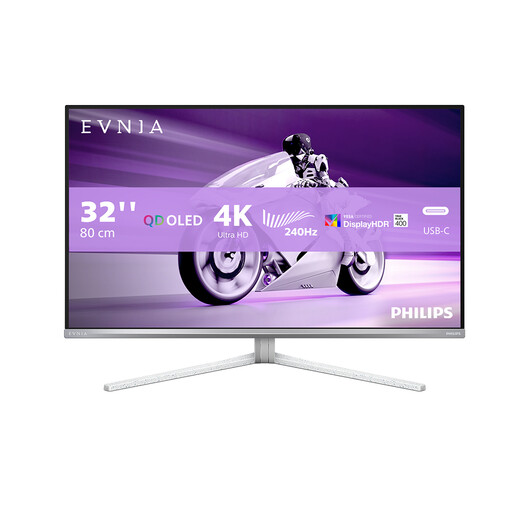
PHILIPS Evnia 32M2N8900 32-inch UHD OLED monitor
This 32-inch OLED is worth comparing if dark-scene viewing matters more to you than an ultrawide field of view.
The listing describes a UHD OLED screen but gives both 240Hz and 175Hz refresh figures. Confirm the exact refresh specification, console input modes and model-specific warranty before choosing it.
View on Joybuy
 No image available
ASUS ProArt Display PA32UCG-K 32-inch 4K IPS Mini LED monitor
Consider this 16:9 local-dimming option if you want a 32-inch screen for games and other display work, rather than an OLED ultrawide.
Its title specifies 4K, IPS, Mini LED and 120Hz. As this is presented as a professional monitor, confirm the gaming input modes you need; the listed HDMI and peak-brightness details also require checking against the exact configuration.
View on Joybuy
 No image available
Acer Predator X27U W3 26.5-inch QD-OLED gaming monitor
This suits a more compact PC setup if you want QD-OLED but can accept a screen smaller than the large formats at the centre of this choice.
The listed resolution is 2560×1440 and the refresh rate is 240Hz. Confirm console input modes and the warranty for this model if either matters to your use.
View on Joybuy
 No image available
CRUA 32-inch 1500R curved QHD gaming monitor, black
Consider this if a 32-inch curved screen matters more to you than choosing an OLED or Mini LED panel.
The title specifies 2560×1440, a 1500R curve and 165Hz. Check the supported mode for your connection: the listing calls for DisplayPort to reach its stated maximum refresh rate at QHD. Check its HDR and local-dimming details separately if those are priorities.
View on Joybuy
Common questions
Do I need OLED to play survival horror?
No. OLED is worth considering when deep blacks in a dim room are your priority, while a full-array-local-dimming IPS screen is another route if you want a conventional 16:9 format for mixed use. Compare the exact models’ HDR implementations rather than relying on the panel names alone.
Will any high-refresh monitor run PS5 games at 4K and 120Hz?
No. PlayStation UK states that PS5 supports 4K output at 120Hz, but the monitor must accept that mode through the HDMI connection. Check the exact model’s supported resolution and refresh rate, plus HDR and VRR support if you intend to use them.
What should I measure before buying a 45-inch or 57-inch monitor?
Measure usable desk width and depth and your normal eye-to-screen distance. Then compare those measurements with the exact monitor and stand dimensions; Samsung UK’s 57-inch 1000R G95NC, for example, needs a different placement check from a smaller 16:9 screen.
What should I do with a monitor I replace?
Use an appropriate electrical-equipment recycling route or a retailer take-back service where available. GOV.UK explains that UK waste electrical and electronic equipment rules aim to reduce electrical waste going to landfill or incineration.


