Hosts with wide seating
Guests may be spread across a sofa and side chairs rather than facing the centre of the screen. These hosts need to assess the picture from the outer seats, not just from directly in front.


For a short-film screening with guests seated well to the sides, consider OLED if dark-scene contrast also matters: Samsung UK’s buying guidance describes OLED as typically offering wider-angle viewing than QLED. For a room used in daylight, QLED is another starting point, but check the exact TV’s reflections and side-seat picture rather than relying on its panel category. A Mini LED model with documented viewing-angle and anti-reflection features can address both concerns; whichever route you take, measure the installation space and check sound connections and energy information.
Guests may be spread across a sofa and side chairs rather than facing the centre of the screen. These hosts need to assess the picture from the outer seats, not just from directly in front.
Daylight or lamps may remain on during a screening. For these viewers, visibility and reflections can matter as much as dark-scene contrast.
A 75-inch or larger TV must fit through the access route and onto suitable furniture or a wall. The group’s sound setup also matters if dialogue needs to reach seats across the room.
Start with where guests will sit and how much light will be in the room. Then check whether the screen and any external audio can be installed where you intend to use them.
| Concern | What to check | Who this matters to |
|---|---|---|
| Picture from side seats | Check viewing-angle information for the exact model and assess how far the outer seats are from the centre. | If guests sit well to either side, I need them to follow the film without relying on the central seat. Around 42% of consumers put side-seat viewing first. |
| Bright-room visibility | Consider the light at screening time and check model-specific reflection treatment. | With daylight or lamps in the room, I want the picture to remain easy to see. For around 25% of consumers, bright-room visibility is the primary concern. |
| Placement and sound | Check TV and stand dimensions, weight and mounting requirements; check HDMI eARC/ARC if connecting compatible external audio. | Before choosing a very large screen, I need somewhere suitable to put it and a workable way to connect sound. Placement and sound come first for around 33% of consumers. |
The diagonal does not tell you whether a TV will fit the furniture, wall or delivery route. Sony lists its 85-inch K-85XR90 at approximately 188.8 cm wide and 55.7 kg with the stand.
Use the exact model’s specifications to check its full width, stand footprint, weight and mounting pattern before ordering.
A larger screen may call for different furniture or a suitable mounting arrangement.
Brightness and viewing angle are separate considerations. Samsung UK’s guidance describes QLED as a daylight-oriented route and OLED as typically offering wider-angle viewing; neither description establishes the result for every model.
Decide whether light or side seating is the bigger issue, then check reflection and viewing-angle details for each shortlisted TV.
Screen size and panel type are not substitutes for the model’s energy information. UK government guidance covers energy labels and product information sheets for in-scope televisions sold online.
Compare the displayed label and product information sheet for the sizes and models you are considering.
Samsung UK identifies the 75-inch Q8F example as QE75Q8FAAUXXU, while a Joybuy listing uses the shorter identifier QE75Q8FAAU. The names alone do not establish that the variants are identical.
Compare the complete model number, variant, specifications and warranty terms with the manufacturer’s product page before relying on a listing.
The UK 77-inch OLED C5E illustrates an OLED route for group screenings where dark scenes and seats away from the centre matter.
The UK 75-inch Q8F illustrates a QLED route to consider when group screenings commonly take place in a bright room.
The 85-inch BRAVIA 9 is a Mini LED example for a large room where both broad seating and reflections need model-specific attention.
These 75-inch and 85-inch QLED and QD-Mini LED TVs offer large-screen choices for shared viewing. Compare each exact model against your seating layout, room light and installation space.
 Image unavailable
Consider this large-screen model if group seating and room lighting are both on your shortlist of checks.
The product name lists HDR and up to 512 dimming zones. Check the exact 75-inch model’s side-seat picture and reflection handling, as well as its dimensions and stand footprint.
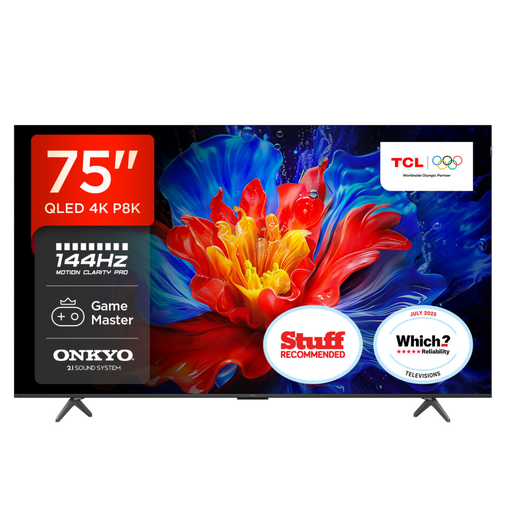 Image unavailable
A 75-inch QLED option to consider when daylight viewing is an important part of the group’s plans.
The product name lists HDR PRO, an ONKYO 2.1 sound system, Miracast and Google Cast. Check the picture from side seats and the TV’s reflections in the intended room.
 Image unavailable
This 75-inch model is another Mini LED option for a shared screen where the seating arrangement needs checking.
The product name lists HDR and up to 2048 local dimming zones; that figure is not a side-seat or reflection measurement. Check the model’s viewing characteristics, dimensions and stand footprint before arranging installation.
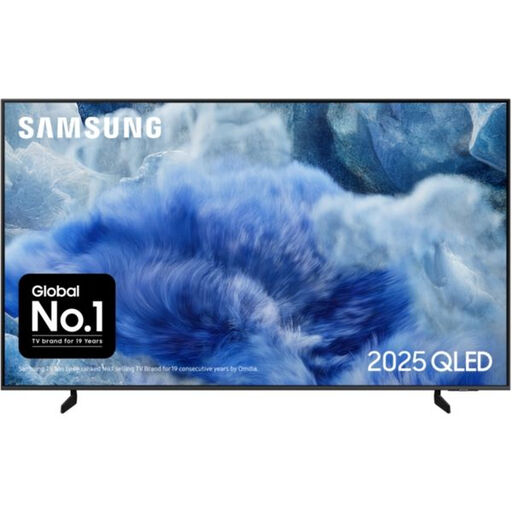 Image unavailable
Consider the 85-inch screen if the group needs a larger display and the room can accommodate it.
The product description gives a width of approximately 189.2 cm. Check the weight, stand footprint, delivery route and picture from side seats against your plans.
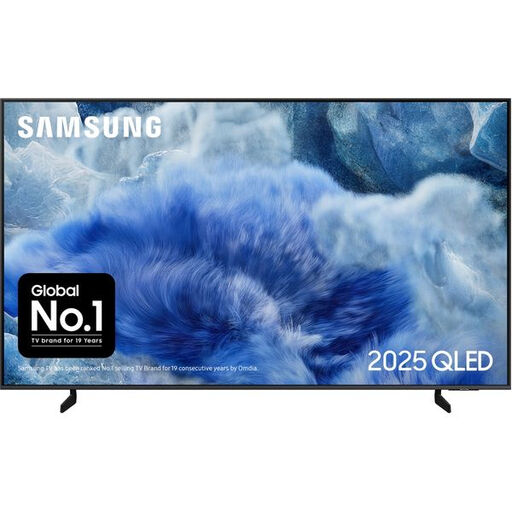 Image unavailable
This 75-inch listing is a large-screen option for a shared room, subject to checks for the intended seating and light.
The product name lists 4K Ultra HD, Wi-Fi and a one-year warranty. Confirm the complete model variant and warranty terms, along with the stand footprint and point-of-sale energy information.
Consider OLED when side-seat viewing and dark-scene contrast lead the decision; consider QLED when daylight is the bigger obstacle. Samsung UK’s buying guidance describes those general differences, but the exact model’s viewing angle and reflection handling still matter.
Measure the available furniture or wall space and the delivery route, then compare them with the TV’s full dimensions, weight, stand footprint and mounting pattern. Sony lists its 85-inch K-85XR90 at approximately 188.8 cm wide and 55.7 kg with the stand, with a 40.0 × 40.0 cm VESA hole pitch; other models need their own measurements.
Not automatically: assess whether dialogue will be clear from the group’s likely seats before deciding on external audio. If you plan to add a compatible soundbar or AV receiver, check the TV’s connections; Sony lists HDMI eARC/ARC for the K-85XR90.
Compare the energy label and product information sheet for each shortlisted size and model. UK government guidance on in-scope electronic displays, including televisions, covers displaying an energy label at the online point of sale and providing a product information sheet.