Who each approach suits

Users who want a simple cleaning handover

If several people use the milk system, you may prefer parts that are straightforward to remove and rinse. Philips instructs users to clean the two parts of its LatteGo system after each use; check the routine for the exact machine you choose.

Households or flatmates making repeat drinks

A listed one-touch latte macchiato recipe lets users select the drink without each person learning to dose coffee and texture milk. De'Longhi, Philips and Siemens describe automatic models with milk-drink options, but menus and controls vary by model.

Hands-on coffee makers willing to share the work

If users want to adjust coffee preparation and milk texture, a semi-automatic machine may suit them. Sage describes adjustable milk texturing on its Barista Touch Impress; the group still needs to agree who handles preparation and cleaning.

What matters when choosing

One-touch bean-to-cup

Choose when: Several people want to select a latte macchiato without learning espresso preparation.

Trade-off: Fewer drink-making steps do not remove the milk-system and machine-care routine.

Semi-automatic espresso

Choose when: Regular users want to take part in preparing the coffee and texturing the milk.

Trade-off: Each drink involves more preparation and a clear responsibility for cleaning afterwards.

Concern Buying checks Who this matters to
Milk-system cleaning Check what must be cleaned after each milk drink and whether milk-contact parts detach or have a model-specific cleaning programme. If I leave a milk drink for the next person to make, I want the clean-up rule to be easy to follow. Around 46% of consumers put milk-system cleaning first.
Repeatable drinks Confirm that the exact model lists latte macchiato or a suitable milk-coffee recipe; check which drink settings users can save or adjust. When different people use the machine, I want each person to find their drink without learning to dose and steam milk. Roughly 36% of consumers primarily want repeatable, low-training preparation.
Hands-on control Check how coffee is dosed and how milk texture is controlled, then agree who will clear the coffee puck and clean the steam wand. I would rather take part in making the espresso and shaping the milk than press one button, provided the other users accept that routine too. About 18% of consumers put hands-on control first.

Shared-kitchen pitfalls

  • Assuming automatic cleaning covers every task

    A cleaning programme does not replace the full care routine. Philips, for example, instructs LatteGo users to clean its two milk-system parts after each use and sets out separate tasks for other components.

    Read the exact model’s care instructions before buying and agree who handles after-use and periodic cleaning.

    Allow time for recurring maintenance and check which cleaners, filters or descaler the chosen model requires.

  • Choosing semi-automatic espresso without a willing operator

    Guided preparation can reduce some steps, but users still handle coffee preparation and milk texturing rather than selecting a finished one-touch drink.

    Choose this format when regular users want that involvement and will reset and clean the machine after use.

  • Overlooking how milk is stored between drinks

    A removable milk container and a hose drawing from a separate container create different storage and cleaning routines. Siemens and Melitta describe milk-system options across their automatic ranges.

    Decide which arrangement the group can manage, then check the selected model’s milk-storage and cleaning instructions.

  • Leaving workplace electrical checks until installation

    If the shared kitchen is at work, the Health and Safety Executive says electrical equipment should be suitable for its use and maintained to prevent danger. The checks needed depend on the equipment and its environment.

    Ask the responsible workplace manager about electrical suitability, location and the site’s inspection and maintenance arrangements before purchase.

Brands to consider

De'Longhi

De'Longhi describes compatible automatic bean-to-cup models that make milk drinks including latte macchiato at the touch of a button.

  • Relevant if users want a fresh-bean, one-touch milk-drink routine.
  • Confirm the exact model’s drink menu, milk system and cleaning instructions.

Philips

Philips lists latte macchiato on its Series 3300 EP3347/90 and describes a detachable, two-part LatteGo milk system.

  • Philips says LatteGo’s parts can be rinsed under the tap or cleaned in a dishwasher after use.
  • Milk-part cleaning is only one part of the machine’s care routine.

Sage

Sage’s semi-automatic Barista Touch Impress is an example for users interested in guided preparation and adjustable milk texture.

  • The described steam wand offers adjustable milk temperature and texture.
  • The hands-on workflow needs users willing to prepare drinks and clean up; check current model availability.

Melitta

Melitta’s Latte Select range provides automatic milk drinks and a milk-system cleaning function.

  • Melitta describes an after-drink hot-water-and-steam cleaning function for compatible Latte Select models.
  • Follow the selected model’s instructions for cleaning its removable milk components.

Siemens

Siemens describes EQ700 automatic machines with adjustable drink strength, milk ratio and cup size.

  • These controls are relevant where regular users prefer different milk-drink settings.
  • Check whether the selected machine uses a milk container or hose, as this affects storage and cleaning.

Joybuy product choices

This bean-to-cup option is for shared-kitchen users considering automatic milk preparation. Check the exact drink menu and cleaning routine against your group’s needs.
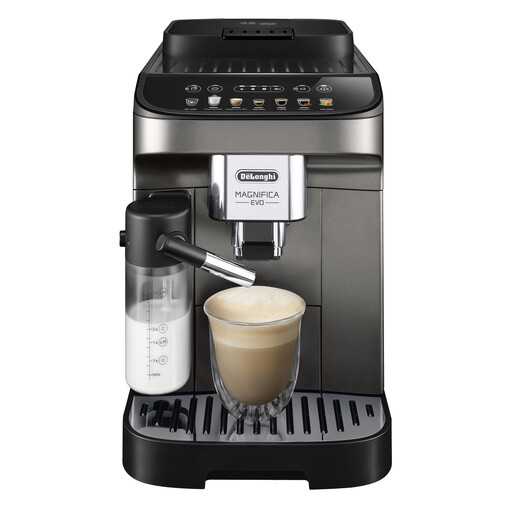
Black De'Longhi Magnifica Evo ECAM290.83.TB coffee machine

De'Longhi Magnifica Evo ECAM290.83.TB, black, auto milk

Consider this fully automatic bean-to-cup model if shared users want automatic milk preparation. Before buying, confirm that the ECAM290.83.TB offers the latte macchiato recipe you want and check how its milk system must be cleaned after use.

Joybuy

Frequently asked questions

Which machine makes latte macchiato simpler for several users?

A one-touch bean-to-cup machine is the simpler workflow when several people want the drink without learning espresso dosing and milk texturing. Check that the exact model lists latte macchiato or a suitable milk-coffee recipe, then compare its after-use cleaning steps.

Does automatic milk-system cleaning replace washing the parts?

No: follow the care routine for the particular milk system. Philips instructs users to rinse or dishwasher-clean LatteGo’s two parts after each use and also specifies separate brew-group maintenance.

Does a workplace coffee machine always need PAT testing on a fixed schedule?

No universal testing interval follows from placing a coffee machine in a workplace kitchen. The Health and Safety Executive says work equipment must be maintained to prevent danger, while the type and frequency of checks, inspections and testing depend on the equipment, environment and previous checks. Ask the responsible manager about the site’s arrangements.

Which recurring maintenance items should I check before buying?

Check the selected model’s instructions for filters, descaler, cleaning tablets and any milk-system cleaner it requires. The routine varies by machine and milk system, so include both after-use tasks and periodic maintenance when deciding who will look after a shared machine.