What matters when choosing?
For a hall bulletin, establish the recording connection first, choose a pickup pattern for the presenter and PA setup, then decide whether movement makes a wireless link worthwhile.
| Concern |
What to check |
Who this matters to |
| Speech and PA feedback |
Compare the stated pickup pattern with the presenter’s movement and whether the hall PA will be on. Check clip position and pop protection. |
If the PA is active or hall noise competes with speech, I want the presenter to remain intelligible without a level that changes sharply as they turn. Around 38% of consumers put speech and feedback control first. |
| Recording connection |
Match the exact recorder or bodypack input to the microphone connector, wiring and power requirements; a physical adapter alone may not establish compatibility. |
When I already have a recorder, camera or bodypack, I need a microphone that will connect and receive power correctly. Compatibility is the primary concern for around 38% of consumers. |
| Movement and recording continuity |
Decide whether a cable restricts the presenter. For wireless, check receiver output, power, operating band and available monitoring or onboard recording. |
If the presenter must cross the hall, I need freedom to move while keeping track of the recording and radio link. Around 24% of consumers would make mobility and recording continuity their first concern. |
Joybuy wireless microphone option
This USB-C wireless option is relevant when a bulletin presenter needs to move away from the recording device. Confirm that the device accepts its receiver before choosing it for the hall.
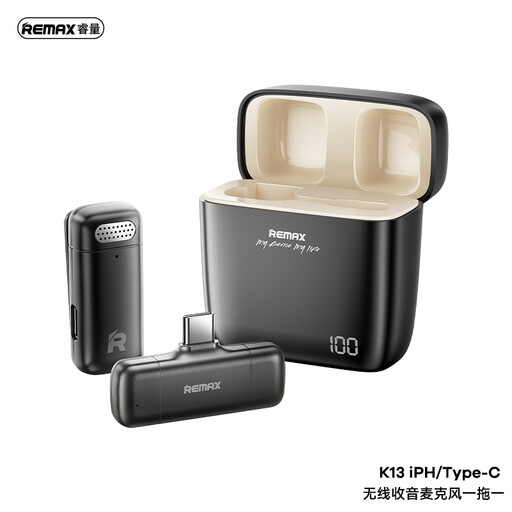 Image unavailable
REMAX K13 1-to-1 USB-C Wireless Microphone – Black
Consider this wireless model if the presenter needs to move and the USB-C connection suits the recording device.
Confirm device compatibility, battery runtime and the operating band; test the wireless link in the hall before recording.
View on Joybuy
Common questions
Should I use an omnidirectional or cardioid lavalier in a community hall?
An omnidirectional lavalier is a practical choice when the presenter turns their head and PA feedback is controlled. Consider a cardioid model when ambient-noise rejection or feedback headroom matters more and microphone orientation can remain consistent; Shure describes this trade-off for its WL183 and WL185.
Where should I clip a lavalier for a spoken bulletin?
Keep the capsule clear of hands and clothing, then make a short monitored recording in the hall. Shure’s guidance for its WL18x microphones gives a placement of approximately 76–152 mm below the neckline; use the placement advice for the model you choose rather than assuming one position suits every mic.
Can I plug any lavalier into my phone, camera or transmitter?
No: the microphone must match the device’s input, connector wiring and power arrangement. RØDE lists 3.5 mm TRS connections for Lavalier II and Lavalier GO, while Shure lists bodypack connector variants for the WL185; a physical adapter alone does not establish compatibility.
Does a wireless lavalier need a UK licence?
It depends on the system’s operating band and the conditions of use. Ofcom identifies licence-exempt wireless-microphone ranges but notes that shared use can bring interference; check the exact transmitter band and current Ofcom requirements before use, particularly if a coordinated licensed setup is being considered.
How should we handle recordings of identifiable contributors?
If an organisation records identifiable voices as personal data, it should plan how to meet the UK GDPR and Data Protection Act 2018 requirements. Identify an appropriate lawful basis, explain the recording’s purpose and use, limit what is kept to what is necessary, and secure the files. The applicable lawful basis depends on the circumstances; consent is not automatically required for every recording.


