Who is this for?

Pronunciation learners bothered by echo

You want to review consonants, vowels and pacing in a reflective bedroom, study or home office. Shure notes that a microphone cannot separate speech from room reflections; close, consistent placement helps you capture more direct speech but does not treat the room.

People practising directly into a phone

You record short drills on a smartphone or tablet and would rather check one straightforward connection than manage a wireless kit. The device port, microphone plug and any required adapter decide whether that approach will work.

People recording while moving

You practise standing, presenting or filming yourself. A compatible lavalier-and-transmitter arrangement or wireless clip-on system may fit that routine, provided you are comfortable checking connections and managing the additional equipment.

What matters when choosing?

For solo pronunciation practice in an untreated room, establish where the microphone will sit and how it will connect before deciding whether wireless movement is useful.

Concern What to check Who this matters to
Direct speech versus room echo Look for a practical collar or upper-chest mount, then test the position in your room. I want to hear the speech sounds I am practising without room reflections dominating the recording; around 36% of consumers put direct-speech clarity first.
Recorder compatibility Match the plug, input and any adapter to your exact phone, computer, interface or transmitter. If I record on a device I already own, the microphone has to connect correctly before other features matter; roughly 29% of consumers prioritise compatibility.
Rustle and repeatable placement Check the clip and windscreen or pop filter, and test with your usual clothing. I need successive takes to be comparable, without fabric or cable movement distracting from my pronunciation; about 21% of consumers place stable, quiet mounting first.
Movement while recording For a wireless setup, check the receiver connection, charging routine and whether onboard recording is available. When I practise standing or film myself at a distance, freedom to move matters more than a simple cable; around 14% of consumers make mobile recording their primary concern.

Mistakes to avoid

  • Expecting noise cancellation to cure room echo

    Shure explains that a microphone cannot effectively separate direct speech from reverberation. A closer position can improve the balance in a recording without changing the room itself.

    Make a short recording in your usual practice position. If reflections still obscure speech, try a different position or reduce hard, reflective surroundings rather than relying on a microphone setting.

  • Assuming every 3.5 mm microphone fits the same device

    Shure’s MVL is intended for compatible TRRS mobile connections, whereas RØDE’s Lavalier II and Deity’s W.Lav Pro use locking TRS connections associated with compatible equipment. A plug fitting a socket does not establish that it will record correctly.

    Identify your recorder’s input and check the exact microphone, adapter and device combination before buying.

    Your setup may also require an adapter, interface or compatible transmitter.

  • Concealing the microphone before checking for rustle

    Fabric rubbing against a close-mounted microphone can interfere with the pronunciation sounds you want to review.

    Start with a visible collar or lapel clip, secure the cable and test while wearing the clothes and making the movements you normally would.

    A different clip, mount or windscreen may be needed if the initial placement remains noisy.

  • Choosing wireless for stationary desk practice without checking the setup

    A wireless system adds a radio link and charging routine. Ofcom’s licence-free frequency ranges are not a promise of interference-free recording or permission for every system.

    If you need to move, check the exact system’s UK frequency requirements, receiver connection and charging arrangement. Otherwise, consider whether a compatible wired microphone meets your needs.

Brands to consider for different recording setups

Shure

The MOTIV MVL offers a wired, direct-to-mobile approach for speech recording.

  • Shure specifies an omnidirectional lavalier with a 3.5 mm TRRS plug, clothing clip and windscreen.
  • Shure says the MVL works with most compatible Android or iOS TRRS inputs or an appropriate CTIA-compliant adapter; check your exact device rather than assuming a universal connection.

RØDE

The Lavalier II is a wired option for a compatible transmitter or recording interface.

  • RØDE specifies a locking 3.5 mm TRS connector, 1.2 m cable, pop filter and mounting clip.
  • Check connector compatibility with your equipment. Its lavalier placement does not remove reverberation from an untreated room.

Deity Microphones

The W.Lav Pro 3.5 mm is a compact lavalier intended for a compatible wireless-system connection.

  • Deity specifies a locking 3.5 mm connector and a 1.8 m cable, alongside a clip and foam pop filter.
  • Confirm the connector wiring and transmitter compatibility; do not treat it as a direct smartphone microphone.

Sennheiser

The MKE Essential Omni has an EW connector variant associated with compatible Sennheiser wireless equipment.

  • Sennheiser offers mounting options for this production-oriented lavalier line.
  • Check the particular connector and equipment combination; this route can add unnecessary setup for short phone-based drills.

DJI

DJI Mic 2 represents a wireless clip-on recording setup rather than a wired lavalier on its own.

  • DJI lists transmitter-based onboard recording, which may matter when you want an audio copy alongside a wireless link.
  • Check the package contents, recorder connection and charging routine. Onboard recording does not remove room echo.

Joybuy products for this setup

This lapel microphone is a wearable option to consider for close-positioned speech practice. Check its connection method and fit with your recorder before choosing it for your routine.
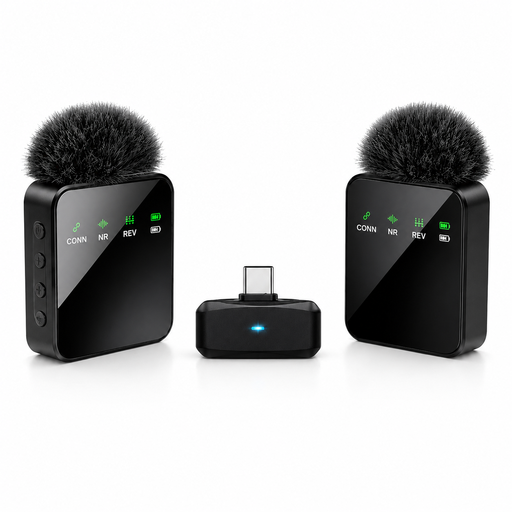
Verbex ST5 dual-mic Type-C button-style lapel microphone

Verbex ST5 dual-mic Type-C button-style lapel microphone

Consider its wearable lapel form if you want to position a microphone close to your mouth for practice. It is listed with a dual-mic design and Type-C interface, but the wireless descriptions conflict: confirm how it connects, whether it works with your recorder and how you will keep its position consistent.

View on Joybuy

Frequently asked questions

Will a lavalier remove echo from an untreated room?

No. Shure explains that a microphone cannot effectively separate your voice from room reflections. Placing a lavalier close to your mouth can improve the balance of direct speech in the recording, so test its position in the room where you practise.

Where should I clip a lavalier for pronunciation practice?

Start with a secure, visible position near your collar or upper chest, clear of rubbing fabric. Record a short test while speaking and moving normally, then adjust the clip, cable or windscreen if clothing noise or bursts of breath interfere.

Can I plug any lavalier into my phone?

No; the microphone connection must match the phone and any adapter. Shure says its MVL works with most compatible Android or iOS devices with a 3.5 mm TRRS input or an appropriate CTIA-compliant adapter, while a locking TRS lavalier intended for a transmitter needs a different compatibility check.

Do I need a UK licence for a wireless microphone?

The answer depends on the system’s frequency and operating conditions. Ofcom lists frequency ranges that can be used without a licence, but you should check the exact equipment and intended UK use against its requirements; a licence-free range can still be subject to interference.