What matters when choosing?
Start with the maximum number of actors who need separate microphones at once; that determines whether a compact kit, a managed wireless system or safely routed wired microphones are practical.
Compact 2.4 GHz wireless
Choose when: One or two moving performers need a quick-to-set-up kit, particularly if the selected model provides transmitter recording.
Allow for: The two-transmitter limit of a dual-channel kit and a shared 2.4 GHz band that Ofcom says can be subject to interference.
UHF bodypacks
Choose when: More performers need individual wireless channels and the production can manage receivers and frequency planning.
Allow for: Checking the exact UK frequency variant and operating arrangements; a manufacturer's channel-capacity figure does not establish what will work in your hall.
Wired lavaliers
Choose when: Performers can stay near fixed positions and cables can reach compatible recorder or mixer inputs.
Allow for: Securing cable runs, managing movement and matching each microphone's connector and power requirements to its input.
| Concern |
What to check |
Who this matters to |
| Recoverable dialogue |
Check whether each transmitter records locally, how its files are retrieved and whether the kit has enough independent channels. |
If actors move and deliver both quiet and emphatic lines, I want another recording path when the main take has a level or wireless-link problem. Around 31% of consumers put recoverable dialogue first. |
| Wireless channel planning |
Count simultaneous performers, then check receiver and bodypack quantities, the frequency variant and the intended UK operating arrangement. |
When several actors speak in the same scene, I need an individual mic for each without relying on a two-transmitter kit. Roughly 31% of consumers give simultaneous channel planning priority. |
| Wired practicality |
Check available recorder inputs, microphone power and whether cable paths can be secured away from movement and walkways. |
If performers stay in predictable places, I would rather manage cables than plan wireless frequencies, provided nobody has to cross a loose cable. Around 23% of consumers prioritise a workable wired setup. |
| Capsule and costume placement |
Check the capsule pattern, compatible connector and whether clothing will touch the microphone or cable. |
For an audio-only performance, I need speech to remain intelligible when an actor turns or a costume shifts. About 15% of consumers put placement and capsule choice first. |
Relevant brands to consider
These product lines illustrate different recording approaches; compare exact models, variants and connections rather than treating a brand name as a complete setup.
RØDE
The Wireless PRO is a compact two-transmitter route for small-cast dialogue where local recording is part of the plan.
- RØDE specifies 32-bit-float on-board recording and 32 GB per transmitter, with over 40 hours of stated recording capacity.
- Its two transmitters do not cover more than two independently miked performers at once; its 2.4 GHz wireless link also uses shared spectrum.
Sennheiser
EW-D is a digital UHF bodypack-system route for productions planning several wireless channels.
- Sennheiser specifies automatic scanning, 56 MHz tuning bandwidth and 2,240 selectable frequencies for EW-D.
- Sennheiser's stated capacity of up to 90 channels is a system specification, not the number available in a particular hall; check the exact frequency variant and UK operating conditions.
Shure
SLX-D offers a receiver-and-bodypack route, while Shure's lavalier range includes different capsule patterns and connector options.
- Shure specifies RF scanning for SLX-D and describes the WL93 as omnidirectional and the WL185M as cardioid.
- Shure's SLX-D figures of up to 10 compatible systems per 6 MHz TV band or 12 per 8 MHz band depend on region and band. Check that the selected lavalier connector fits the bodypack.
Audio-Technica
The BP898 family offers a cardioid lavalier in wired and wireless terminations for productions choosing their recording path separately from the capsule.
- Audio-Technica identifies both wired and wireless BP898 variants, giving productions a choice of connection route.
- The cardioid BP898 calls for consistent placement, and its termination and powering requirements depend on the variant. Check those details against the intended input.
Joybuy products for a small-cast setup
This two-transmitter wireless kit is a starting point for a small-cast recording plan. Check that its outputs connect to your recorder and that it provides any separate or local recording paths your production needs.
 No image available
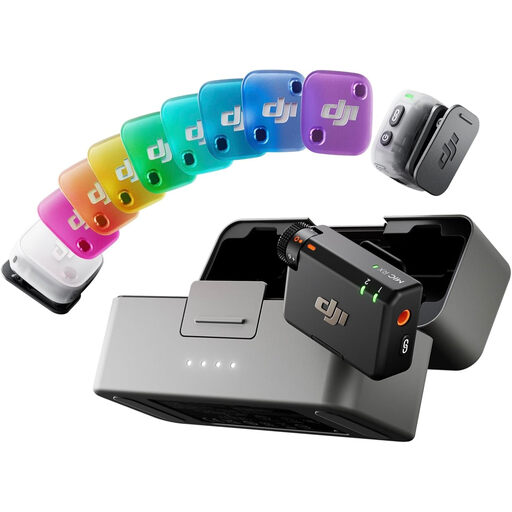
DJI Mic Mini 2 (2 TX + 1 RX + Charging Case)
Consider this kit if two transmitters cover the actors who need microphones at the same time and its receiver suits your recording setup.
The listed configuration contains 2 TX, 1 RX and a charging case.
Before using it for a hall recording, confirm the recorder connection, whether the transmitters provide separate channels or local backup files, and the wireless frequency details for UK use.
View on Joybuy
Questions about recording with lavaliers
Do I need a licence for a wireless lavalier in a UK community hall?
The answer depends on the system's frequency band and how it will be used. Ofcom lists 173.8–175 MHz, 863–865 MHz and 2400–2483.5 MHz for licence-exempt use under the applicable conditions, while other arrangements may require licensing or coordination. Check the exact frequency variant and current Ofcom conditions before recording.
How many wireless microphones can I use at once?
Plan for the number of actors who need separate microphones in the same scene, then check what the chosen system and frequencies can accommodate. Ofcom describes typical simultaneous use of up to three frequencies in the licence-exempt VHF range and up to four in the 863–865 MHz UHF range; those figures are planning guidance, not a guarantee for a particular hall.
Should actors wear omnidirectional or cardioid lavaliers?
An omnidirectional model is worth considering when actors turn their heads and a consistent close position is difficult; a cardioid model calls for more deliberate placement when focused pickup matters. Shure notes that its omnidirectional WL93 cannot be aimed and changes sound with body placement, while Audio-Technica notes pronounced close-range proximity effect for its cardioid BP898. Test the chosen microphone with the performance wardrobe.
Where should I place a lavalier for spoken dialogue?
Follow the instructions for the exact microphone and test its position during a costumed rehearsal. For one model-specific reference, Shure's PG185 guide advises placement about 15–25 cm from the mouth; Shure also advises positioning the opening of its WL93 away from the actor's body. Neither instruction replaces listening for clothing rustle and changes as the actor moves.
Can any lavalier connect to my bodypack or recorder?
No: the connector, wiring and power requirement must match the exact input. Shure offers WL185M connector options, and Audio-Technica offers BP898 variants for different wired or wireless connections. Check both the microphone variant and the bodypack or recorder specification before buying.


