
24/7 Customer Support

Free returns

Same-day & Next-day Delivery

Quality Guaranteed

Unlock Your Welcome Offers: FREE Delivery | Up to 80% OFF | Free 30-day JoyPlus trial
Download the APP
Replacing standard halogen or HID lighting with LED car headlight bulbs can give your vehicle a whiter appearance and a different light distribution. However, a high lumen figure or “plug and play” label does not guarantee compatibility, a suitable beam pattern or a trouble-free installation.
Before buying, check the original bulb code, headlight design and available space behind the dust cover. The right upgrade is the one that fits the socket, works with the vehicle’s electrical system and maintains a controlled beam.
Listings may advertise extremely high output figures, but these figures can refer to a pair of bulbs, theoretical LED output or a measurement taken under specific conditions. They do not automatically indicate how much useful light reaches the road.
A poorly positioned LED chip can create dark areas, excessive foreground light or glare for oncoming drivers. Look for a 1:1 filament-position design, focused beam information and clear fitting details rather than relying on lumens alone.
A plug-and-play design normally means the bulb connects to the existing socket without extensive rewiring. It does not mean that one bulb type suits all vehicles. H7 LED headlight bulbs, H11 LED bulbs, H4, H1, HB3 and HB4 bulbs all use different fittings and may serve different lighting functions.
Check your handbook, the marking on the original bulb or the vehicle manufacturer’s parts information. A bulb that looks similar may still have a different locking tab, connector or base diameter.
CANbus error-free bulbs are designed to reduce dashboard warnings, flickering or electrical compatibility issues. Yet vehicle systems vary, and sensitive models may still require a decoder or resistor module. An external driver, limited space or a cooling fan can also prevent a straightforward installation.
Treat “98%” or “99% compatibility” as a product specification, not a guarantee for your particular vehicle. Test the lamps after fitting and check for warning messages, flickering and correct high- and low-beam operation.
Start with the exact code: H7, H11, H8/H9/H11, H1, H4, 9005/HB3, 9006/HB4 or HIR2/9012. The original bulb may have its code printed on the base or packaging.
H8, H9 and H11 bulbs can look alike but are not automatically interchangeable. Likewise, 9005 HB3 LED bulbs and 9006 HB4 LED bulbs have different bases. HIR2 9012 LED bulbs are designed for a specific socket and are not replacements for H4, H7 or H11 fittings.
For HID-equipped headlights, D1S D1R LED bulbs and D4S LED bulbs are intended only for compatible HID assemblies. They are not direct replacements for a halogen reflector or a factory LED unit.
A 6000K cool white headlight usually appears whiter than a warm halogen bulb. Colour temperature describes the appearance of the light, not its measured brightness or legal suitability.
The chip position is more important for beam control. A narrow chip arrangement that imitates the original halogen filament can help the reflector or projector produce a more familiar pattern. After installation, check the beam against a wall and arrange professional adjustment if the cutoff is uneven or too high.
UK drivers should also confirm that the conversion is suitable for their headlamp assembly and road use. A bulb fitting physically into the housing does not by itself confirm approval for every vehicle or lighting arrangement. Avoid dazzling other road users and check the latest MOT and vehicle requirements where relevant.
LEDs produce heat around the chip and base. Aluminium housings, copper elements, heat sinks and cooling fans are common ways of managing it. Fan-cooled bulbs may need additional clearance behind the headlamp, while fanless designs can be useful where space or noise is a concern.
An IP65 or IP68 waterproof car bulb rating describes resistance to dust and water under stated test conditions. It does not remove the need to reinstall the factory dust cover correctly. Also check whether the bulb’s total length allows the cover and retaining clip to close securely.
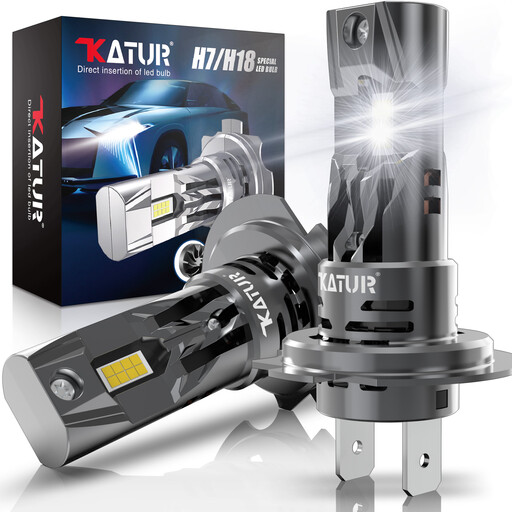
Why This Fits Their Persona: A compact pack of 2 for drivers making a straightforward H7 replacement, including DIY owners who want a 1:1-style fitting without an external driver.
The listing specifies a 1:1 mini size and plug-and-play installation, helping buyers check space and wiring requirements before ordering.
6000K colour temperature, built-in CANbus design, aluminium housing and a stated 60,000-hour operating life.
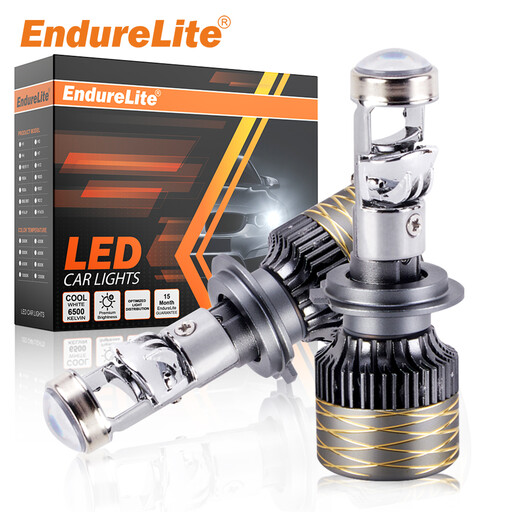
Why This Fits Their Persona: Suits owners of compatible vehicles who prioritise cooling, weather resistance and a stated focused beam design for regular night driving.
Its specification identifies H8/H9/H11 compatibility rather than presenting the bulb as a universal fit for every headlamp.
Pack of 2, IP68 waterproof construction, integrated 10,000 RPM cooling fan and stated 50,000-hour operating life.
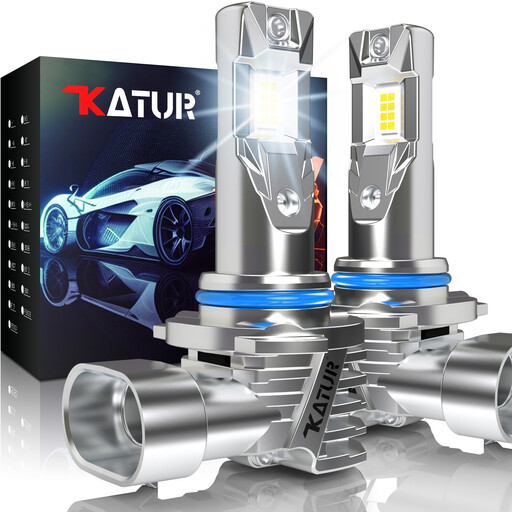
Why This Fits Their Persona: Designed for drivers whose vehicle specifically uses an HIR2/9012 socket and who need a fanless format for a more confined headlamp space.
The product information clearly states that it is for HIR2/9012 sockets only, not H4, H7 or H11 systems.
Fanless mini design, 6000K white output, 12V compatibility and pack-of-2 format.
We have compiled a complete, real-time list of products that fully satisfy these strict selection criteria and UK safety regulations.
They can use a different wattage for a comparable lighting application, but actual running cost depends on the bulb’s rated power, usage time and the vehicle’s charging system. Check the stated wattage rather than assuming every LED conversion uses less energy.
Product listings commonly state operating lives such as 50,000 or 60,000 hours. These are manufacturer specifications and real service life can vary with heat, vibration, voltage, installation and usage. Effective cooling and correct sealing are important factors.
Not always. Some bulbs include an integrated CANbus-ready driver, while sensitive vehicles may still display a warning or flicker. If that happens, check the product instructions and vehicle compatibility before adding a decoder or resistor.