
24/7 Customer Support

Free returns

Same-day & Next-day Delivery

Quality Guaranteed

Unlock Your Welcome Offers: FREE Delivery | Up to 80% OFF | Free 30-day JoyPlus trial
Download the APP
Dim headlights can make unlit roads, country lanes and winter commutes more tiring. Replacing worn halogen or HID bulbs with LED car headlight bulbs may provide a cooler-white beam, quicker start-up and simpler maintenance, but compatibility matters more than a high lumen figure on the box.
The wrong bulb can leave you with flickering, dashboard warnings, poor beam control or a housing that will not close properly. This guide explains what to check before buying and matches several options to different UK driving needs.
Listings often promote very high lumen figures or percentage increases over standard bulbs. These figures may describe a pair, theoretical chip output or a manufacturer’s own comparison. They do not automatically indicate useful light on the road.
A well-positioned LED chip, suitable reflector or projector compatibility and correct beam alignment are more important than headline brightness. Excessive glare can inconvenience oncoming drivers and may indicate that the bulb is not correctly matched to the headlamp optics.
An H1 LED bulb is generally intended as a halogen replacement bulb, while D1S, D2S, D3S and D4S products are designed for vehicles originally fitted with HID/Xenon assemblies. A D2S LED bulb should not be treated as a universal substitute for an H1 socket.
Check the existing bulb marking, vehicle handbook and, where necessary, the original bulb before ordering. Some products listed as D1S/R or D3S/R cover both related fitments, but the headlamp housing still needs to accept that base design.
A CANbus-ready LED bulb includes a driver intended to reduce error messages, flickering or radio interference. It does not guarantee compatibility with every UK vehicle. Some sensitive systems, particularly on certain European models, may still need an additional decoder or load solution.
Check the product notes carefully and keep the original bulbs until the replacement has been installed and tested.
Confirm the exact designation: H1 LED headlight bulbs for a compatible halogen housing, or HID replacement bulbs such as D1S LED bulbs, D2S LED bulbs, D3S LED bulbs and D4S LED bulbs for suitable HID assemblies.
A 1:1 LED headlight bulb is shaped to approximate the original bulb’s size and light-emitting position. This can help with installation and beam alignment, but it is not a substitute for checking the available depth. Fans, heat sinks and external drivers may interfere with a dust cover or narrow rear housing.
Most products in this selection use either 6000K LED bulbs or 6500K LED bulbs. A 6000K specification is usually described as cool white, while 6500K appears slightly cooler and more blue-white.
Colour temperature is not the same as brightness. A higher Kelvin number does not necessarily provide more usable road illumination, and very cool light may produce more visual contrast in some conditions without improving every aspect of wet-weather visibility.
LED chips generate heat at the rear of the bulb, so examine the cooling design. Common features include an aluminium body, copper heat-transfer components and a built-in fan. Fan noise, available space and dust-cover clearance should all be considered.
An IP65 or IP68 waterproof LED headlight bulb rating relates to resistance under specified test conditions; it does not mean the bulb can be submerged indefinitely. Product listings may quote operating lifespans of 50,000 or 60,000 hours, but actual service life depends on temperature, voltage, usage and installation quality.
After installation, check the cut-off, beam height and illumination pattern on a level surface. Headlights should be aimed correctly to reduce glare. UK roadworthiness requirements apply to the vehicle and its lamps, so confirm that the retrofit is appropriate for your headlamp type and meets applicable road-use and MOT expectations. If the beam cannot be aligned correctly, revert to a suitable approved solution or seek professional advice.
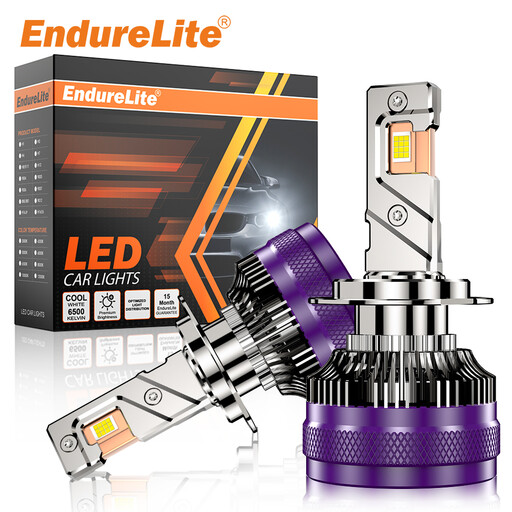
Why This Fits Their Persona: A straightforward option for motorists moving from H1 halogen bulbs to a cool-white LED setup for regular commuting and occasional night driving.
The listing identifies it as an H1 halogen replacement and notes that some sensitive vehicles may require additional decoders.
6000K specification, one-piece plug-and-play design, IP68 rating and fan-assisted cooling.
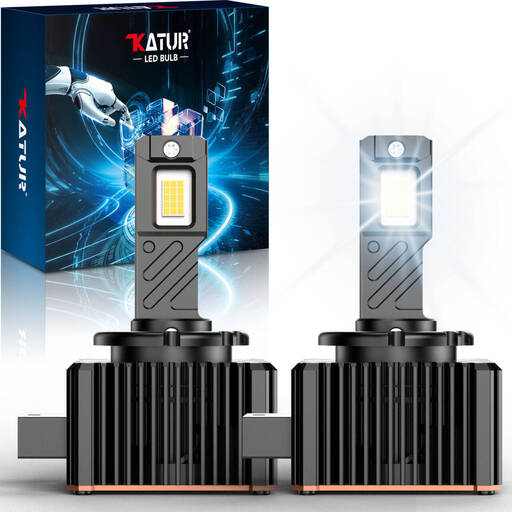
Why This Fits Their Persona: Suitable for drivers with HID-equipped vehicles who want a compact D1S/D1R replacement with a cooler 6500K appearance.
The product description clearly states that it is for HID assemblies rather than halogen or complete LED headlamp units.
1:1 mini design, built-in intelligent driver, fan cooling and stated 50,000-hour operating life.
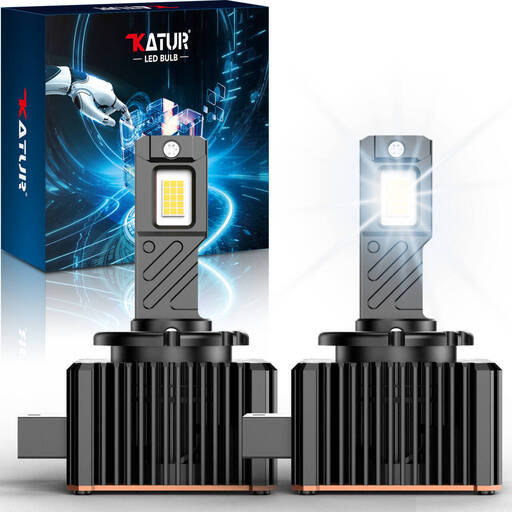
Why This Fits Their Persona: A practical match for frequent night drivers with D3S or D3R HID headlamps who prioritise rapid start-up and thermal management.
It specifies HID-only use, 1:1 installation and an integrated driver, helping avoid incompatible halogen purchases and wiring changes.
6500K output, stated 0.01-second start-up, 16,000RPM fan and aluminium construction.
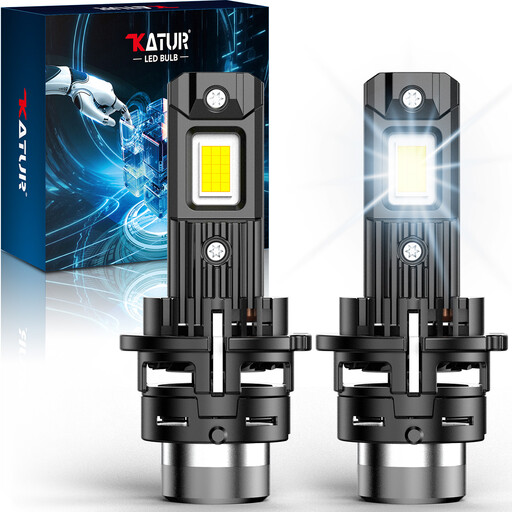
Why This Fits Their Persona: Designed for D4S/D4R HID users seeking a direct replacement format for regular motorway, rural and winter driving.
The listing distinguishes HID replacement use from LED and halogen assemblies and highlights plug-and-play installation.
6500K white light, integrated cooling fan, stated 60,000-hour life and CANbus-focused driver design.
We have compiled a complete, real-time list of products that fully satisfy these strict selection criteria and UK safety regulations.
LED bulbs may use less electrical power for a comparable lighting application, but the saving depends on the vehicle, bulb design and driving hours. Purchase price, cooling-fan reliability and compatibility should be considered alongside electricity use.
No. D1S and D2S LED bulbs are intended for compatible HID assemblies. Halogen housings normally require the correct halogen-format bulb, such as an H1 LED bulb, and the beam must still be checked after installation.
Product listings commonly state 50,000 or 60,000 hours, but these are claimed operating-life figures rather than a guarantee for every vehicle. Heat, vibration, voltage stability, moisture and installation quality can affect actual lifespan.