
24/7 Customer Support

Free returns

Same-day & Next-day Delivery

Quality Guaranteed

Unlock Your Welcome Offers: FREE Delivery | Up to 80% OFF | Free 30-day JoyPlus trial
Download the APP
Choosing the right ceiling light can feel like a significant decision. It’s not just about illuminating a room; it’s about setting the mood, complementing your decor and ensuring the space is functional. With so many styles, features and technical specifications to consider, it's easy to feel overwhelmed.
As the Joybuy Product Recommendation Officer, my role is to help you navigate these choices. This guide offers practical advice on selecting the right LED ceiling lights for your home, followed by a few recommendations that cater to different needs and styles.
Before you start browsing, considering a few key factors will help narrow down your options and ensure you find a light that you'll be happy with for years to come.
The height of your ceiling is a primary factor in determining the right type of fixture.
Different rooms have different lighting requirements. Thinking about how you use a space will guide you toward the right features.
A ceiling light is a prominent fixture, so its style should complement your home's aesthetic. Finishes play a huge role here. A gold ceiling light, for example, can add a touch of warmth and luxury to a room, fitting well with both mid-century and contemporary decor. A simple white or black fixture might be better suited to a minimalist or industrial design.
Here are a few recommendations from our catalogue, selected to meet a range of common requirements for UK homes.
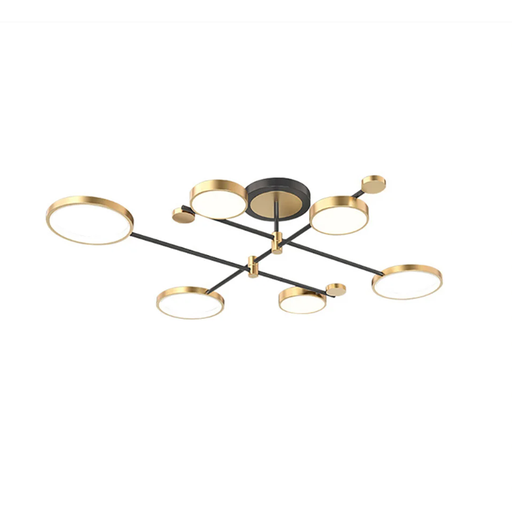
Why It Stands Out: This fixture combines function with sculptural art. The interlocking gold rings create a striking visual centrepiece that distributes warm white light evenly. Its semi-flush design makes it a statement piece that works well in rooms with standard ceiling heights, adding a touch of modern elegance without overwhelming the space.
Pros:
Who is it for? This light is for those looking to make a design statement. It’s a great fit for anyone wanting to add a sophisticated, mid-century modern focal point to their living room ceiling lights or dining area.
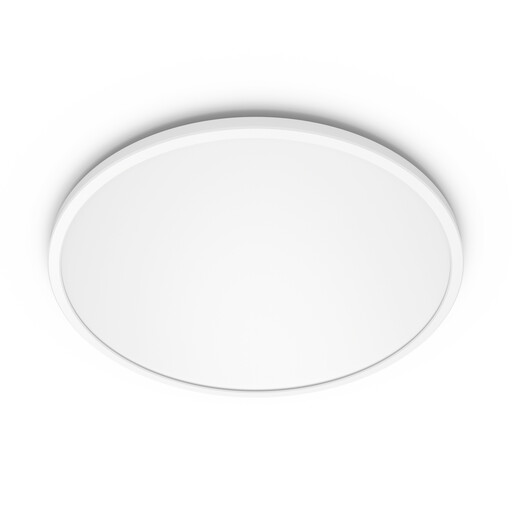
Why It Stands Out: This Philips luminaire is the definition of practical, unobtrusive lighting. Its super slim design (only 23mm high) makes it one of the most effective flush ceiling lights for low ceilings. It provides uniform, warm white light and features a step-dimming function (SceneSwitch) that allows you to cycle through three brightness levels using your existing wall switch.
Pros:
Who is it for? This is a practical solution for homeowners or renters with low ceilings in bedrooms, kitchens or hallways who need a functional, no-fuss light that maximises headroom and offers basic dimming without needing a special switch.

Why It Stands Out: This is a highly capable smart ceiling light designed for customisation. It offers both a main light and a side-glowing RGB ceiling light that can display 16 million colours. You can adjust everything from brightness to colour temperature (warm to cool white) and create flowing colour effects. Full compatibility with Alexa, Google Home and SmartThings allows for seamless voice control.
Pros:
Who is it for? This is an excellent choice for tech-savvy users, gamers or anyone who wants to transform their bedroom ceiling lights or entertainment area into an immersive environment. It offers both high-quality functional lighting and endless creative possibilities.
The recommendations above focus on fixtures that sit close to the ceiling. If you have higher ceilings and are looking for a light that hangs lower to create a more dramatic effect, you may want to consider a different type of fixture.
For more eye-catching options, explore our collection of LED suspended lights.
Integrated LED lights have the light source built directly into the fixture, meaning there are no bulbs to change. The main advantages are their long lifespan (often 15,000-50,000 hours), excellent energy efficiency and the sleek, compact designs they allow for. The consideration is that if the LED module fails after its long life, the entire fixture typically needs to be replaced.
Yes, you can. A dimmable light will function perfectly as a standard on/off light with a standard switch. However, to use the dimming feature, you will need to install a compatible LED dimmer switch. Some smart lights, like the Yeelight model mentioned, can be dimmed via an app or voice control without requiring a physical dimmer switch.
The difference lies in how they are mounted. A flush mount light sits directly against the surface of the ceiling with no gap. This is the preferred choice for low ceilings to maximise vertical space. A semi-flush mount light hangs a few inches below the ceiling, leaving a small gap. This allows light to cast both downwards and upwards and it adds a bit more of a decorative presence to the room.