
24/7 Customer Support

Free returns

Same-day & Next-day Delivery

Quality Guaranteed

Unlock Your Welcome Offers: FREE Delivery | Up to 80% OFF | Free 30-day JoyPlus trial
Download the APP
Choosing the right LED ceiling light can transform a room, but navigating the market can feel like a chore. With so many styles and technical claims, it's easy to make a purchase you later regret. As the Joybuy Product Recommendation Officer, my role is to help you sidestep the common pitfalls and find a light that is both stylish and genuinely functional for your home.
This guide focuses on the practical aspects of selecting a light, cutting through the clutter to highlight what truly matters for UK households.
Before looking at what to buy, it's crucial to understand what to avoid. Many shoppers find their new light is unsuitable only after installation, leading to disappointment and wasted money.
To avoid the traps above, focus on these three non-negotiable parameters. They will ensure your new LED ceiling lights are fit for purpose.
The IP rating is a two-digit number that indicates a fixture's resistance to solids (first digit) and liquids (second digit). For most indoor areas like living rooms and bedrooms, this isn't a major concern. However, for bathroom ceiling lights and kitchen ceiling lights, it is essential.
LED lighting colour is measured in Kelvins (K). This determines the "warmth" or "coolness" of the light, which has a significant impact on a room's atmosphere.
Many modern ceiling lights now offer adjustable colour temperatures, often controlled by a remote, giving you the flexibility to change the mood on demand.
Forget watts; lumens (lm) are the true measure of brightness. A higher lumen count means a brighter light. As a rough guide for an average-sized room (around 15 square metres):
For ultimate control, look for dimmable ceiling lights. This feature allows you to adjust the brightness to suit the time of day or activity, moving from bright and functional to soft and atmospheric with ease. Many models now include ceiling lights with remote control for added convenience.
Based on these practical criteria, here are a few options from our catalogue that are well-suited to different UK lifestyles and needs.

Why This Fits Their Persona: This user values convenience, connectivity and modern aesthetics. The Yeelight's hub-free WiFi control, compatibility with Google Assistant and Alexa and ambient RGB backlight are perfect for creating automated lighting scenes for movie nights, dinner parties or focused work. Its ultra-slim profile is ideal for contemporary interiors.
Its IP54 waterproof and dustproof rating directly solves the moisture-mismatch pitfall, making it a genuinely safe and durable choice for kitchens and bathrooms, not just living rooms.
Hub-free smart control via WiFi and a versatile RGB backlight for creating ambient moods. The quick-mount base is designed for simpler installation.
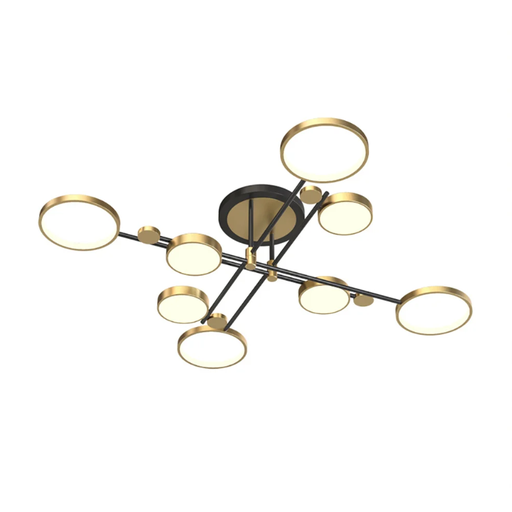
Why This Fits Their Persona: For this person, a light is not just a utility but a piece of art. This large, Sputnik-inspired ring light serves as a dramatic centrepiece in a living room, dining room or hallway with high ceilings. It's for someone who prioritises bold, visual impact. The choice of gold or a striking black ceiling lights finish allows it to fit into various modern decor schemes.
It is designed to be sloped ceiling compatible, directly addressing a common installation surprise that frustrates buyers of large or unconventional fixtures.
A bold, statement-making design that functions as an artistic focal point. The integrated LED provides wide, ambient warm white light without the need for separate bulbs.
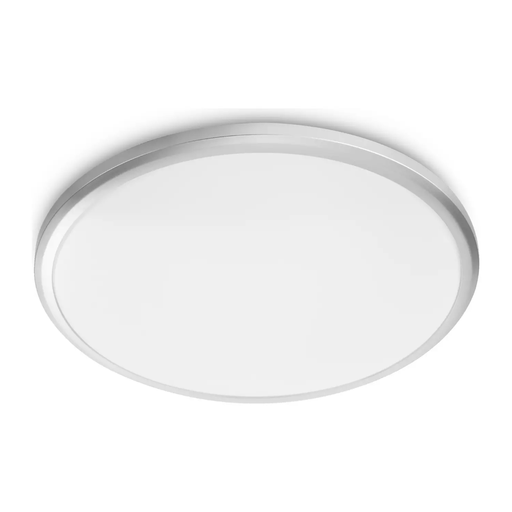
Why This Fits Their Persona: This user wants a no-fuss solution that saves energy and just works. The built-in motion sensor is perfect for hallways, utility rooms or bathrooms, providing hands-free light only when needed. It prioritises function and long-term reliability over elaborate design.
This light is explicitly described as moisture-resistant and suitable for humid environments, directly countering the pitfall of using an inappropriate fixture in a bathroom or kitchen.
The integrated motion sensor provides convenience and helps reduce energy consumption. According to Philips, it is also designed to meet their EyeComfort standards, which address factors like flicker and glare.
We have compiled a complete, real-time list of products that fully satisfy these strict selection criteria and UK safety regulations.
1. How long do integrated LED ceiling lights last? Most integrated LED fixtures are rated for a long lifespan, often between 15,000 and 50,000 hours. For a light used 4 hours a day, that translates to over 10 years of use. Unlike traditional bulbs, they don't "burn out" but gradually dim over time. The main advantage is that you won't have to worry about changing bulbs for the lifetime of the fitting.
2. Are LED ceiling lights expensive to run? No, they are highly energy-efficient. An LED light uses significantly less electricity (watts) to produce the same amount of light (lumens) as an old halogen or incandescent bulb. Switching to LED is one of the simplest ways to reduce your home's electricity consumption and lower your energy bills.
3. Can I install an LED ceiling light myself? In the UK, any work on fixed electrical installations, including hardwired ceiling lights, should legally be carried out by a qualified electrician to comply with Part P of the Building Regulations. While some simple flush mount ceiling lights may seem straightforward, incorrect wiring is a serious fire and safety risk. We always recommend professional installation.