
24/7 Customer Support

Free returns

Same-day & Next-day Delivery

Quality Guaranteed

Unlock Your Welcome Offers: FREE Delivery | Up to 80% OFF | Free 30-day JoyPlus trial
Download the APP
A suitable LED desk lamp can make a home office, study area or reading corner easier to use, but product listings often make comparison harder than it needs to be. Brightness figures may be missing, “eye-care” wording can sound more meaningful than the technical information behind it, and a compact lamp may not remain stable when its arm is fully extended.
Before choosing a dimmable desk lamp, check how it performs in everyday UK use: does it illuminate the whole work area, can you position it without glare and does its charging function match your devices? The following points help filter out common buying traps.
A lamp offering warm, neutral and cool light is not automatically brighter or more versatile. Colour temperature, measured in Kelvin (K), describes the appearance of the light:
Brightness is measured in lumens, while wattage indicates electrical power consumption. A higher wattage does not necessarily mean more useful light, so check the lumen output and whether the lamp has a broad diffuser.
Terms such as “eye-caring”, “flicker-free” and “full-spectrum LED” should be treated as product descriptions, not health endorsements. Look for specific information instead, including stated flicker performance, glare control, colour rendering and blue-light hazard classification.
An eye-care desk lamp should also be positioned correctly. Even a well-designed lamp can cause discomfort if the LEDs are visible from your normal seating position or if the light reflects directly from a monitor.
A lamp may be described as adjustable, but that does not tell you how far the head moves or whether the base stays stable. Check the adjustment range, hinge construction and folded dimensions. A foldable desk lamp can help on a student desk with a small footprint, bedside table or shared workstation, but only if it provides enough reach when opened.
Also check whether the stated measurements refer to the folded lamp, base or complete product. This is particularly important when your desk is beneath a shelf or monitor riser.
For reading, studying and office work, compare the lamp’s lumen output, light-panel size and beam spread rather than wattage alone. A narrow beam may create a bright patch with deep shadows, while a wider rectangular panel can cover more of a keyboard, notebook or craft area.
Designers, crafters and anyone working with colour should also consider the colour rendering index (CRI). A higher stated CRI can indicate more accurate colour appearance, although it should be considered alongside the diffuser, workspace coverage and your own task requirements.
A practical adjustable desk light should offer more than a single low and high setting. Stepless dimming gives finer control for changing daylight, while three or more preset colour modes can make switching between work and relaxation straightforward.
Look for a head or arm that can be angled away from your eyes and monitor. A gooseneck, multi-joint arm or 0–180-degree head adjustment can be useful, but the lamp should remain stable at the selected angle.
A USB desk lamp may have a USB connection for power, while a lamp with USB A and USB C charging ports can also charge compatible devices. Check the stated output, as a 5V/2.1A port is intended for everyday USB-powered devices and should not be assumed to provide laptop-level charging.
For UK use, confirm that the product includes a suitable UK plug or that any supplied adaptor is appropriate. Check the product information for the rated voltage, required power supply, compliance markings and indoor-use limitations. Keep table lamps away from water and do not use them in damp locations unless the product specifically carries a suitable IP rating.
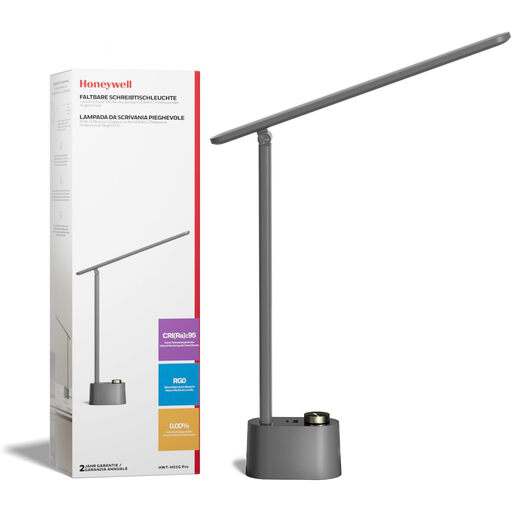
Why This Fits Their Persona: A practical option for students or first-time home-office users who want adjustable light, a compact form and device charging without adding a separate charger to the desk.
The listing specifies dimming, three colour modes, a foldable design and USB A/C ports rather than relying only on general “smart lighting” language.
11W LED construction, 48 listed SMD lights, adjustable colour temperature and USB A plus USB C connectivity.
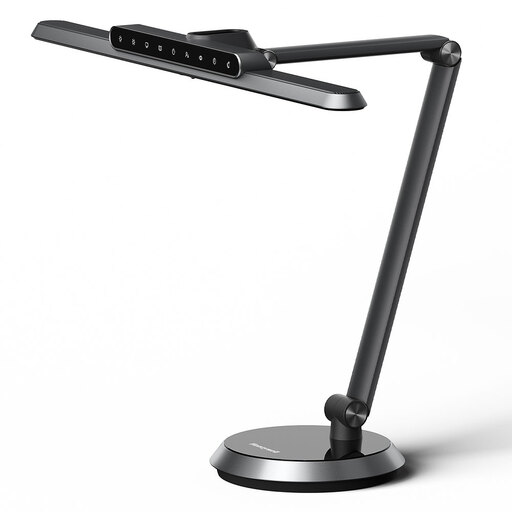
Why This Fits Their Persona: Suitable for a dedicated home-office setup where automatic activation, ambient-light adjustment and a higher stated output are more important than fold-away storage.
Its specifications identify 1,000 lumens, three colour modes, stepless dimming and a gooseneck, making the positioning and output easier to assess.
Motion sensing, ambient-light sensing, memory function, 18W power and a stated CRI of 91 or above.
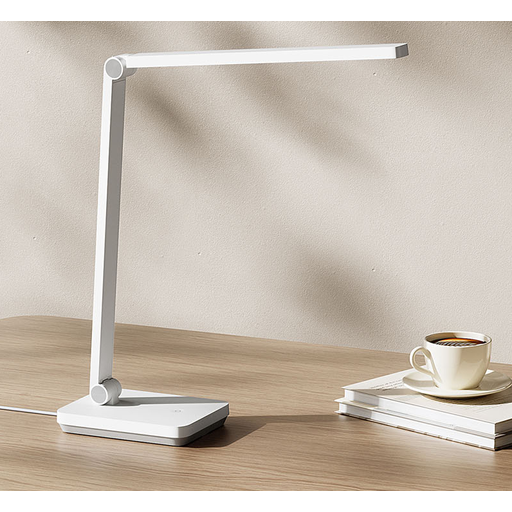
Why This Fits Their Persona: A focused choice for readers, students and detailed-task users who prioritise wide-area illumination, colour accuracy and precise positioning.
The product information states the number of brightness levels, three-shaft adjustment and wide-area illumination, rather than presenting adjustability as an unspecified feature.
Three brightness levels, three-shaft flexible positioning, stated Ra90 colour rendering and RG0 classification in the listing.
We have compiled a complete, real-time list of products that fully satisfy these strict selection criteria and UK safety regulations.
Place it to the side opposite your writing hand where possible, so your hand does not cast a shadow across the page. For monitor work, angle the lamp towards the desk rather than the screen to reduce reflections. Keep the light source outside your direct line of sight.
LED products generally have a longer rated operating life than traditional replaceable bulbs, but the actual lifespan depends on heat management, power supply quality and usage. Check the manufacturer’s stated hours and whether the lamp has a replaceable power adaptor or integrated LED panel.
Running cost depends on wattage, hours and your electricity tariff. As a simple guide, an 11W lamp used for five hours consumes approximately 0.055 kWh per day. Multiply that figure by your unit rate and usage days to estimate the cost. Dimming the lamp can reduce power use on models designed for adjustable output, though the exact saving varies by product.