
24/7 Customer Support

Free returns

Same-day & Next-day Delivery

Quality Guaranteed

Unlock Your Welcome Offers: FREE Delivery | Up to 80% OFF | Free 30-day JoyPlus trial
Download the APP
Choosing an LED floodlight for a driveway, garden, garage or business exterior can appear straightforward. However, brightness figures and weatherproof claims do not always tell the whole story. The wrong fitting may create glare, leave dark areas or require replacement sooner than expected.
The most common buying pitfalls include:
Lumens describe the visible light output. Wattage describes the electricity consumed by the fitting. A modern LED can produce useful brightness with lower wattage than older halogen or incandescent lighting, but products should still be compared by their stated lumen output.
As a practical guide:
A 20W LED floodlight may provide around 1300 to 1500 lumens depending on the design. A 30W LED floodlight may offer approximately 2400 lumens. These figures are product-specific, so check the listing rather than relying on wattage alone.
The IP code indicates protection against solid particles and water. The first digit relates to solids such as dust, while the second concerns water.
For many exposed outdoor locations, an IP65 floodlight is a practical choice because it offers a higher level of enclosure protection than IP44. It can be suitable for mounting near entrances, garages, walls and driveways, subject to the manufacturer’s instructions and correct installation.
An IP44 fitting may be more appropriate in a reasonably protected position, such as beneath a roof overhang. It should not automatically be treated as equivalent to an IP65 model.
Colour temperature is measured in Kelvin:
Also check the beam angle. A 110° beam angle is designed to spread light across a wider area, which can be useful for driveway lighting, building entrances and larger gardens. Mounting height and aiming direction will affect the final coverage, so avoid pointing a powerful fitting directly towards neighbouring windows or public paths.
For mains-powered products, installation should follow the supplied instructions and applicable UK electrical requirements. If you are uncertain about wiring or exterior electrical work, use a suitably qualified electrician.
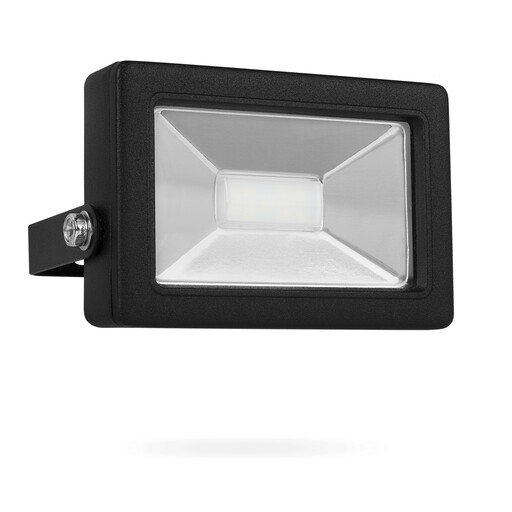
Why This Fits Their Persona: A compact option for a front entrance, small garden, shed, garage doorway or short pathway where moderate illumination is sufficient.
Its stated 650-lumen output makes expectations clearer than choosing by wattage alone, while the IP65 rating is suited to many exposed outdoor positions.
Integrated 10W LED, 4000K natural white light, compact 105 × 134 × 38 mm housing and listed A energy rating.

Why This Fits Their Persona: Suitable for homeowners who want stronger general-purpose lighting around a driveway, patio, garage or garden without moving to a larger 30W fitting.
The 1500-lumen specification gives a measurable brightness reference, and IP65 protection is stated for outdoor installation.
20W integrated LED, 4000K natural white light, no routine bulb replacement and a slim housing.
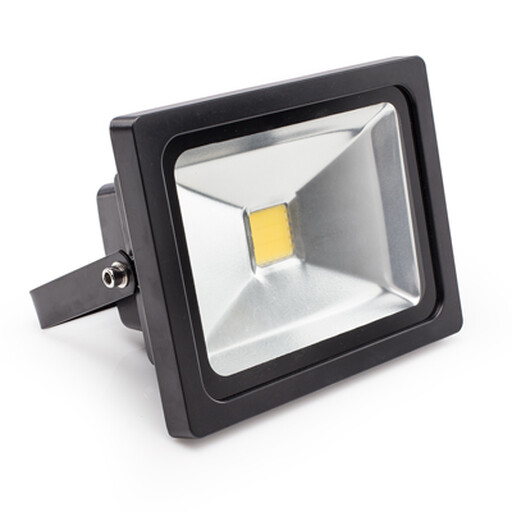
Why This Fits Their Persona: Designed for larger driveways, parking areas, workshops, storage yards, broad gardens and commercial exterior spaces requiring wider illumination.
Its stated 110° beam angle helps buyers assess coverage, while the IP65 rating provides a clear outdoor protection specification.
2400 lumens, 30W integrated LED, wide 110° beam and included wall-mounting hardware.
We have compiled a complete, real-time list of products that fully satisfy these strict selection criteria and UK safety regulations.
Before ordering an outdoor LED floodlight, measure the mounting position and identify the area that needs illumination. Check whether the supplied cable length, bracket adjustment and mounting hardware suit the wall, fence or garage structure.
To estimate running cost, use this calculation:
Watts ÷ 1,000 × hours used × electricity tariff = operating cost
For example, a 20W fitting uses 0.02 kWh per hour. The actual cost depends on how long it operates and the electricity rate on your tariff. A lower-wattage fitting may be sufficient for a small entrance, while a higher-output model could reduce the need for multiple lights across a larger area.
Avoid aiming a security floodlight towards neighbours’ homes, roads or footpaths. Good positioning can improve visibility while reducing unwanted glare. Clean the front cover periodically and inspect fixings after severe weather.
Many are designed for outdoor use, but suitability depends on the product’s IP rating and installation position. An IP65 floodlight generally offers more enclosure protection than an IP44 model. Always follow the manufacturer’s installation guidance and avoid exposing cable connections to water.
A small driveway may suit around 650 lumens, while a medium driveway often benefits from approximately 1300 to 1500 lumens. Larger driveways, yards and commercial areas may require 2400 lumens or more, depending on mounting height and beam angle.
A 20W LED floodlight consumes 0.02 kilowatt-hours for each hour it operates. Its running cost depends on usage time and your electricity tariff. Using a timer, sensor or suitable operating schedule can help prevent unnecessary illumination, where the fitting supports those controls.