
24/7 Customer Support

Free returns

Same-day & Next-day Delivery

Quality Guaranteed

Unlock Your Welcome Offers: FREE Delivery | Up to 80% OFF | Free 30-day JoyPlus trial
Download the APP
Straining to see the road ahead on a dark, rainy night is a common frustration for many UK drivers. If your car's factory-fitted halogen bulbs cast a dim, yellowish light, you are likely all too familiar with this feeling. Upgrading your vehicle's lighting is not just about aesthetics; it is a practical step towards improving visibility and driving confidence after sunset.
Many drivers are now turning to LED headlight bulbs for a cost-effective and significant improvement. However, the market is filled with technical jargon and ambitious claims, making it difficult to choose the right product. This guide is designed to cut through the jargon, offering clear, practical advice to help you select a suitable LED headlight conversion kit for your car.
Before you make a purchase, consider these key factors to ensure you get a compatible and effective upgrade.
The most critical step is identifying the correct bulb type for your vehicle. This is usually printed on the base of your existing bulb or listed in your car's owner manual. Common types include HIR2, H7, H4 and D2S.
Many modern kits are designed as plug and play headlights, meaning they are built to the same size and specification as the original halogen bulb for a direct, tool-free replacement. However, if you are replacing factory HID/Xenon bulbs with a D2S LED replacement, you may need to bypass the original HID ballast, which can be a more involved process. Always check the product's installation requirements.
A proper LED upgrade should illuminate the road more effectively without dazzling oncoming traffic.
Many vehicles manufactured after the early 2000s use a Controller Area Network (CANbus) system to monitor the vehicle's functions, including the headlights. Since LED bulbs draw less power than halogens, the CANbus system may mistakenly think a bulb has failed, resulting in a dashboard warning light or flickering.
To avoid this, look for CANbus error free headlights. These have built-in circuitry or come with external decoders (resistors) to communicate correctly with your car's computer system, ensuring smooth, error-free operation.
Here are a few recommendations from our catalogue that address the common needs of UK drivers looking to upgrade their vehicle's lighting.

Why It Stands Out: The standout feature of this KATUR HIR2 kit is its fanless design. By using an aviation-grade aluminium body for passive heat dissipation, it operates silently and eliminates the risk of fan failure, a common point of weakness in other LED bulbs. Its 1:1 mini size makes it a true plug and play option, fitting easily into tight headlight housings without modification.
Pros:
Who is it for?: Drivers with vehicles using HIR2/9012 bulbs (common in many Toyota, GM and Chrysler models) who want a straightforward, reliable and silent upgrade.
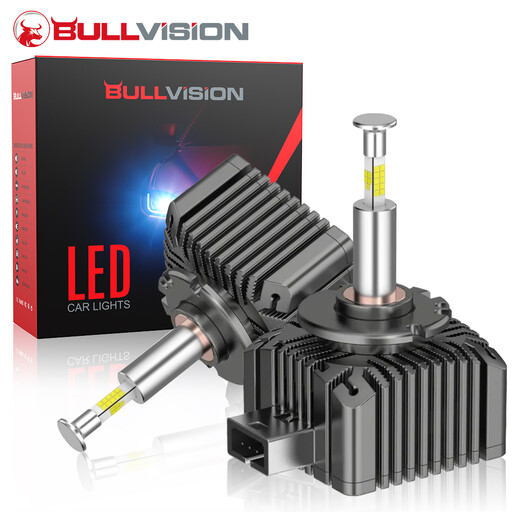
Why It Stands Out: This Bullvision kit is specifically designed as a D2S LED replacement for cars originally equipped with HID/Xenon headlights. Its main advantage is the built-in intelligent driver, making it a CANbus error free solution for 99% of compatible vehicles. According to Bullvision, the bulbs provide a 300% increase in brightness over stock lights and feature a powerful cooling fan rated for a long operational life.
Pros:
Who is it for?: Owners of European and Japanese cars (e.g., Audi, BMW, Lexus from 2000-2015) with factory D2S/D2R HID systems who are seeking a brighter, whiter light and want to avoid CANbus compatibility issues.
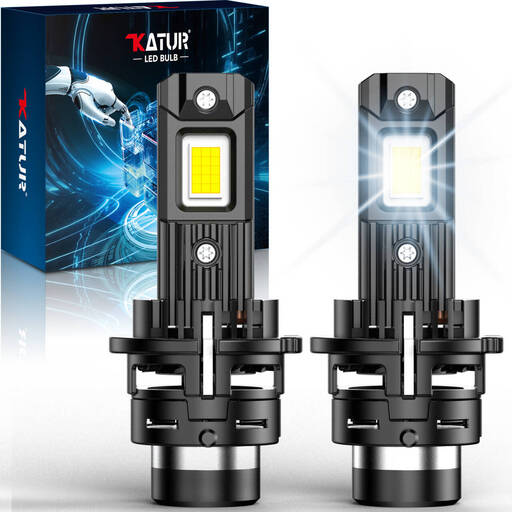
Why It Stands Out: For those prioritising sheer light output and instant performance, this KATUR D2S bulb is a compelling option. It features a 6500K white colour temperature for a very crisp, cool light. The manufacturer highlights its 0.01-second instant start-up, eliminating the warm-up delay common with older HID bulbs. Its 1:1 design aims to make the switch from HID to LED as simple as possible.
Pros:
Who is it for?: Drivers looking for a very bright car headlight bulb to replace their D2S HIDs, who value immediate, full-intensity light the moment they switch on their headlights.
The right lighting solution depends entirely on your vehicle's specifications and your personal preferences. If the products above are not the right fit, or if you are looking for a different bulb type, there are many other choices available.
Explore our full range of automotive lighting solutions on our 2D lamp category page to find the perfect fit for your vehicle.
1. Are LED headlight conversion kits legal for road use in the UK? The legal status of aftermarket LED bulbs is a key consideration. UK regulations require that headlight bulbs match the technology the headlamp unit was designed for. This means fitting an LED bulb into a housing designed for a halogen bulb is not compliant for road use and may result in an MOT failure. It is the vehicle owner's responsibility to ensure their car complies with all current DVSA regulations and is roadworthy.
2. Will I get a dashboard error after installing LED headlights? This is possible on vehicles with a CANbus system. The system's lower power detection may trigger a "bulb out" warning. To prevent this, it is advisable to choose an LED headlight conversion kit that is advertised as CANbus error free or includes the necessary decoders to function correctly with your car's electronics.
3. What is the difference between 6000K and 6500K light? Both colour temperatures produce a modern, cool white light that is a significant departure from the yellow of halogen bulbs. 6000K is generally considered a pure, neutral white. 6500K has a slightly cooler, more noticeable blue tint. The choice between them is largely a matter of aesthetic preference, as both offer excellent clarity for night-time driving.