
24/7 Customer Support

Free returns

Same-day & Next-day Delivery

Quality Guaranteed

Unlock Your Welcome Offers: FREE Delivery | Up to 80% OFF | Free 30-day JoyPlus trial
Download the APP
Replacing worn or dim car headlight bulbs can improve visibility and refresh the appearance of your vehicle, but choosing the wrong product may create more problems than it solves. LED headlight bulbs are available for many halogen and HID applications, including H7, HB4 9006, H15, HIR2 9012, D1S, D2S, D3S and D4S fittings.
The key is to look beyond impressive lumen figures. The correct bulb type, beam positioning, electrical compatibility and road-use suitability matter just as much.
A plug and play LED bulb may connect directly to the original socket, but that does not guarantee compatibility with every vehicle. Headlight housings vary in available space, retaining clips, dust-cap clearance and polarity.
Always check:
For example, an H7 LED bulb is not interchangeable with an H15 LED bulb, even if both are used in some headlamp assemblies.
Large lumen numbers do not automatically mean a better beam. Light distribution depends on the LED chip position, reflector or projector design and the bulb’s alignment. An incorrectly positioned bulb can produce glare for other road users while leaving dark areas on the road.
Claims such as “600% brighter” or “800% brightness” should therefore be treated as manufacturer or seller specifications rather than a guarantee of real-world illumination in every vehicle.
CANbus error-free bulbs are designed to reduce dashboard warnings, flickering or bulb-out messages. However, vehicle electrical systems differ, and some sensitive models may still need a separate decoder or resistor.
Check whether the product includes an integrated driver and whether additional CANbus equipment may be required before ordering.
Start with the fitting, not the colour temperature. Common replacements include:
D1S and D1R, or D2S and D2R, should not be assumed to be interchangeable. The “S” and “R” versions relate to different optical applications, so match the original marking carefully.
A suitable LED replacement should place its light-emitting points in a position comparable with the original filament or HID light source. The bulb should lock firmly into the holder and sit at the correct rotational angle.
After installation:
A straightforward installation does not remove the need for correct alignment.
Many buyers search for 6500K xenon white headlight bulbs because the cool white appearance looks noticeably different from traditional halogen light. However, colour temperature is a visual specification, not a direct measure of brightness or legality.
Cooling is also important. LED bulbs may use an aluminium body, heat sink or high-speed fan to manage operating temperature. Confirm that the rear of the bulb has enough room and that the fan will not be obstructed by the dust cover.
Some listed products state a lifespan of up to 60,000 hours. This is a product specification, not a promise that every bulb will last that long in every vehicle. Heat, vibration, moisture and voltage variation can affect service life.
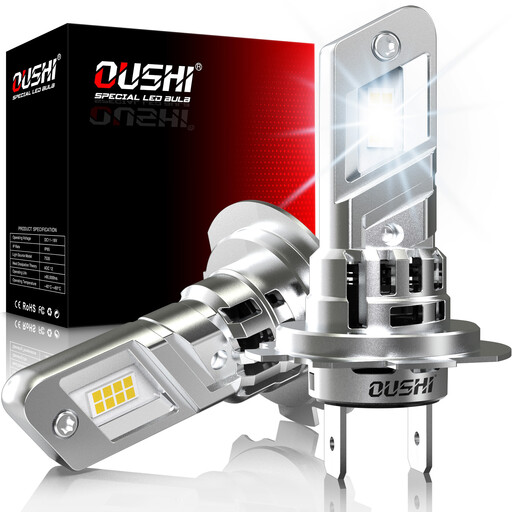
Why This Fits Their Persona: A practical option for drivers whose vehicle uses H7 halogen bulbs and who want a direct replacement with a compact form.
Its listed 1:1 mini halogen design and integrated CANbus system address common concerns about bulky installation and warning messages, although vehicle-specific checking remains necessary.
6500K colour temperature; pair supplied with integrated cooling fan and no external driver listed.
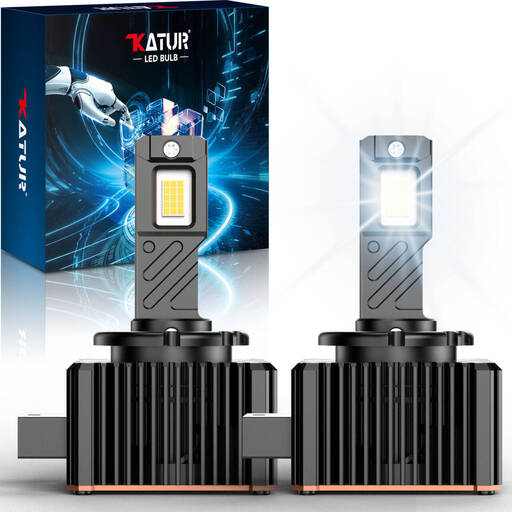
Why This Fits Their Persona: Intended for drivers replacing compatible HID bulbs who want a 6500K appearance and a compact replacement format.
The listing clearly states that it is for HID assemblies only, helping prevent an incorrect halogen-to-HID application.
Built-in intelligent driver; aluminium construction and cooling fan listed; supplied as a pair.
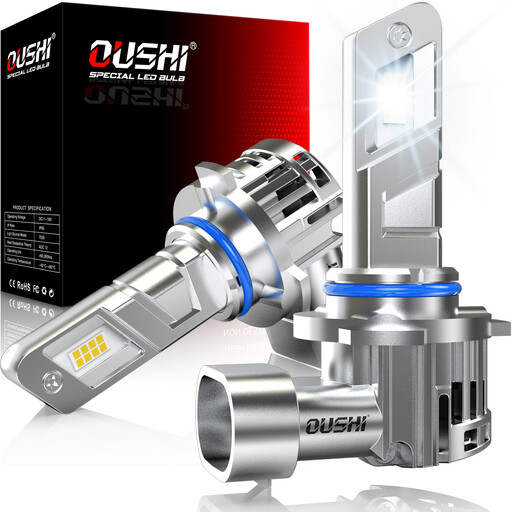
Why This Fits Their Persona: Suitable for drivers with HB4 or 9006 fittings who regularly drive at night and require a replacement designed for continuous vehicle use.
The product information identifies the HB4/9006 fitting, cooling fan and possible need for an additional decoder on sensitive vehicles.
1:1 mini format; 6500K colour specification; CANbus system and aviation-aluminium housing listed.
We have compiled a complete, real-time list of products that fully satisfy these strict selection criteria and UK safety regulations.
Before fitting car headlight replacement bulbs, check the vehicle handbook and the relevant UK road-use requirements. A bulb that physically fits may still produce an unsuitable beam pattern in a particular headlamp housing.
It is sensible to:
If the vehicle uses a factory HID system, choose a compatible D-series replacement rather than assuming an H-series LED bulb will work.
Legality can depend on the vehicle, headlamp housing, bulb approval and beam performance. Check the product documentation and current UK requirements before use on public roads. If the conversion affects the beam pattern or causes glare, it may be unsuitable regardless of its connector type.
LED products are often marketed with longer service-life figures, and many listings specify up to 60,000 hours. Actual longevity depends on heat management, weather sealing, electrical conditions, vibration and installation quality.
They can reduce error messages on compatible vehicles, but no universal guarantee applies to every car. Some systems may require an additional decoder. Check the vehicle model and product guidance before purchase.