
24/7 Customer Support

Free returns

Same-day & Next-day Delivery

Quality Guaranteed

Unlock Your Welcome Offers: FREE Delivery | Up to 80% OFF | Free 30-day JoyPlus trial
Download the APP
Replacing tired halogen lamps can improve the appearance and illumination of a vehicle, but choosing LED headlight bulbs is not simply a case of selecting the highest lumen number. The correct socket, beam pattern, cooling system and vehicle electronics all affect whether a replacement works properly.
For UK drivers, there is also a practical legal consideration: a bulb must be suitable for the vehicle’s headlamp housing and must not create excessive glare. Always check the vehicle handbook, the bulb marking and the latest MOT requirements before fitting an LED retrofit. If the beam cannot be aligned correctly, a complete approved headlamp assembly may be more appropriate.
Listings may advertise figures such as 30000 lumens, but this number does not automatically indicate a well-controlled beam. Poorly positioned LED chips can scatter light, create dark areas or dazzle other road users. Compare the bulb’s chip placement, adjustable collar and compatibility with the original reflector or projector.
A correctly aligned 1:1 halogen replacement may produce more useful road illumination than a higher-rated bulb with an unsuitable design.
A plug-and-play car bulb should match the original socket and connector, but modern vehicles may monitor bulb resistance and current draw. This can result in a dashboard warning, flickering or rapid flashing after installation.
CANbus error-free LED bulbs include decoding circuitry intended to reduce these issues. However, “compatible with 98%” or “99%” of vehicles remains a listing statement rather than a guarantee for every model. Sensitive vehicles may still need an additional decoder or resistor.
LEDs generate heat around the chip and driver. A turbo cooling fan, copper heat-transfer ring or aluminium housing can help manage operating temperature, but the fan must have enough clearance inside the headlamp housing. A bulb that fits the socket may not leave sufficient room for its fan, external driver or dust cap.
Check the physical dimensions and whether the replacement preserves the headlamp’s waterproof seal before ordering.
Start by removing the original bulb or checking the vehicle’s manual. Common choices include:
Do not rely on a similar-looking connector. H11, H8 and H9 may share some physical characteristics, but the vehicle’s wiring, retainer and lamp function still need checking.
A 6000K xenon white bulb generally gives a neutral cool-white appearance, while 6500K cool white appears bluer. Higher colour temperature is not automatically brighter and can be less comfortable in rain, mist or spray.
For frequent motorway, rural or winter driving, prioritise a controlled beam and reliable alignment over a bluer colour. After fitting, test both dipped and main beam and check for uneven illumination or glare.
Look for a compact aluminium body, adequate heat dissipation and a driver that suits the vehicle’s voltage. Some products specify 9–32V or DC11–18V, while others are designed for 12V systems.
A fan-cooled bulb may offer more thermal headroom than a passive design, but it introduces a moving part and requires clearance. Also check whether the product has an external driver, built-in decoding or a non-polarised connector. These details affect installation time and the chance of needing extra components.
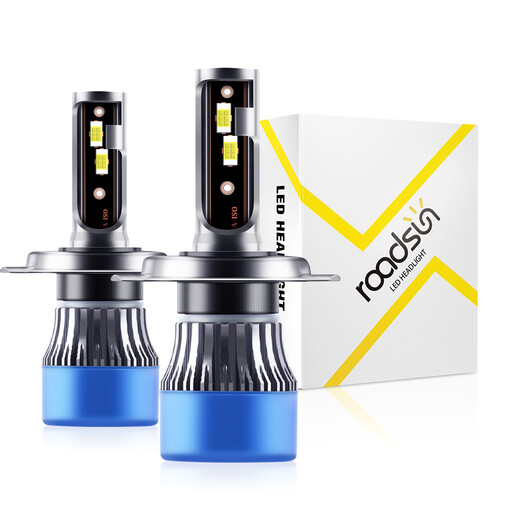
Why This Fits Their Persona: A practical option for drivers, motorcyclists and van users whose vehicle uses one H4 socket for both main and dipped beam.
The listing identifies the H4/9003/HB2 connector, integrated main and dipped beam and a 360° adjustable base, helping buyers check fit and alignment before installation.
The product listing specifies 6000K light, a cooling fan, IP67 protection and a non-polarised plug.

Why This Fits Their Persona: Suits car owners who want a compact H7 upgrade with stated CANbus support and a direct-fit design.
Its listing states a 1:1 mini size and built-in CANbus system, while also warning that some sensitive vehicles may require an additional decoder.
The product specifies 30000 lumens per pair, a 6500K colour temperature and a high-speed cooling fan.
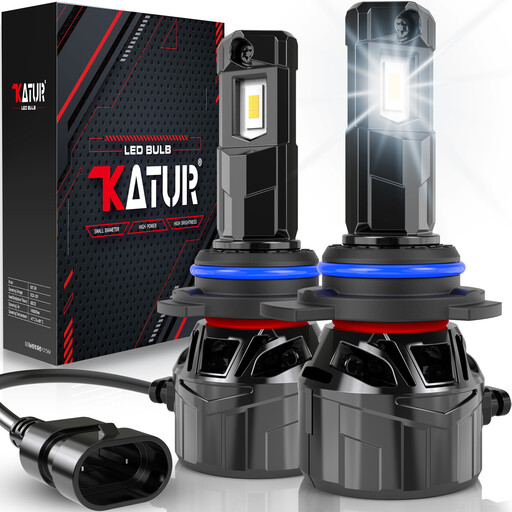
Why This Fits Their Persona: Designed for drivers covering long distances who need HIR2 compatibility, compact dimensions and an active cooling system.
The listing identifies the 9012 HIR2 socket, 1:1 halogen dimensions and CANbus decoding, while noting that sensitive vehicles can still show errors.
The listed specification includes a 16,000RPM turbo fan, copper heat-transfer ring and 9–32V operating support.
We have compiled a complete, real-time list of products that fully satisfy these strict selection criteria and UK safety regulations.
Legality depends on the bulb, vehicle, headlamp approval and how the light performs once installed. A retrofit that causes glare or fails to produce a compliant beam may create MOT or road-use issues. Check current UK requirements and use a qualified garage if uncertain.
Product listings commonly state operating lives between 50,000 and 60,000 hours, but actual service life can vary with heat, voltage, vibration, moisture and daily use. Good ventilation and correct installation are important.
They are designed to reduce error messages, flickering and bulb-out warnings, but they do not guarantee compatibility with every vehicle. Sensitive electrical systems may need an external CANbus decoder, so retain the original bulbs until the replacement has been fully tested.