
24/7 Customer Support

Free returns

Same-day & Next-day Delivery

Quality Guaranteed

Unlock Your Welcome Offers: FREE Delivery | Up to 80% OFF | Free 30-day JoyPlus trial
Download the APP
Replacing halogen lamps with LED headlight bulbs can change the colour, appearance and perceived brightness of your vehicle’s lighting. However, choosing purely by a large lumen figure or a low price can lead to poor beam control, dashboard errors or a bulb that does not fit beneath the headlamp dust cover.
This guide from the Joybuy Product Recommendation Officer focuses on the practical checks UK drivers should make before buying.
Listings may advertise figures such as 30000LM LED bulbs or “600% brighter”. These figures are usually stated for a pair and may represent a maximum output rather than continuous, measured illumination on the road. A high number does not automatically mean a well-shaped beam.
The position and spacing of the LED chips are also important. If they do not sit in a similar location to the original halogen filament, the resulting beam may be scattered, creating glare for other road users while failing to illuminate the road evenly.
A bulb fitting is not universal. H1 LED headlight bulbs, H4 LED headlight bulbs, H7 LED headlight bulbs, H8, H9, H11, HB3 9005, HB4 9006 and HIR2 9012 bulbs all use different bases and applications.
Even when the fitting is correct, the rear of the bulb may be too large for the housing. Cooling fans, heat sinks and external drivers can also interfere with the dust cap or wiring.
CANbus LED bulbs include electronics intended to reduce flickering, bulb-out warnings or radio interference. They do not guarantee error-free operation in every car. Some vehicles monitor current very closely and may still need an additional decoder or resistor.
Always check the vehicle handbook, original bulb marking and seller compatibility guidance. If a retrofit changes the approved lighting arrangement, check its suitability for road use, MOT requirements and your insurer before installation.
Remove the original bulb or consult the vehicle handbook before ordering. Check both the fitting code and function:
Also check whether you need high beam and low beam LED bulbs, dipped-beam bulbs, fog-light bulbs or daytime-running-light replacements.
6000K LED headlight bulbs and 6500K xenon white bulbs produce a cool white appearance. This can look cleaner than the warmer tone of many halogen lamps, but colour temperature is not the same as brightness or beam quality.
A very cool light may offer less visual contrast in rain, mist or dirty conditions than a slightly warmer source. For UK driving, prioritise correct beam alignment, suitable light distribution and legal compliance over colour alone.
LEDs convert electrical power into light and heat. Look for practical cooling features such as an aluminium housing, heat sink, copper components or a fan. Fan-equipped designs can be effective in compact housings, but they add a moving part and should not foul the dust cover.
Useful specifications to compare include:
For interior lighting, car interior T10 W5W LED bulbs are a separate purchase category. Confirm the T10, W5W, 501, 194 or 168 designation, polarity and available space before fitting.
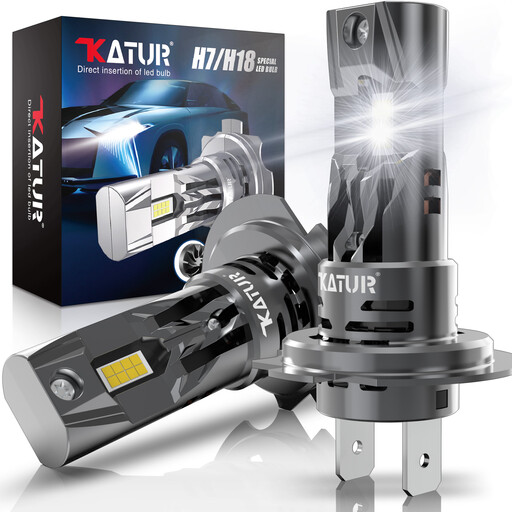
Why This Fits Their Persona: A compact option for drivers replacing a confirmed H7 halogen fitting without wanting external wiring or a separate driver.
The listed 1:1 mini size and plug-and-play design address common space and installation problems. Its CANbus-ready specification still requires vehicle checking.
6000K colour temperature, 1:1 size, built-in cooling fan and listed 100W/30000LM output per pair.
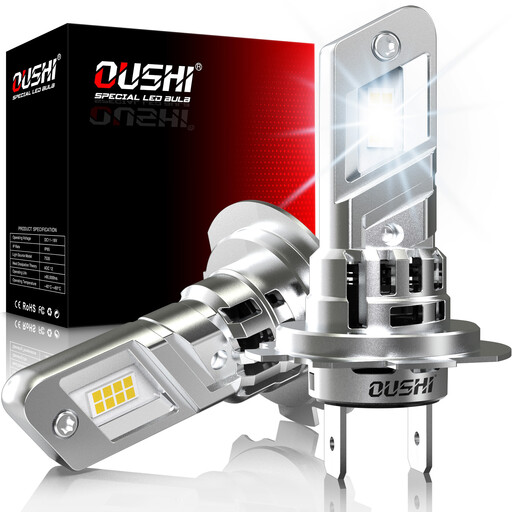
Why This Fits Their Persona: Suits drivers who want a compact H7 replacement with fan cooling and a stated CANbus system for European vehicles.
The product description specifies a 1:1 mini body, no external driver and a high-speed cooling fan, while noting that some sensitive vehicles may need a decoder.
6500K colour temperature, 30000LM stated pair output, aviation aluminium housing and claimed lifespan of up to 60,000 hours.
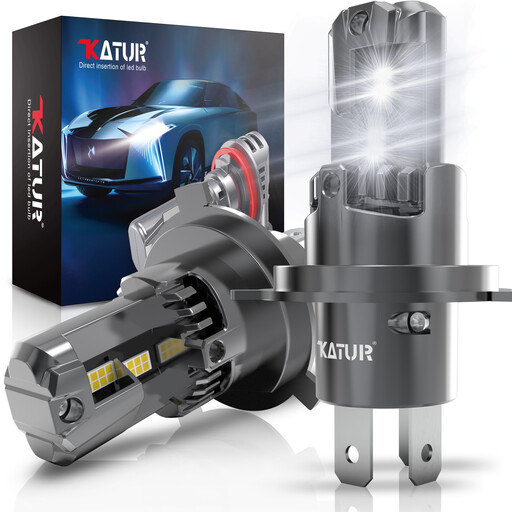
Why This Fits Their Persona: Designed for vehicles using a combined H4 high- and low-beam fitting, including drivers who regularly cover dark rural roads.
It identifies the HB2/9003 high- and low-beam application and lists a 1:1 halogen-style design, reducing the risk of ordering a single-function bulb.
6000K light, stated 100W/30000LM output per pair, aluminium housing, turbo fan and IP65 water-resistance specification.
We have compiled a complete, real-time list of products that fully satisfy these strict selection criteria and UK safety regulations.
Before fitting, switch off the vehicle and allow the original bulb to cool. Avoid touching LED chips or glass components, ensure the sealing ring is correctly positioned and confirm that the bulb sits straight in the reflector.
After installation:
For interior upgrades, T10 W5W LED bulbs are usually simple to install, but polarity can matter. If the bulb does not illuminate, remove it, rotate it and test again.
Legality depends on the bulb, vehicle, headlamp assembly and applicable approval requirements. A bulb that fits physically may still produce an unsuitable beam or fail inspection. Check current UK rules, the vehicle handbook and MOT guidance before using a retrofit on public roads.
Many listings state operating lives of up to 60,000 hours, but actual life depends on heat management, voltage, fan operation and usage. Treat lifespan figures as manufacturer specifications rather than a guarantee.
Not always. Vehicles with bulb monitoring may show an error, flicker or refuse to operate correctly after an LED conversion. CANbus-ready bulbs can help, but some sensitive models require an additional decoder. Check compatibility before purchase and retain the original bulbs in case you need to reverse the conversion.