
24/7 Customer Support

Free returns

Same-day & Next-day Delivery

Quality Guaranteed

Unlock Your Welcome Offers: FREE Delivery | Up to 80% OFF | Free 30-day JoyPlus trial
Download the APP
Upgrading your car's standard halogen bulbs to a modern set of LED headlight bulbs can transform your night-time driving experience. The promise of brighter, clearer light is appealing, but the market is filled with confusing specifications and bold claims. As a UK driver, navigating this can feel like driving in the fog you’re trying to eliminate.
Many find their exciting new purchase leads to disappointment. To help you make a clear-headed choice, we're highlighting the most common pitfalls that catch buyers out and what to look for instead.
To ensure you get a reliable and effective LED headlight conversion kit UK drivers can depend on, focus on these core parameters.
Before looking at any other feature, you must identify the correct fitment for your vehicle. This is usually printed on your existing bulb or listed in your car's owner manual. Common types include:
Installing the wrong fitment is impossible, so confirming this first saves time and hassle. A 1:1 mini size design that mimics the original halogen bulb's dimensions is also highly desirable, as it ensures the bulb will fit inside the headlight housing without modification.
CANbus (Controller Area Network) is the internal computer system that manages your vehicle's electronics. Halogen bulbs draw a specific amount of power, and when a low-power LED is installed, the system can mistakenly believe the bulb has failed, triggering an error. A quality CANbus ready bulb has integrated circuitry to prevent this. For sensitive vehicles (often German brands), an external CANbus decoder or adapter may still be required for flawless operation.
A precise beam pattern is crucial for road safety and legality. The goal is to replicate the sharp cut-off of a halogen bulb, directing light onto the road and out of the eyes of other drivers. Look for bulbs with ultra-thin chip spacing, which helps to create a focused beam without dark spots.
For colour, most drivers prefer 6000K headlight bulbs or 6500K xenon white bulbs. This colour temperature produces a crisp, modern white light that is close to natural daylight, improving contrast and reducing eye strain during night driving.
We've filtered through the options to match different driver needs with products that address the common pitfalls.
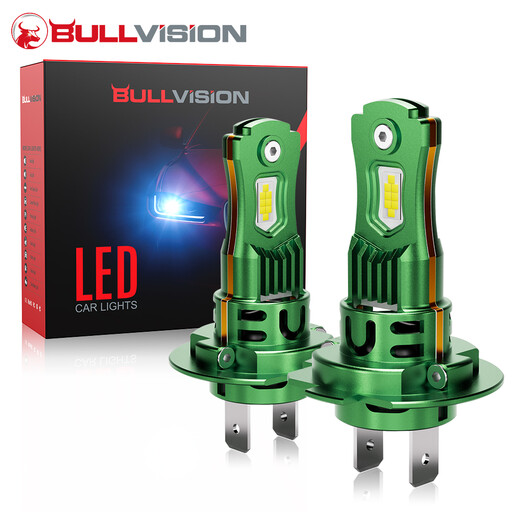
Why This Fits Their Persona: Ideal for the UK driver seeking a straightforward, noticeable improvement over stock halogens without complexity. The focus is on easy installation and reliable daily performance for commutes and town driving.
Its 1:1 size design makes it a true plug and play LED headlight, avoiding installation issues. The built-in CANbus driver is designed for high compatibility, reducing the risk of dashboard errors in many common UK vehicles.
The main benefit is simplicity. No external adapters or drivers are needed, making it one of the easiest upgrades. It features an active fan cooling system to maintain performance.
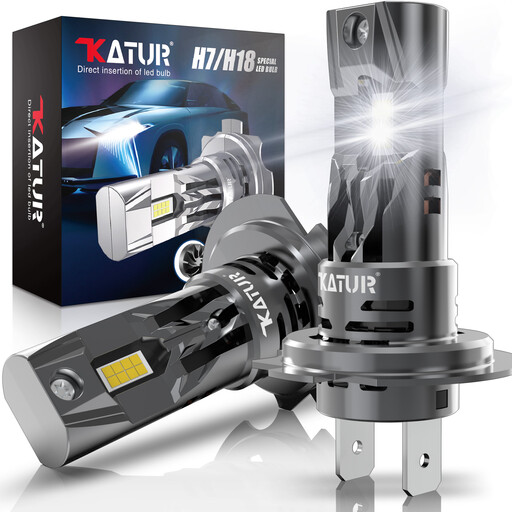
Why This Fits Their Persona: For the driver who prioritises maximum visibility on dark B-roads and motorways. This user wants a significant upgrade in brightness and is looking for a robust solution that can sustain high output.
It tackles the heat dissipation pitfall head-on with a powerful 16,000 RPM turbo fan and a hollow-carved heat sink. The external driver provides a more stable power supply and a more sophisticated CANbus solution, avoiding errors.
High power output (100W per pair) and an active, high-speed cooling system ensure sustained brightness and longevity. The 6000K xenon white colour provides excellent clarity.
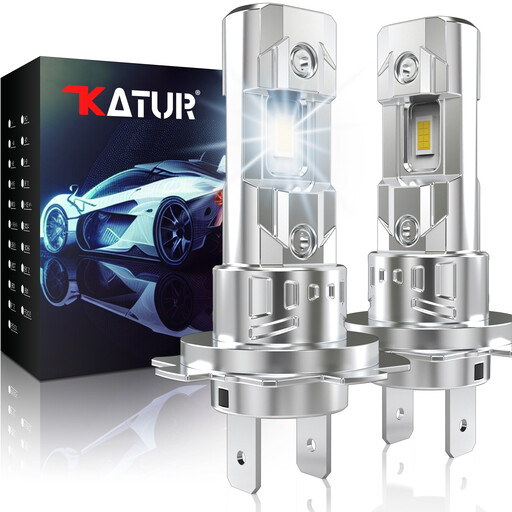
Why This Fits Their Persona: Perfect for owners of cars with tight headlight housings where a bulky, fan-cooled bulb won't fit. This user values silent operation and the reliability of a design with no moving parts to fail.
The fanless design completely eliminates the risk of fan failure, a common point of weakness. Its 1:1 mini halogen design ensures it fits without needing to modify the dust cap, avoiding a major installation headache.
Completely silent operation and an all-in-one, compact body. The aviation-grade aluminium construction provides passive heat dissipation for a long operational life.
We have compiled a complete, real-time list of products that fully satisfy these strict selection criteria and UK safety regulations.
This is a key consideration. For a vehicle to be road legal and pass its MOT, the headlight must produce a compliant beam pattern that does not cause dazzle to other road users. While LED bulbs themselves are legal to sell, fitting them into a headlight unit originally designed for halogen bulbs can sometimes alter the beam pattern. It is advisable to choose high-quality LED bulbs designed to mimic the filament position of a halogen bulb accurately. Always check the latest DVSA guidelines and ensure your headlights are correctly aligned after installation.
No, quite the opposite. LED technology is significantly more energy-efficient than halogen. For a given amount of light output, an LED bulb will draw considerably less power from your car's electrical system. This makes them an efficient upgrade that reduces the load on your alternator and battery.