
24/7 Customer Support

Free returns

Same-day & Next-day Delivery

Quality Guaranteed

Unlock Your Welcome Offers: FREE Delivery | Up to 80% OFF | Free 30-day JoyPlus trial
Download the APP
Upgrading your car's standard halogen bulbs to modern LED headlight bulbs can transform your night-time driving experience. The promise of brighter, clearer light and a sleek, contemporary look is appealing. However, the market is flooded with options, and it's easy to fall into common traps that lead to wasted money, dashboard error messages and even a failed MOT.
As a Joybuy Product Recommendation Officer, my role is to help you navigate this complex market. We'll bypass the marketing hype and focus on the practical details that ensure you get a reliable car headlight upgrade. Here are the key pitfalls to watch out for:
To make a smart purchase, you need to look past the headline claims and focus on three core parameters. Getting these right is non-negotiable for performance, safety and compatibility.
Before you even consider brightness or features, you must identify the correct fitment for your vehicle. This is indicated by a code, such as H7 LED bulb, H4 LED headlight or H11 LED bulb.
Your vehicle's owner's manual is the most reliable source for this information. Installing the wrong fitment type is not an option; it simply will not fit or function correctly.
CANBUS (Controller Area Network Bus) is the internal communications system that allows your car's electronic components to talk to each other. Halogen bulbs have a specific electrical resistance that the CANBUS system monitors. Because LEDs use less power, the system can mistakenly believe a bulb has failed, leading to a warning light.
A quality CANBUS ready LED headlight has built-in resistors or circuitry to mimic the load of a halogen bulb, satisfying the car's computer. For many cars, this is enough. However, for some sensitive models (particularly from German manufacturers), an additional external CANBUS decoder may still be required to fully resolve any errors.
The single biggest factor determining an LED bulb's lifespan is its ability to manage heat. LEDs generate significant heat at their base, and if this isn't drawn away effectively, the LED chips will degrade quickly, losing brightness and eventually failing.
Look for bulbs constructed from aviation-grade aluminium with an active cooling system, typically a high-speed turbo fan. This combination actively dissipates heat, ensuring the bulb operates within its optimal temperature range and reaches its potential lifespan, which can be up to 60,000 hours in some cases. A passive heat sink alone is often insufficient for high-power bulbs.
Instead of a generic list, we've matched specific bulbs to the drivers who will benefit most from their features.

Why This Fits Their Persona: For the UK commuter who needs a reliable, no-fuss upgrade for their daily drive. The focus is on easy installation and a significant, safe improvement in visibility over stock halogen bulbs without requiring complex modifications.
Its 1:1 mini size design directly mimics a standard halogen bulb, avoiding the "plug and play" deception. This ensures it fits directly into the factory housing without needing to cut or modify the dust cap.
The main benefit is the straightforward installation. It combines this with a crisp 6500K xenon white car bulbs colour and an integrated high-speed cooling fan for reliability.
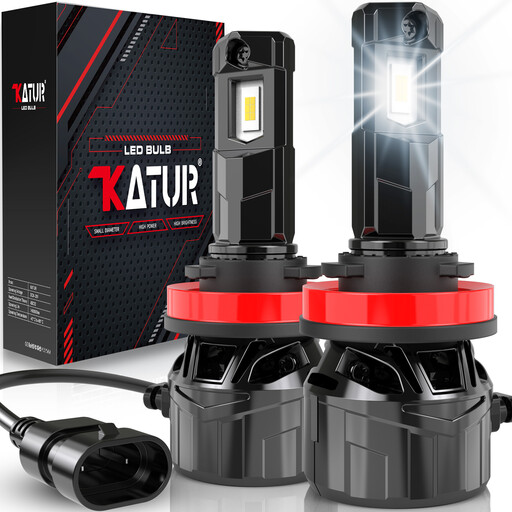
Why This Fits Their Persona: Ideal for the enthusiast or rural driver who prioritises maximum illumination on unlit B-roads. The high power and lumen rating, when properly focused, provide superior range and width for spotting hazards earlier.
It counters the "lumen lie" by pairing its high output with a robust cooling system. The 16,000RPM turbo fan and copper tube design ensure the bulb can sustain its brightness without overheating and failing prematurely.
The combination of high power (120W per pair) and an efficient thermal management system delivers sustained high performance for those who need the most light possible.
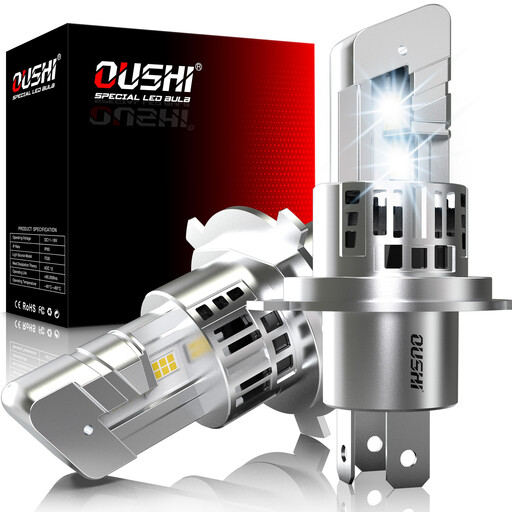
Why This Fits Their Persona: This is for the owner of a newer vehicle, especially a European brand, whose primary concern is avoiding electronic conflicts. This H4 dual-beam bulb is built with sensitive onboard systems in mind.
It directly tackles the "error-free" myth by incorporating what the manufacturer describes as a "latest generation CANBUS system" designed for high compatibility with 98% of vehicles, specifically noting its suitability for European cars.
Its key strength is the advanced CANBUS integration, reducing the likelihood of needing extra decoders. It also offers a dual-beam (Hi/Lo) function in a compact, plug and play car bulbs format.
We have compiled a complete, real-time list of products that fully satisfy these strict selection criteria and UK safety regulations.
This is an important consideration for UK drivers. According to current DVSA guidelines, for a headlight conversion to be compliant for an MOT, the bulb and the headlamp unit it is fitted into must be designed to be used together and carry the relevant 'E' mark approval. Fitting aftermarket LED bulbs into headlight units designed for halogen bulbs is, in most cases, not considered road legal for the purposes of an MOT test. Many of these products are therefore intended for off-road use. Always check the latest government and DVSA regulations before fitting.
Not always, but it's common. If a bulb is advertised as "98% CANBUS ready," there is still a 2% chance your car is in the sensitive minority. A good rule of thumb is that the newer and more premium your vehicle (especially brands like Audi, BMW, Mercedes and VW Group), the higher the likelihood you might encounter an error message. If you do, a simple plug-in CANBUS decoder is usually the solution.
Manufacturers often quote lifespans of 30,000 to 60,000 hours. While impressive, this is a theoretical maximum achieved under ideal lab conditions. In the real world, the lifespan is dictated almost entirely by the effectiveness of the cooling system. A bulb with a powerful fan and quality materials that runs cool will last significantly longer than a poorly cooled bulb, which may fail in a fraction of the advertised time.