
24/7 Customer Support

Free returns

Same-day & Next-day Delivery

Quality Guaranteed

Unlock Your Welcome Offers: FREE Delivery | Up to 80% OFF | Free 30-day JoyPlus trial
Download the APP
Replacing tired halogen or HID lighting can make night driving feel more comfortable, but choosing LED headlight bulbs for cars is not simply a matter of selecting the highest lumen figure. The wrong fitting, unsuitable beam pattern or poor heat management can leave you with wasted money, warning lights or lighting that is unsuitable for public roads.
This guide explains the specifications that matter, the common marketing traps to avoid and which products may suit different UK driving needs.
Listings may advertise figures such as 20,000 or 30,000 lumens. These figures can refer to a pair, peak output or a manufacturer’s stated measurement rather than the light available on the road. A higher number does not automatically mean a better beam.
Look for information about chip placement, beam direction and bulb dimensions. A compact 1:1 design can help position the LED chips similarly to the original filament, although the finished beam still depends on the vehicle’s reflector or projector housing.
H7, H4, H11 and HIR2 9012 bulbs use different bases and electrical connections. HID fittings such as D1S D1R LED bulbs, D3S D3R LED bulbs and D4S LED bulbs are also intended for vehicles originally fitted with compatible HID assemblies, not standard halogen sockets.
Check the owner’s manual, the marking on the removed bulb or the vehicle’s parts catalogue before ordering. “Universal fit” should never replace a proper socket check.
A bulb may connect directly to the factory socket yet still trigger a dashboard warning, flicker or fail to fit beneath the dust cover. Vehicles with sensitive bulb-monitoring systems may need a decoder or resistor, even where a listing describes the product as CANbus error-free or CANbus-ready.
Also check the available space for a fan, heat sink and wiring. A fan-cooled bulb may need more clearance, while a fanless model can be easier to install in a tight housing.
The fitting must match the original bulb exactly. Common options include:
LED fog light bulbs should also be matched to the original fitting. Do not assume that an H11 headlight bulb is automatically suitable for every H11 fog-light housing.
A 6000K or 6500K white headlight bulb produces a cool white appearance, but colour temperature does not measure brightness or beam quality. The important consideration is whether the bulb creates a controlled beam with a clear cut-off and no distracting dark areas.
After installation, check the beam against a wall and have the headlight aim adjusted if necessary. Avoid dazzling oncoming drivers. For use on public roads, check the vehicle, lamp and replacement bulb requirements that apply in the UK; a direct physical fit does not by itself confirm road legality or MOT suitability.
LED chips produce heat at the rear of the bulb. Fan-cooled LED bulbs can move heat away quickly but introduce moving parts and may produce a small operating noise. Fanless LED bulbs are quieter and often more compact, but depend on an aluminium body or heat sink for passive cooling.
Look for stated ingress protection, such as IP65, IP67 or IP68, while remembering that the rating applies under specified test conditions. Check whether the factory dust cover can be refitted, as this helps protect the headlight assembly from moisture and dust.
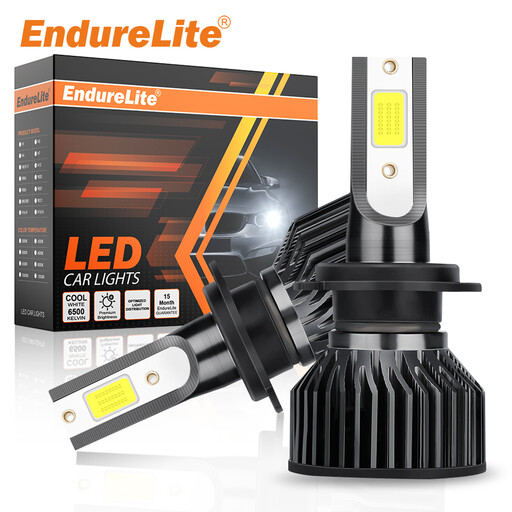
Why This Fits Their Persona: A multi-fitting option for drivers who have confirmed one of the listed socket types and want a straightforward replacement for regular commuting.
The listing specifies 1:1 sizing, a 6000K colour temperature and CANbus-ready electronics, rather than relying only on a brightness figure.
Aluminium construction, IP68 stated protection and plug-and-play installation.
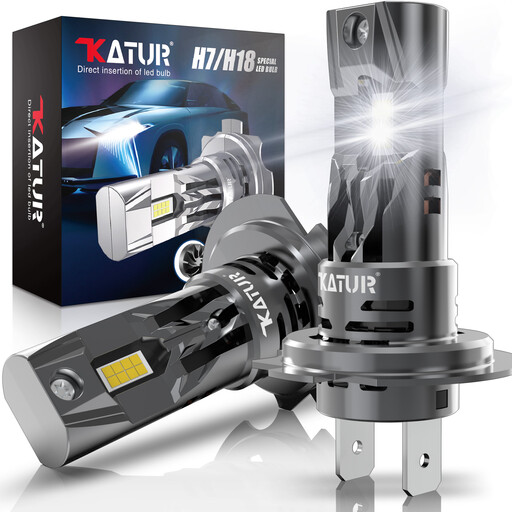
Why This Fits Their Persona: Suitable for H7 users seeking a compact design with active cooling and a cool white appearance for frequent night driving.
Its listed 1:1 mini form can help with limited housing space, while the separate cooling system addresses heat management.
The product listing states a 16,000RPM fan, 6000K colour temperature and an external smart driver.
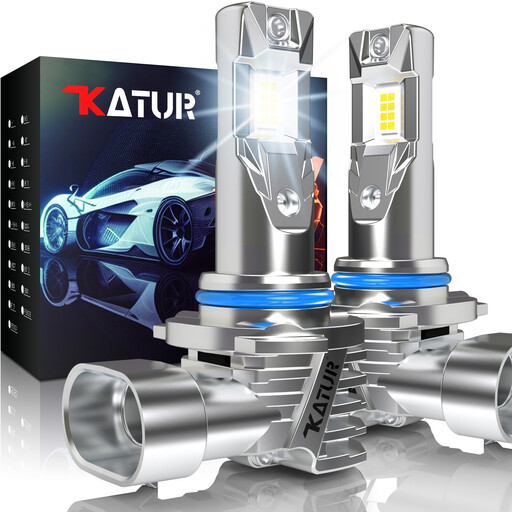
Why This Fits Their Persona: Designed for drivers whose vehicle specifically uses HIR2/9012 bulbs and who regularly travel on rural or poorly lit roads.
The fanless construction avoids fan failure and noise, while the mini design is intended to leave space beneath the dust cover.
The listed specifications include 6000K white light, 80W per pair and an all-in-one design without an external driver.
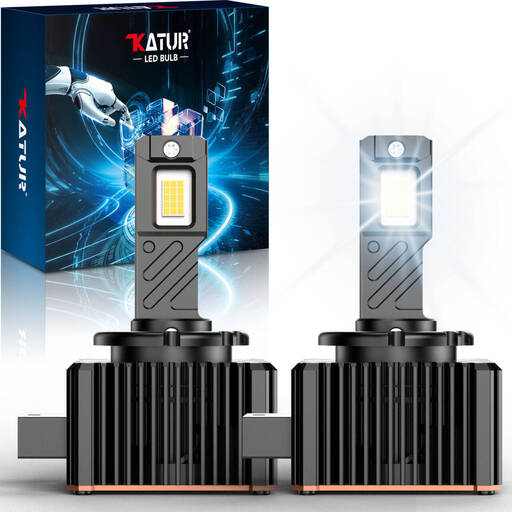
Why This Fits Their Persona: A targeted option for owners replacing compatible D1S or D1R HID bulbs without changing to a halogen-based fitting.
The listing clearly states that it is for HID headlight assemblies only, helping prevent an incompatible halogen purchase.
The product details specify 6500K white light, a built-in cooling fan and 1:1 plug-and-play installation.
For interior upgrades, car interior T10 W5W LED bulbs are commonly used for map, dome, number-plate and courtesy lights. Confirm the length and polarity, as some LED designs need to be rotated in the socket.
We have compiled a complete, real-time list of products that fully satisfy these strict selection criteria and UK safety regulations.
Legality depends on the vehicle, headlamp housing, bulb approval and intended road use. A bulb that fits physically may not meet the requirements for public-road use. Check the relevant UK rules, product marking and MOT implications before installation, and ensure the beam does not dazzle other drivers.
LEDs can produce light using less electrical power than an equivalent halogen design, but the actual wattage varies by product. Check the stated wattage and vehicle compatibility rather than assuming every LED replacement has the same consumption.
Listings may state service lives of 50,000 or 60,000 hours, but real-world life depends on heat, voltage, operating time, moisture and installation quality. Good ventilation, a correctly fitted dust cover and a compatible electrical system all support dependable operation.