
24/7 Customer Support

Free returns

Same-day & Next-day Delivery

Quality Guaranteed

Unlock Your Welcome Offers: FREE Delivery | Up to 80% OFF | Free 30-day JoyPlus trial
Download the APP
Upgrading your car's standard halogen bulbs to modern LED headlight bulbs is one of the most impactful changes you can make for night-time driving. The promise of improved visibility, a sharper look and enhanced safety is compelling. However, the market is flooded with options, and not all are created equal. Many UK drivers find themselves disappointed with bulbs that flicker, fail prematurely or trigger dashboard warning lights.
As the Joybuy Product Recommendation Officer, my role is to help you navigate this complex market. Before you make a decision, let's illuminate the three most common pitfalls that can lead to a frustrating and costly purchase.
You will see many products advertised with staggering brightness figures—300%, 600% or even 800% brighter than halogen. While higher lumen counts can indicate brighter output, this number is meaningless without a well-designed beam pattern. A poorly focused bulb scatters light everywhere, dazzling oncoming drivers and failing to illuminate the road where you need it most. The true measure of a good bulb is not just raw brightness, but a controlled, focused beam that mimics or improves upon the original halogen pattern.
The term plug and play car lights suggests a simple, five-minute job. For many older vehicles, this is true. However, most cars built in the last 15 years, especially European models, use a CANbus (Controller Area Network) system to monitor vehicle functions. A standard LED bulb draws far less power than a halogen one, which can trick the car's computer into thinking the bulb has failed. This results in the dreaded dashboard error message or worse, constant flickering. A truly compatible upgrade requires H11 CANbus ready bulbs or a similar fitment with built-in decoders.
LED chips generate significant heat. Without effective cooling, this heat degrades the chip, causing the light to dim and eventually fail, drastically shortening the bulb's lifespan. Some designs use a fanless, passive heatsink, while others use a high-speed fan. The key is not the method, but its effectiveness. A bulb without a robust, well-engineered cooling system made from materials like aviation-grade aluminium will not deliver the long life headlight bulbs are known for.
To make a smart choice, focus on these three non-negotiable factors.
Before looking at any other feature, you must identify your car's correct bulb fitment. This is usually a code like H7, H4 or H11.
Your vehicle's handbook is the most reliable source for this information. Installing the wrong fitment is impossible without modification and will result in an unsafe beam pattern.
As mentioned, CANbus errors are a major headache. When shopping, look for bulbs specifically labelled as "CANbus Ready" or "Error Free". These have built-in resistors or circuitry to communicate properly with your car's computer. For particularly sensitive systems (often found in German marques like BMW, Audi and Volkswagen), even a "CANbus ready" bulb may require an additional external decoder or anti-flicker LED headlights module. It's a small component that plugs in between the bulb and the car's wiring to ensure stable, error-free operation.
The lifespan of an LED bulb is directly tied to its ability to dissipate heat.
Additionally, check for an IP rating, such as IP67 or IP68. This indicates the bulb's resistance to dust and water, a crucial feature for waterproof car bulbs that can withstand the harsh environment of a UK engine bay.
Based on these practical criteria, we've matched a few options from our catalogue to different types of UK drivers.
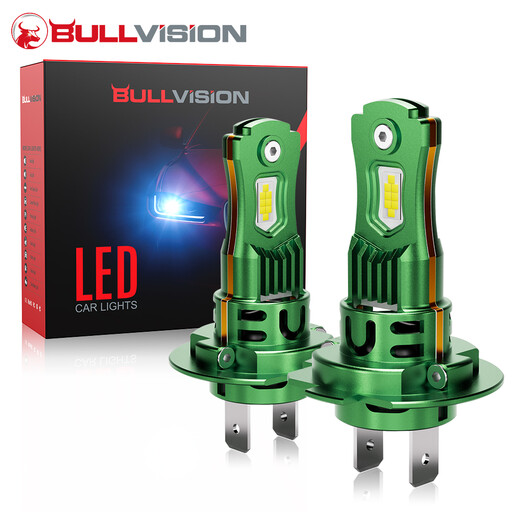
Why This Fits Their Persona: This driver needs a reliable, no-fuss upgrade for their daily drive on B-roads and motorways. They want better visibility than their old halogens without the complexity or cost of a high-performance setup.
Its 1:1 mini size design makes it a genuine plug and play replacement for halogen bulbs, fitting into the housing without modification. The built-in fan provides active cooling to prevent premature failure.
Provides a balanced upgrade with a clean 6000K cool white light and a focused beam pattern. The integrated CANbus driver is designed for high compatibility with most vehicle systems.
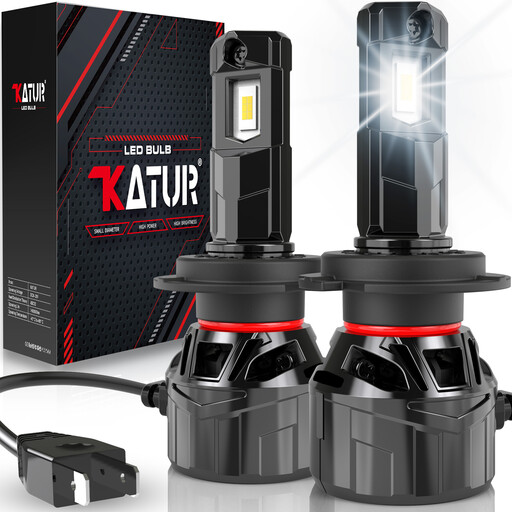
Why This Fits Their Persona: This user prioritises maximum illumination for driving on unlit country lanes. They understand technical specifications and want the highest output, backed by a robust cooling system for sustained performance.
It counters the overheating trap with a powerful 16,000 RPM turbo fan and a copper/aluminium body, an efficient system designed to handle the heat from its high-power 120W output, ensuring a long life headlight bulb.
Delivers exceptionally high brightness (30,000 lumens per pair) for maximum road coverage. The 9-32V wide voltage design also makes it suitable for a range of vehicles, including 24V trucks.

Why This Fits Their Persona: This driver owns a newer vehicle, likely a European brand, and their primary concern is avoiding CANbus errors, flickering and radio interference. They want a seamless upgrade that works with their car's sophisticated electronics.
It directly tackles the "Plug and Play" myth by incorporating what the manufacturer describes as a "latest generation CANBUS system" specifically designed for high compatibility with European vehicles, reducing the risk of errors.
Offers a very bright xenon white bulb replacement look at 6500K. The focus on CANbus compatibility provides peace of mind for owners of cars with sensitive onboard computers.
We have compiled a complete, real-time list of products that fully satisfy these strict selection criteria and UK safety regulations.
This is a complex area. For a vehicle to pass its MOT, the headlight beam pattern must be correct, avoid dazzling other road users and be the right colour. While many high-quality LED bulbs are designed to produce a compliant beam pattern, fitting them into a headlight unit originally designed for halogen bulbs may be a reason for an MOT failure on cars first used on or after 1 April 1986. It is advisable to check the latest DVSA guidelines and always ensure your headlights are correctly aligned after installation to remain safe and considerate to others.
Not necessarily, but it is a strong possibility for many modern cars. Vehicles from brands like Volkswagen, BMW, Audi, Mercedes-Benz and others with complex electrical systems are particularly sensitive. Many LED bulbs are now sold as "CANbus ready," which works for a high percentage of vehicles (e.g., 98-99%). However, if you install them and experience flickering, a dashboard warning light or radio interference, a separate CANbus decoder is the straightforward solution.
The "K" stands for Kelvin, which is a measure of colour temperature. A standard halogen bulb is around 3200K, giving it a warm, yellowish light.