
24/7 Customer Support

Free returns

Same-day & Next-day Delivery

Quality Guaranteed

Unlock Your Welcome Offers: FREE Delivery | Up to 80% OFF | Free 30-day JoyPlus trial
Download the APP
Upgrading your car’s standard halogen bulbs to modern LED headlight bulbs seems like a straightforward way to improve night-time visibility and give your vehicle a fresh look. However, the market is filled with confusing specifications and bold claims that can lead to a frustrating and costly purchase. Many UK drivers find themselves with bulbs that don't fit, trigger dashboard warning lights or fail just a few months after installation.
As a Joybuy Product Recommendation Officer, my role is to help you navigate these challenges. Before you spend your money, let's look at the three most common pitfalls to avoid:
To make an informed choice, focus on these three core parameters. Getting them right is essential for a successful and legal upgrade.
This is the most critical step. Your vehicle's owner's manual will specify the exact fitment code required. These are not interchangeable.
Always confirm your car's required fitment code before adding anything to your basket.
Most cars built after the mid-2000s use a Controller Area Network (CANBUS) system to monitor the vehicle's functions, including the headlights. Standard halogen bulbs have a specific electrical resistance; LEDs use far less power, which can make the CANBUS system think a bulb has failed. This triggers a dashboard error light or causes the lights to flicker.
A CANBUS ready LED bulb has built-in resistors or circuitry to communicate correctly with your car's computer, preventing these issues. For most modern European vehicles, this feature is not just a recommendation—it's a necessity.
Based on these practical criteria, here are a few options matched to different driver needs.
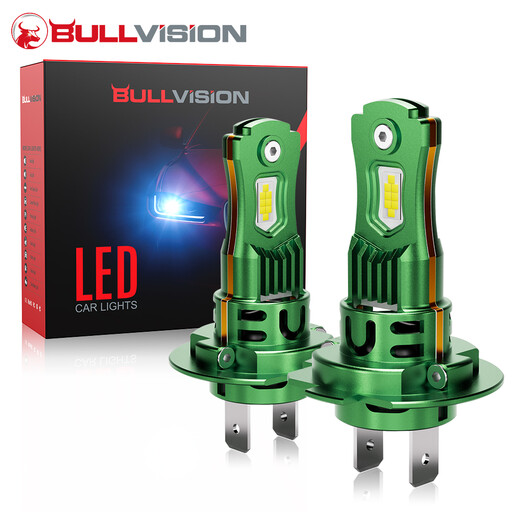
Why This Fits Their Persona: Ideal for the car owner who wants a noticeable, no-fuss improvement over stock halogens. The focus is on easy installation for a common fitment type (H7) without needing to modify the headlight housing.
Its 1:1 mini size design directly counters the "fake plug and play" pitfall. It's built to fit directly into the factory socket without needing extra adapters or leaving the dust cover off.
Features a built-in fan for active cooling to maintain performance and is CANBUS ready for many vehicles, reducing the risk of error codes. (Note: Some sensitive European models may still require a decoder).

Why This Fits Their Persona: For the driver of a modern, often European, car who prioritises high performance, reliability and seamless integration with their vehicle's sophisticated electronics.
This bulb tackles two pitfalls: its high-speed turbo fan provides robust heat dissipation to prevent premature failure and its advanced CANBUS system is designed for high compatibility with complex vehicle computers.
The combination of a 6500K xenon white colour and high lumen output provides exceptional clarity and a wide field of vision. The aviation aluminium body aids longevity.
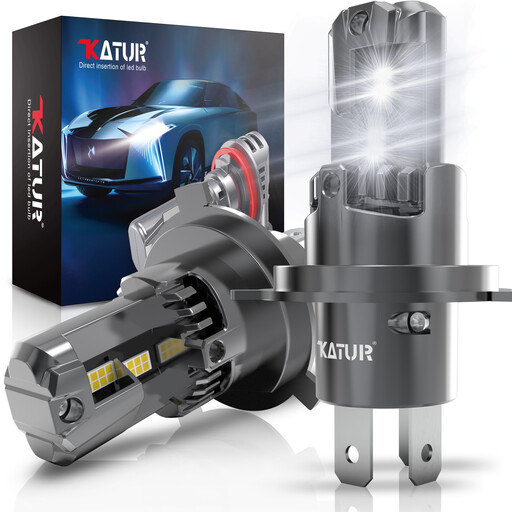
Why This Fits Their Persona: Perfect for owners of vehicles that use a single H4 bulb for both high and low beams. This user wants a single, effective upgrade that handles both functions without complex wiring or multiple purchases.
By being a dedicated Hi/Lo H4 bulb, it avoids the confusion of buying the wrong type. Its 1:1 size and wireless design also ensure it fits easily, honouring the plug-and-play promise.
Provides a precise beam pattern for both dipped and main beam functions from a single unit. The external smart driver helps manage power and CANBUS communication for a longer service life.
We have compiled a complete, real-time list of products that fully satisfy these strict selection criteria and UK safety regulations.
As of recent updates to MOT testing rules, fitting LED bulbs into a headlight unit designed for halogen bulbs is technically an MOT failure. The key factor for passing an MOT is that the headlight must produce a clear and correct beam pattern without causing dazzle. Many aftermarket LED kits are designed to replicate the halogen beam pattern precisely. However, it is important to be aware that their use on public roads may not be compliant with UK regulations. They are often marketed for "off-road" use.
No, quite the opposite. LED bulbs are significantly more energy-efficient than their halogen counterparts. A typical halogen bulb might use 55W of power, whereas an equivalent LED bulb might only use 20-25W to produce a much brighter light. This lower power draw puts less strain on your car's alternator and battery.
If your car has a CANBUS system, installing a standard LED bulb will likely cause issues. The car's computer will detect the lower power consumption and register it as a fault, leading to a persistent "bulb out" warning light on your dashboard. In some cars, it can also cause the headlights to flicker or turn off intermittently. Using CANBUS ready LED bulbs is the correct way to prevent this.