
24/7 Customer Support

Free returns

Same-day & Next-day Delivery

Quality Guaranteed

Unlock Your Welcome Offers: FREE Delivery | Up to 80% OFF | Free 30-day JoyPlus trial
Download the APP
Replacing dim or ageing headlights can improve confidence on unlit UK roads, but choosing the wrong bulb can create fitting problems, dashboard warnings or an unfocused beam. The product page may highlight a large lumen figure, yet that is only one part of a suitable upgrade.
This guide explains what to check before buying LED headlight bulbs, particularly when replacing HID or halogen units with D1S/R, D2S/R, D3S/R, D4S/R, HB3 or 9005 fittings.
A bulb marked D2S, D2R or HB3 is not automatically suitable for every vehicle using that code. The headlight housing, ballast, retaining ring, dust-cover clearance and onboard electronics can all affect compatibility.
D1S LED bulbs, D1R LED bulbs, D2S LED bulbs and D2R LED bulbs are generally associated with HID-style applications, while HB3 and 9005 LED bulbs are commonly used for halogen-type fittings. However, the exact vehicle handbook or existing bulb marking should be checked before ordering.
High advertised brightness does not guarantee useful road illumination. A poorly positioned LED chip can create dark patches, scattered light or glare for oncoming drivers. Look for a 1:1 LED headlight bulb design, narrow chip placement and a shape intended to imitate the original filament or arc position.
A focused beam is particularly important on narrow country lanes, wet motorways and roads with frequent changes in elevation.
Plug-and-play headlight bulbs may install without cutting wires, but HID conversions can involve an external ballast or igniter. Some vehicles may also require a CANbus decoder if the lighting control system detects a different electrical load.
“CANbus error-free bulbs” is best treated as a compatibility feature rather than a universal guarantee. Sensitive vehicles can still display warnings, flicker or refuse to activate the lamps.
Start by identifying the bulb currently installed. Check the marking on the old bulb, the owner’s manual and the vehicle’s fitment information. Relevant options include:
The “S” and “R” versions are not interchangeable assumptions: they relate to the type of headlight optical system and shielding arrangement. A D3S LED bulb should not be selected simply because its base looks similar to a D3R bulb.
A 1:1 design aims to match the original bulb’s physical position and light-emitting geometry. This can help retain the intended beam shape, although the completed installation should still be checked in the vehicle.
Measure the available space behind the headlight before choosing fan-cooled LED bulbs. A large heat sink or external driver may not clear the dust cover. Product descriptions for several options specify a stock-size or mini-size body, which can make fitting easier, but vehicle-specific clearance remains important.
After installation, check both lamps on a level surface. If the beam is uneven, unusually high or scattered, have the headlights aligned rather than relying on brightness alone.
6000K LED headlights generally produce a cool white appearance, while 6500K white headlight bulbs appear slightly cooler and bluer. Colour temperature is visual tone, not a direct measure of brightness. In rain, fog or spray, an excessively blue appearance may offer no practical advantage.
Aluminium housings and built-in fans are commonly used to move heat away from the LED chips. Listings may quote operating lives such as 50,000 or 60,000 hours, but these are manufacturer or seller specifications rather than a guarantee of service life in every UK vehicle. Check fan noise, waterproofing information and available space around the lamp.
For HID replacement bulbs, confirm whether the kit is designed to work with the original ballast or requires a direct 12-volt connection. Follow the supplied instructions and disconnect the vehicle lighting system before installation.
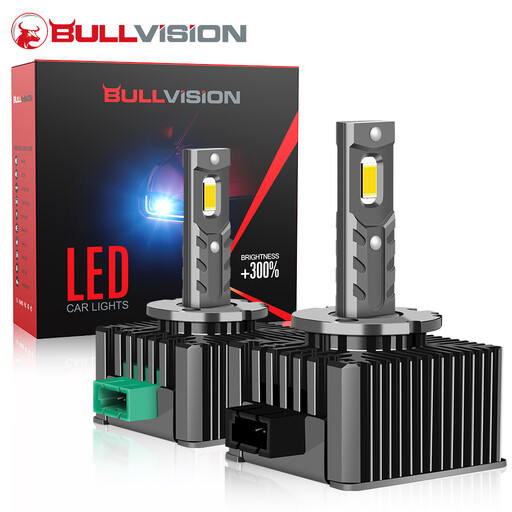
Why This Suits Them: A practical option for drivers who have confirmed a compatible HID socket and want one kit covering several D-series fitments, with a 6000K white output and two bulbs in the pack.
Its listed 1:1 design and CANbus-ready driver address two common concerns: beam positioning and possible electronic warnings. Fitment must still be verified.
D-series coverage, built-in cooling fan, IP68 waterproofing listed and plug-and-play installation.
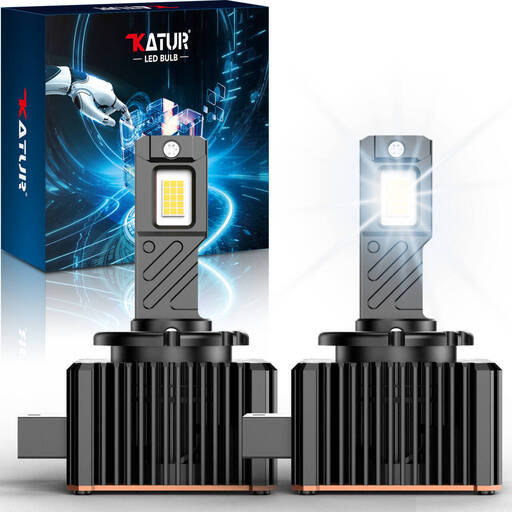
Why This Suits Them: Suited to drivers replacing D3S or D3R HID bulbs who prioritise a high-output specification, rapid start-up and a compact installation without an external driver.
The listing clearly states that it is for HID assemblies only, helping prevent an unsuitable halogen or LED-assembly purchase.
6500K white colour, 1:1 format, built-in 16,000 RPM fan and CANbus-ready intelligent driver listed.
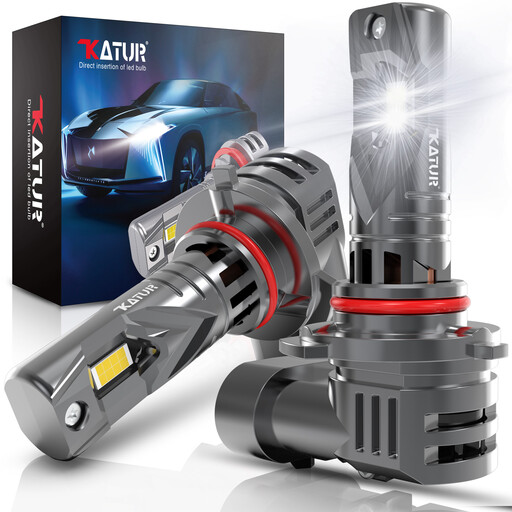
Why This Suits Them: Designed for compatible HB3 or 9005 sockets, this option suits frequent night drivers who want a mini-size halogen replacement with active cooling.
The 1:1 mini format is intended to reduce clearance concerns, while the listed external adaptor and CANbus function address installation and warning-light issues.
6000K white output, 30,000-lumen-per-pair listing, 16,000 RPM fan and IP65 waterproofing listed.
Before fitting, switch off the lights, allow existing bulbs to cool and wear gloves when handling the lamp. Fan-cooled LED bulbs can become hot during operation, so keep cables and covers clear of moving or heated parts.
After installation:
A brighter-looking lamp is not automatically a compliant or properly aimed lamp. Beam control and compatibility should remain the priority.
Some are designed specifically as HID replacement bulbs, including D1S/R, D2S/R, D3S/R and D4S/R formats. They are not automatically suitable for halogen housings or complete LED headlight assemblies. Confirm the original bulb type and whether the vehicle uses a ballast before ordering.
Listings commonly state lifespans from 50,000 to 60,000 hours. These are stated operating-life specifications, not a promise for every vehicle. Heat, vibration, moisture, fan wear and installation quality can affect actual service life.
They may reduce compatibility issues because they include an intelligent driver or CANbus function, but no claim should be treated as universal. Some UK vehicles still need a decoder or different configuration. Check the product instructions and vehicle compatibility before purchase.