
24/7 Customer Support

Free returns

Same-day & Next-day Delivery

Quality Guaranteed

Unlock Your Welcome Offers: FREE Delivery | Up to 80% OFF | Free 30-day JoyPlus trial
Download the APP
Working in poorly lit conditions is not just frustrating; it's a safety hazard. Whether you're a plasterer finishing a wall after sunset, a mechanic deep in an engine bay or a dedicated DIYer in a dimly lit garage, the right lighting is non-negotiable. However, the market for LED job site lights is flooded with options and it's easy to make a costly mistake.
As a Joybuy Product Recommendation Officer, my role is to help you see through the marketing clutter. Before you invest, be aware of these common pitfalls that lead to buyer's remorse:
To ensure you get a reliable tool that performs as expected, focus on these core technical details. They are the true indicators of a quality LED job site light.
The brightness of a light is measured in lumens (lm). For serious work, you need significant output. A 12000lm floodlight, for example, is powerful enough to illuminate a large double garage or a significant section of an outdoor construction site.
Look for a modern 100W LED work light, which offers immense brightness while being far more energy-efficient than old halogen equivalents. Some models also feature dual-brightness settings (e.g., 50W and 100W modes), giving you the flexibility to reduce glare for smaller tasks or conserve energy when maximum brightness isn't needed.
The Ingress Protection (IP) rating is a crucial, two-digit number that tells you exactly how well a device is sealed against dust and water.
An IP65 waterproof work light is certified to be dust-tight and can withstand jets of water from any direction. This means it will operate reliably through rain, sleet and snow, making it a dependable choice for any professional tradesperson.
A truly portable construction light should be easy to transport, set up and position. Key features to look for include:
Based on these practical criteria, we've matched some options to specific user needs.
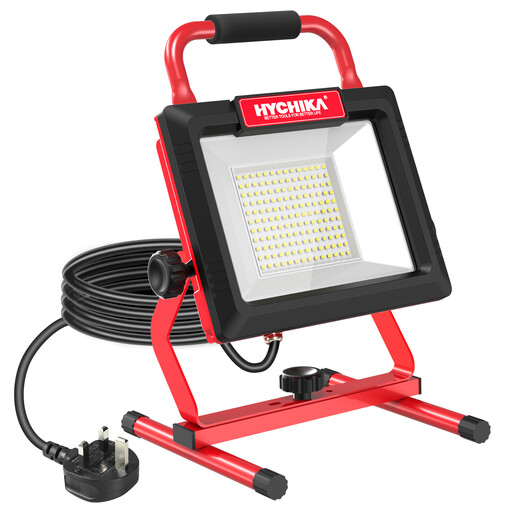
Why This Fits Their Persona: This is for the tradesperson or serious DIYer who needs a single, powerful and reliable lighting solution for everything from workshop tasks to outdoor construction sites. It's a robust workhorse designed for demanding environments.
Its certified IP65 weatherproof rating means it genuinely withstands rain, not just a light mist. The integrated stand is made from aluminium and is part of a sturdy, well-balanced design, avoiding the flimsy stand flaw.
Delivers a powerful 12,000 lumens with a dual-brightness mode for versatility. The 360° rotational design and 2-metre cable provide excellent flexibility on site.
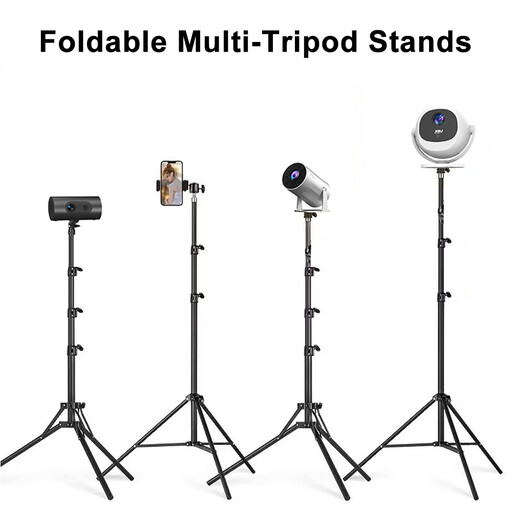
Why This Fits Their Persona: This is for the user who needs maximum height and positioning flexibility, such as a decorator painting a ceiling or a mechanic needing to light an engine bay from above. Note: This is a stand only, for use with a separate light head that has a standard 1/4 inch screw mount.
This directly solves the "poor adjustability" pitfall of many integrated lights. Its telescopic design and 360° gimbal offer far greater positioning control than most built-in stands, ensuring the light is always perfectly aimed.
Provides an impressive adjustable height range from 60cm to 160cm. The aluminium alloy body and triangular support structure ensure stability even when fully extended.
We have compiled a complete, real-time list of products that fully satisfy these strict selection criteria and UK safety regulations.
Running costs for LED lighting are significantly lower than for older technologies. Based on an average UK electricity rate of 25p per kilowatt-hour (kWh), a 100W LED work light would cost approximately 2.5 pence per hour to run at full power. This makes it a very economical choice for extended use in a workshop garage light setting.
High-quality LED chips used in job site lights typically have a very long operational lifespan, often rated for 30,000 to 50,000 hours. For a tradesperson using the light for 20 hours a week, this could translate to many years of reliable service. The lifespan is more often limited by the physical durability of the housing and stand rather than the LED itself.
You can only use an LED work light in the rain if it has an appropriate IP rating. Look for a light that is rated IP65 or higher. This certification ensures the housing is sealed against dust and can withstand water jets, making it safe for use during rainfall. Never use a light with a lower rating (e.g., IP44) or no rating at all in wet conditions, as this poses a serious electrical hazard.