Late-night readers sharing a room
You need to see the notation while keeping direct glare and light spill away from the other occupant. A light you can dim and aim is more useful here than one that lights the whole room.


Choose a dimmable light you can aim at the score without shining it towards the other person. A clip-on stand light suits a movable stand and limited desk space; a clamp lamp suits a secure furniture edge; and a wide-head desk lamp is worth considering when lighting both pages evenly matters most, provided you can control its light spill.
You need to see the notation while keeping direct glare and light spill away from the other occupant. A light you can dim and aim is more useful here than one that lights the whole room.
A compact light attached to the stand or a nearby edge can leave the desk or bedside surface free. Check that its beam reaches both pages of your score and that its clip fits the mounting point.
Uneven lighting or glare can make reading harder. RNIB advises people with sight loss to consider suitable lighting; an adjustable task light lets you position illumination where you need it rather than relying only on a ceiling light.
Choose it when: Your score sits on a stand that you move, or you have little furniture space beside it.
Trade-off: The clip must fit the stand, and a narrow head may leave the edges of two pages dim.
Choose it when: You have a secure desk or bedside edge and want a fixed light aimed down at the music.
Trade-off: The clamp and arm must fit your setup, and the shade needs positioning out of both occupants’ direct view.
Choose it when: Your main difficulty is illuminating a broad, two-page score from a desk position.
Trade-off: Wider coverage calls for careful aiming and dimming when someone else is resting in the room.
| Concern | What to check | Who this matters to |
|---|---|---|
| Disturbing the other occupant | Look for dimming and a head or shade you can aim down at the score, away from direct sightlines. | If I read while someone else rests, I need enough light for the notes without lighting their side of the room; around 42% of consumers put limiting disturbance first. |
| Lighting both pages | Check the stated illumination width or head arrangement. Read any lux figure together with its measurement distance. | When I follow a two-page score, I need to see markings near both outer edges without repeatedly moving the lamp; around 33% of consumers put full-spread coverage first. |
| Mounting in a small space | Check the clip or clamp against the actual stand or furniture edge, and consider where the charging cable will go. | With little surface space beside my stand, I want a light I can mount without a large base; around 25% of consumers make compact placement their first priority. |
An exposed, over-bright light can create glare for the reader and disturb the other occupant.
Aim the lamp at the notation before adjusting brightness, then use only as much light as you need to read comfortably.
A narrow beam may light the centre of a score while leaving markings near the edges harder to see.
Check the head layout or stated coverage against your open score; twin heads or a wider light bar are options to consider.
Colour rendering and colour temperature describe different characteristics from temporal light modulation, or variation in light output over time. The U.S. Department of Energy notes that dimming can affect that variation.
If flicker concerns you, look for information about temporal light modulation for the exact lamp and its dimming settings rather than relying on a CRI figure or daylight wording.
A lamp’s plug or other power arrangement needs to suit where you intend to use it.
Before ordering, check the exact model’s intended delivery region, power arrangement and applicable conformity information.
Its DuoPro Clamp Lamp is a fixed-edge option for directing light onto a desk or score.
Its E-Reading desk-lamp range provides wide-head options for lighting a broad desk or score.
Its music-stand lights are relevant when the score is on a stand rather than a desk.
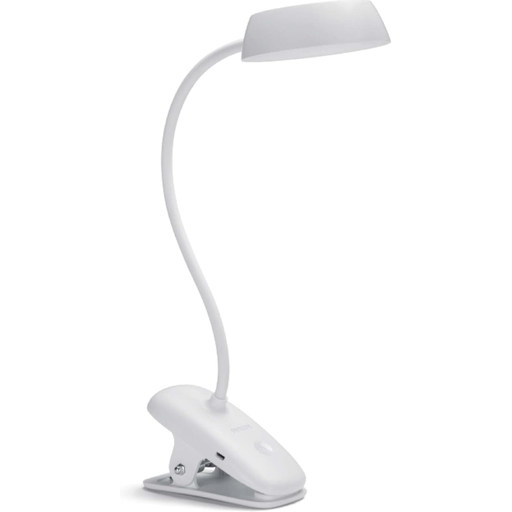
This clip-on desk lamp is relevant if surface space is limited. Check whether its mounting and illumination suit your music stand or desk before treating it as a light for a full score.
 No image available
For a reading area with little spare surface space, the clip-on design may be useful if it fits your chosen edge.
The product name specifies USB rechargeable operation and 3 W. Check the clip dimensions, head movement and coverage across both pages before buying.
Aim the lamp down at the score and keep its light source out of your direct line of sight where possible. Adjust its position before increasing brightness; RNIB also advises considering general room lighting if strong contrasts or shadows make reading uncomfortable.
It can light your score without a desk lamp if it attaches securely and reaches both pages from your normal reading position. Check the clip fit, head layout and brightness controls: a compact head does not necessarily cover the outer edges of a wide score.
No. Colour rendering index, or CRI, describes colour rendition, while flicker concerns changes in light output over time. The U.S. Department of Energy notes that dimming can affect temporal light modulation, so check information for the exact lamp and dimming arrangement if this matters to you.