
24/7 Customer Support

Free returns

Same-day & Next-day Delivery

Quality Guaranteed

Unlock Your Welcome Offers: FREE Delivery | Up to 80% OFF | Free 30-day JoyPlus trial
Download the APP
A well-chosen LED motion sensor night light can make late-night trips to the bathroom, nursery or hallway easier without switching on a bright ceiling lamp. However, product listings often focus on appearance while leaving out details that affect everyday use.
Three common buying traps are worth checking before you order:
Look for the stated motion detection range and light threshold. The Arlgsite rechargeable model, for example, lists a detection range of 3–5 metres and activation at ambient light levels of 20 LUX or below. This type of specification gives you a clearer idea of whether it will work in a hallway, corridor or bathroom at night.
Consider the mounting position carefully. A sensor facing a doorway may detect movement earlier than one placed behind furniture. Avoid covering the sensor, and check that the lamp will not be triggered continuously by movement from a nearby staircase or busy passage.
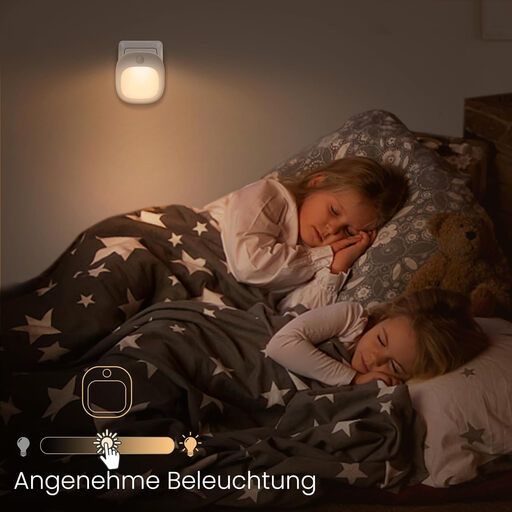
A dimmable night light is more adaptable than a single-output lamp. Five brightness levels allow you to use a lower setting beside a bed and a stronger setting in a hallway or bathroom. A touch dimming night light can also be convenient when you need a small adjustment without searching for a separate switch.
Colour temperature affects the feel of a room:
A model advertised as a 3 colour temperature night light gives you more flexibility, but check whether the temperature can be changed independently of brightness.
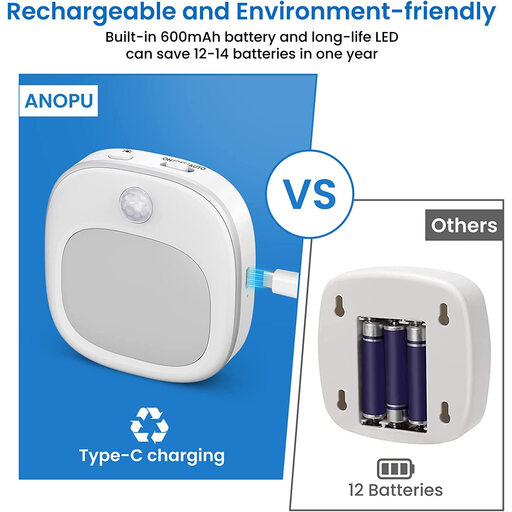
A rechargeable night light should state its battery capacity, charging connection and approximate runtime. The Arlgsite model uses a 500mAh battery and lists up to 10 hours in sensor mode. The VIVREAL sloth lamp has a 1,200mAh battery, USB Type-C charging and up to six hours at maximum brightness.
USB Type-C is useful if your household already uses compatible charging cables, but it is still sensible to check whether a cable and charger are included. Battery-powered models are convenient for shelves and bedside tables, while a plug-in night light avoids routine charging.
For durability, ABS plastic and metal are common materials. Soft silicone can be useful for a decorative bedroom or baby room night light, but keep any electrical product away from water and follow the supplied safety instructions. A bathroom night light should not be placed where it may be splashed or exposed to excessive moisture.
Why This Fits Their Persona: Two lights can cover a bedroom and hallway, or a landing and toilet, without buying separate single units.
Its listing specifies motion detection, five-level dimming and three colour temperatures rather than relying only on a brightness headline.
Two-pack format; ABS and metal construction; 1W SMD LED specification.

Why This Fits Their Persona: The soft silicone sloth design suits a bedside table, nursery or housewarming gift where appearance matters as much as practical lighting.
The listing gives a stated three-hour charging time, battery capacity and maximum-brightness runtime, making charging expectations clearer.
USB Type-C input; three brightness levels; 1,200mAh battery; charging indicator light.
Why This Fits Their Persona: A practical choice for households needing flexible lighting in a baby room, corridor, bedroom or other area without a nearby socket.
Its sensor mode, light threshold, detection range and charging compatibility are stated, helping you assess placement before purchase.
Up to 10 hours in sensor mode; five brightness levels; three colour temperatures; USB charging.
Motion activation is convenient for walkways, but a bedside lamp may benefit more from manual control. The 2 sets of motion capture night lights with touch dimming combine constant-light and sensor modes with stepless touch dimming and a memory function. Their 20LM output and 4,000–4,500K colour temperature are specified for bedroom and bathroom use.
For a plug-in night light, check socket position, voltage compatibility and whether the unit leaves adjacent sockets usable. For a rechargeable model, consider how often it will be used and whether the charging port is easy to access.
We have compiled a complete, real-time list of products that fully satisfy these strict selection criteria and UK safety regulations.
LEDs generally use relatively little power compared with traditional bulbs, but running cost depends on wattage, activation frequency and operating mode. A sensor that activates only in darkness can reduce unnecessary operation. Plug-in models may use a small amount of standby power, while rechargeable models use electricity when charging.
Place it where movement is visible to the sensor, such as near a doorway or along a dark section of corridor. Keep it away from direct splashes, steam-heavy areas and obstructions. In a bathroom, follow the product’s moisture and placement warnings rather than assuming that every bathroom night light is suitable for wet locations.
Charging frequency varies with battery capacity, brightness and the number of activations. Check the stated runtime in the mode you expect to use. A model rated for maximum brightness may last longer in sensor mode or at a lower setting, but actual results depend on household usage.