
24/7 Customer Support

Free returns

Same-day & Next-day Delivery

Quality Guaranteed

Unlock Your Welcome Offers: FREE Delivery | Up to 80% OFF | Free 30-day JoyPlus trial
Download the APP
Choosing LED outdoor floodlights for a driveway, garden or building entrance can appear straightforward: compare wattage, choose a bright model and install it outside. In practice, several products use impressive-looking figures that do not tell the full story. A suitable light must match the size of the area, exposure to UK weather and the way you plan to control or install it.
This guide explains the key specifications to check, common buying traps and practical options for different property needs.
Wattage measures energy consumption, not the amount of light produced. A modern LED may use 20W while producing more usable light than an older halogen fitting with a much higher wattage.
For a more useful comparison, check lumens. For example, a 650-lumen fitting can suit a small entrance or pathway, while a 2400 lumen floodlight is more appropriate for a wider driveway, garden or building perimeter.
The IP rating indicates protection against solids and water, but different ratings offer different levels of protection.
Always check the complete installation instructions rather than relying on the phrase “weatherproof floodlight” alone.
A very bright light aimed towards a neighbour’s windows, pavement or road can create glare and may cause nuisance. A driveway floodlight should provide useful coverage without shining directly into people’s eyes.
Beam angle, mounting height and head adjustment are as important as the lumen figure. A wide 110° beam can spread light across a large area, whereas a narrower beam may be more suitable for a gate, doorway or specific pathway.
Use the following as a practical starting point, rather than a fixed rule:
The surface colour, mounting position and surrounding obstructions will affect the perceived brightness. A 1500-lumen light mounted too low or behind foliage may cover less area than expected.
Colour temperature is measured in Kelvin (K):
A cool white outdoor light can make movement and objects easier to distinguish, but warmer light may feel more comfortable on patios and near living spaces. Select the colour based on the purpose of the fitting, not simply the highest Kelvin number.
Many wall-mounted security lights are designed for hardwired installation. Before buying, check whether the product includes mounting hardware, a cable, sensor or junction-box compatibility. Existing wiring and the wall material can affect the installation process.
In the UK, mains electrical work should be completed in accordance with applicable wiring requirements. If you are not confident isolating the supply and making secure, weather-protected connections, use a qualified electrician. Disconnect power before installation or maintenance, and confirm that the product’s voltage matches the supply.
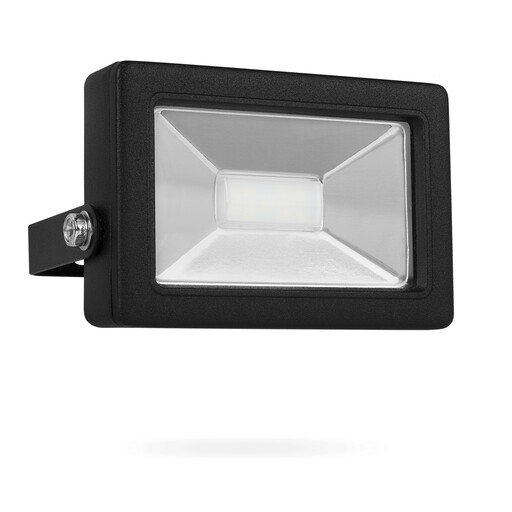
Why This Fits Their Persona: A compact option for UK homeowners who need practical lighting near a back door, shed, garage or small driveway without illuminating the entire garden.
Its specification lists 650 lumens and 4000K light, making the intended coverage clearer than choosing by wattage alone. The IP65 housing is suited to outdoor exposure when installed correctly.
Integrated 10W LED; 650 lumens; IP65 protection; compact 105 × 134 × 38mm housing.
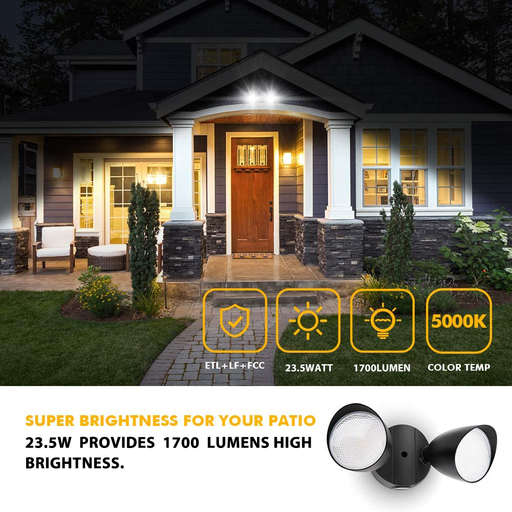
Why This Fits Their Persona: Suitable for property owners who want directional control across a patio, driveway, entrance or garden perimeter rather than one fixed pool of light.
The two independently adjustable heads help target light where it is needed, reducing the need to overcompensate with excessive brightness. Its listed IP54/IP65 weather-resistant specification should be checked against the exact installation position.
Twin-head design; 360° rotation per head; integrated LED; hardwired wall-mount format.
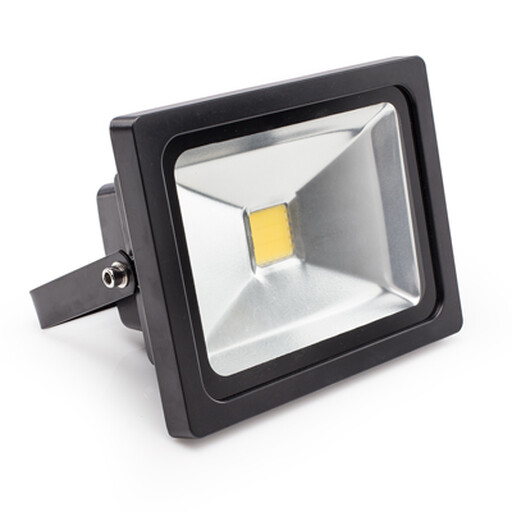
Why This Fits Their Persona: A practical match for landlords, small businesses and homeowners lighting a wide driveway, workshop frontage, parking area or larger garden.
The stated 2400-lumen output is paired with a 110° beam angle, giving buyers two useful indicators for judging coverage instead of relying on a vague “super bright” description.
30W integrated LED; 2400 lumens; 110° beam; IP65 rating; mounting hardware included.
Before ordering or fitting an outdoor LED security light, check:
For more adaptable directional lighting, browse the wider spot lights range.
We have compiled a complete, real-time list of products that fully satisfy these strict selection criteria and UK safety regulations.
Running cost depends on wattage and usage time. For example, a 20W fitting uses 0.02 kWh for each hour it operates, while a 30W fitting uses 0.03 kWh per hour. Multiply this by your electricity tariff and actual operating hours to estimate the cost. Timers, motion sensors or schedules can help avoid unnecessary overnight use where compatible.
An IP65 LED floodlight is designed to resist dust and water jets and is commonly suitable for exposed outdoor mounting when installed according to the instructions. It is not a guarantee against incorrect cable connections, flooding or immersion. Position the fitting so water can drain away, and use appropriately protected electrical connections.
Choose 4000K for balanced everyday visibility, 5000K for a clearer security or task-lighting appearance, and 6400K where a colder, high-contrast light is preferred for larger functional areas. Brightness, beam angle and mounting position should be considered alongside colour temperature.