Hands-and-materials demonstrators
If close craft steps are the focus, glare, hard shadows and changing colour can make materials harder to show. An aimable bi-colour light with a suitable diffusion option gives you more control over the shot.


For a craft explanation filmed at a desk, start with a dimmable bi-colour video panel that you can aim at the work and soften where needed. Choose the output and mounting arrangement around your shot; prioritise a documented fan-free design for close-mic narration or battery operation if the light must move away from a socket. Check the exact listing for power equipment, diffusion and mounting accessories.
If close craft steps are the focus, glare, hard shadows and changing colour can make materials harder to show. An aimable bi-colour light with a suitable diffusion option gives you more control over the shot.
Lighting both your face and the work surface calls for brightness and colour-temperature control. If you record a spoken explanation near the light, consider its documented cooling design too.
If the office doubles as another workspace, check where the light can be mounted and how easily it can be put away. Battery operation or controls you can reach from the desk may matter more than a permanent studio arrangement.
Plan where the camera, work surface and light will sit before comparing panels. That makes it easier to judge whether softness, colour adjustment, a quiet recording setup or portability should lead your choice.
| Concern | What to check | Who this matters to |
|---|---|---|
| Soft light on craft details | Check for dimming and whether suitable diffusion is included or can be fitted. | When hands and reflective materials fill the frame, I want their details visible without harsh glare; around 27% of consumers would put soft detail lighting first. |
| Colour and exposure control | Compare the stated bi-colour range and adjustability, then set the camera’s white balance for the room. | If daylight changes while I film, I need the panel to work with the room light rather than leave my materials looking different between takes; roughly 33% of consumers would prioritise colour and exposure matching. |
| Quiet, repeatable recording | Look for a documented fan-free design and controls or presets you can use from the filming position. | With a microphone near my desk, I want to record speech without the light adding noise or needing frequent adjustments; about 27% of consumers would make a quiet workflow their primary concern. |
| Space and portability | Check the panel’s form factor, mounting arrangement and battery option, including the accessories required. | When I have to clear the desk after filming, I need a light I can position and put away without a permanent setup; around 13% of consumers would put portability and space first. |
A fixed room fitting does not offer the same aimed placement as the video panels described by amaran, Godox and Nanlite. That distinction matters when the camera needs to show both hands and a work surface.
Compare video or photography lights, then check the dimming, colour-temperature adjustment, mounting method and diffusion option of the exact model.
amaran lists softboxes and grids for a documented P60x three-light kit, while Godox describes battery operation for the LDX series as optional. Those details do not establish what comes with an individual listing.
Check the exact bundle’s contents and the compatible power arrangement before planning where the light will stand.
A bare, bright light close to glossy materials can cause glare or hard shadows. Diffusion changes the light reaching the work, so output alone does not settle the choice.
Sketch the camera, desk and light positions, then check that the panel can be dimmed and used with suitable diffusion for that arrangement.
Marking and product-safety requirements do not tell you whether a particular bundle has the power equipment or mounting accessories your workspace needs.
For Great Britain, check the marking and documentation applicable to the specific product, then check its power supply and package contents separately. Northern Ireland arrangements require a separate check.
The P60x represents a higher-output bi-colour panel route for a light positioned around a desk demonstration.
The LDX50Bi is a bi-colour panel to examine when spoken recording and adjustment from the desk are priorities.
The PavoSlim 60B represents a slim bi-colour panel route when the proposed light position has limited clearance.
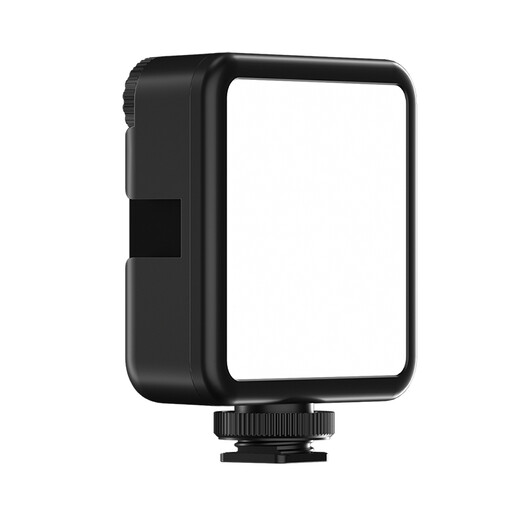
This compact camera light is a portable option for a small filming setup. Before choosing it to light an entire craft demonstration, check whether its output, coverage and cold-shoe mounting arrangement suit your planned shot.
 No image available
Consider this portable camera light if you need adjustable lighting in a setup you put away after filming.
The product name specifies adjustable brightness and colour temperature, a rechargeable 3000mAh battery and a cold-shoe mount. Check its coverage for your hands and work surface, the available colour-temperature range and compatibility with your planned mount.
Choose an aimable video light if you need controlled lighting on your hands and work surface. The video panels documented by amaran, Godox and Nanlite offer brightness and colour-temperature adjustment; check that a prospective listing is a filming light rather than a fixed room fitting.
A bi-colour panel is useful when daylight or other room lighting changes, because you can adjust the panel’s colour temperature. It will not set the camera’s white balance for you, so check the recorded image with the lighting you intend to use.
You need batteries only if your chosen setup relies on cable-free placement. Godox describes NP-F battery operation for the LDX50Bi as optional; check the exact light’s compatible battery type and whether the batteries and charging equipment are included.
No. GOV.UK says CE marking continues to be recognised alongside UKCA under relevant rules for products placed on the Great Britain market, but marking does not confirm a bundle’s power lead or accessories. Check the particular product’s documentation and package; Northern Ireland has different arrangements.
Follow the manufacturer’s power and mounting instructions, keep cables out of the way and allow the fixture to cool before storing it. Godox’s LDX50Bi manual also cautions against using damaged equipment or unsuitable accessories and says the fixture is not ordinary room lighting.