Close-up bookbinding tutorial makers
If you film stitching, folded signatures, adhesive work or cover details, you need to judge material colours on camera while keeping the work visible around your hands.


For close-up bookbinding video, choose an adjustable bi-colour light with documented colour-rendering specifications and a position that keeps your hands and camera clear. A compact fixture is easier to place around a crowded bench; if it must sit farther away or shine through additional diffusion, check that its output remains usable. Confirm the mounting, power arrangement and exact bundle before buying.
If you film stitching, folded signatures, adhesive work or cover details, you need to judge material colours on camera while keeping the work visible around your hands.
When presses, tools and camera supports already occupy the desk, the fixture’s weight, mounting position and power leads affect where you can place the light.
If you record lessons or demonstrations regularly, adjustable colour temperature and brightness help you set up each shot consistently. Remote controls may matter when the setup expands to multiple lights.
Start with the paper and cover materials you need to show, then work out where the light can stand and whether its power arrangement suits the length of your sessions.
| Concern | What to check | Who this matters to |
|---|---|---|
| Material colour | Compare stated CRI and TLCI for the exact light, then film your usual paper and cover materials with a consistent camera white balance. | If paper, thread and cover colours are central to my close-ups, I need to see how they record with my camera; around 36% of consumers put material colour first. |
| Hands and shadows | Check diffusion, dimming and whether the light can sit off-axis without blocking the camera or your hands. | When my hands and tools move over the book, I need the work to remain visible without distracting shadows; roughly 29% of consumers prioritise shadow control. |
| Bench fit and power | Check the fixture’s size, mounting clearance and the exact accessories needed for mains or battery operation. | With limited room around the bench, I need a light I can position without crowding the work; around 21% of consumers make fit and flexible power their primary concern. |
| Repeatable setup | Check how brightness and colour temperature are adjusted, and whether remote control suits a multi-light arrangement. | For recurring lessons, I want to recreate the same lighting without rebuilding the setup each time; approximately 14% of consumers put repeatability first. |
Input wattage does not tell you how much light reaches a book at your planned distance. Output figures also depend on the distance, colour setting and diffusion used.
Compare stated lux figures only under comparable conditions, then check the planned light position and modifier with your camera.
A battery-capable light still needs compatible power accessories before it can run away from a socket.
Check the exact bundle and the required battery, connector and charging arrangements.
For the NEEWER AP150B, the V-Mount battery and D-Tap cable are listed separately.
A stated colour-rendering figure cannot establish how your particular paper, cloth and thread will appear under mixed room light or your camera settings.
Film a white page, a neutral reference and your usual materials, then keep white balance consistent for repeatable shots.
Power accessories and product documentation need to correspond to the particular light and the market where you will use it. Great Britain and Northern Ireland have different product-market arrangements.
Check the seller, instructions, power arrangement and model-specific conformity information for the exact variant.
The P260C Pro illustrates a compact bi-colour option for a close-up workspace.
The AP150B is a higher-output option to assess for a fixed filming workstation.
The Astra IP 1x1 is a larger fixture to consider when location conditions and production controls matter.
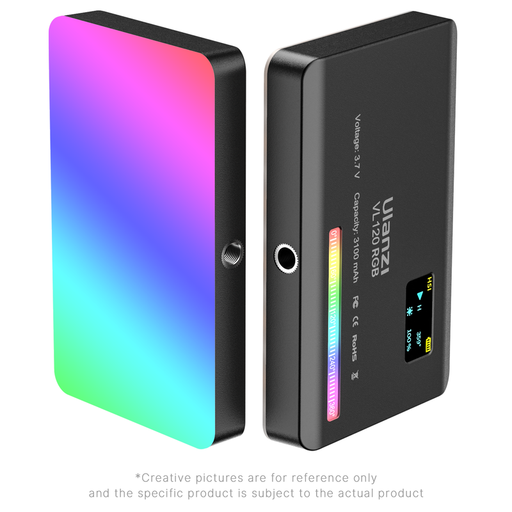
This compact camera video light is a choice to assess for a small bookbinding bench. Check its diffusion, mounting and output at your intended distance before using it in place of a larger panel.
 No image available
A compact camera light to consider where space around the bookbinding bench is limited.
The product title states a 2500–9000 K range, CRI ≥95 and an integrated 3100 mAh battery.
Before relying on it for hand-and-tool shots or longer sessions, check diffusion, dimming, output at your filming distance, mounting and battery runtime for the exact listing.
For close-up bookbinding footage, check documented colour-rendering specifications and whether the light provides usable illumination at your planned distance. Wattage alone does not measure light on the book, while a stated CRI or TLCI figure does not replace filming your actual materials with your camera.
Place a diffused light off-axis so it illuminates the work without obstructing your hands or camera. Godox describes the P260C Pro’s diffuser as softening light; if you add diffusion to another fixture, check that enough light still reaches the book.
Yes, if the particular light has a compatible portable-power arrangement and the accessories you need. NEEWER UK lists V-Mount operation for the AP150B, but its battery and D-Tap cable are sold separately; check the connector, charging arrangement and expected runtime for your setup.
Check the exact model’s supplier information, instructions, power arrangement and applicable conformity documentation. GOV.UK says the Electrical Equipment (Safety) Regulations 2016 set requirements before electrical equipment is placed on the Great Britain market, and that CE marking continues to be recognised alongside UKCA marking in relevant Great Britain product regimes. Northern Ireland has different arrangements; a generic listing image cannot establish the position for your particular light.