What matters when choosing?
Choose the type of light by what you film: white-light demonstrations and recurring coloured-light work call for different controls. Then check how the exact panel will fit, mount and light your tabletop set.
Bi-colour LED panel
Choose when: You mainly film products in white light and need to adjust its colour temperature as room light changes.
Trade-off: Bi-colour control does not provide the coloured-light modes available on RGBWW panels.
RGBWW LED panel
Choose when: Coloured backgrounds or creative effects are a regular part of your demonstrations alongside white-light shots.
Trade-off: Extra colour controls do not replace diffusion or careful placement when reflections and spill are the problem.
| Concern |
What to check |
Who this matters to |
| Consistent product colour |
Check the exact model’s stated CRI, any TLCI rating and its colour-temperature range. Plan how to limit competing room or window light. |
If I show fabric shades or packaging, I need the colour to remain consistent between shoots; around 33% of consumers put product-colour consistency first. |
| Reflections and spill |
Check whether diffusion and a grid are included or compatible, and whether their mounts will fit your setup. |
With glossy products near a backdrop, I need to shape the light without brightening the whole wall. Reflection and spill control come first for around 33% of consumers. |
| White-light adjustments |
Check the dimming and colour-temperature ranges; confirm whether the exact model can save settings if you need presets. |
If I film at different times of day, I want to adjust white light and return to a familiar setup. Around 20% of consumers prioritise that workflow. |
| Placement and power |
Check dimensions, mounting options, the supplied power arrangement and what any battery-compatible kit actually includes. |
When my desk must be cleared between shoots, storage and access to a socket shape my choice; for around 14% of consumers, compact placement and power come first. |
Joybuy products for compact setups
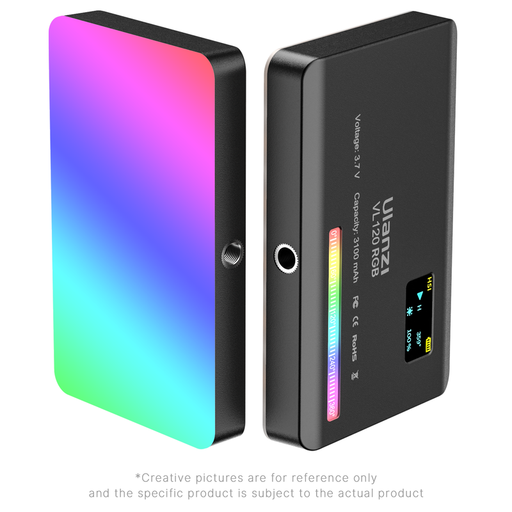
This compact RGB camera-style light is worth considering when you need a portable light for a small demonstration setup. Check its output at your shooting distance and how you would diffuse or mount it before treating it as a replacement for a larger studio panel.
 No image available
ULANZI VL120 RGB video light
A compact option for a demonstration setup where portable, adjustable lighting is the priority.
The listing states an integrated 3100 mAh battery, 2500–9000 K adjustment, CRI ≥ 95, 360° colour control and 20 lighting effects.
Check the brightness controls and output for your shooting distance, plus the exact mounting, diffusion and charging arrangements.
View on Joybuy
Frequently asked questions
Is a bi-colour panel enough for a home product demonstration?
A bi-colour panel is a sensible starting point when you mainly need adjustable white light for products against a simple background. Consider RGBWW instead if coloured backgrounds or effects are a regular requirement, and check diffusion whichever type you choose.
When would I use a softbox or grid?
Use diffusion or a softbox when direct light creates hard reflections or sharp shadows; a grid can help limit light reaching nearby walls or a backdrop. Confirm that each modifier fits the exact panel and has the mounting parts it needs.
Can I compare LED panels by wattage alone?
No. Rated power is not a complete measure of the light reaching your product. Compare exact-model output figures at matching distances and colour-temperature settings where available, then account for placement and any modifier you intend to use.
Are batteries and stands included with panel lights?
Inclusion depends on the exact kit, so check its in-box list. Battery compatibility alone does not establish that a battery or charger is supplied; likewise, confirm the stand, mount and modifiers separately.
What should I check before ordering a mains-powered panel?
Check the exact adaptor and plug arrangement, electrical instructions and supplier information for the product offered. GOV.UK publishes separate product-marking guidance for Great Britain and Northern Ireland, so use the framework relevant to where the product will be supplied rather than relying on a marking image alone.


