What matters when choosing a panel?
For vintage-camera photography, decide whether reflections, repeatable finish colour or limited working space is the main constraint; then compare panels and accessories for that task.
| Concern |
What to check |
Who this matters to |
| Reflections and glare |
Can you dim and position the panel away from the camera axis? Check how a diffuser, light tent or dome would be mounted. |
When chrome and glass mirror the room, I need to shape the reflected light rather than make the panel brighter. Around 42% of consumers would put reflection control first. |
| Colour and finish |
Compare the exact model’s colour-temperature range and stated CRI or TLCI figures; plan a repeatable white-balance workflow. |
If I am documenting paint and aged finishes across several cameras, I want lighting I can adjust consistently. Roughly 33% of consumers would make colour and finish their primary concern. |
| Space and close details |
Check panel size, mounting and power options, plus quoted illuminance at a stated distance and colour temperature. |
For markings and controls photographed at a small desk, I need a light I can place close to the subject. About 25% of consumers would prioritise a compact detail setup. |
Relevant brands to consider
These examples illustrate different panel designs; the specifications and limitations below apply to the named models or kits, not every light from each brand.
Godox
The Litemons LP600R is a route to consider when adjustable colour temperature, dimming and control of light spill are useful in a changing setup.
- CameraWorld lists an 1800–10,000 K range, 0–100% dimming, CRI and TLCI of 96, and barn doors for the LP600R.
- Its NP-F batteries are optional. Barn doors help shape spill but do not replace diffusion for reflective camera surfaces.
amaran
The P60x three-light kit is relevant to a tabletop arrangement where several panels and supplied modifiers will be used together.
- SCAN UK describes three 60 W bi-colour panels with softboxes, grids, power supplies, tilt mounts and a carry case; its stated range is 3200–6500 K.
- Those contents belong to the three-light kit. Check a single-panel package separately rather than assuming it contains the same accessories.
NanLite
The MixPanel 60 is an option when one fixture needs to switch between softer, more directional and coloured-light arrangements.
- Bristol Cameras describes hard, soft, colour-temperature and coloured-light modes, alongside green/magenta adjustment.
- If you use one fixed listing setup, decide whether those modes are useful before choosing a more involved fixture.
SmallRig
The P96 suits consideration as a portable light for nearby fill or camera details rather than an assumed replacement for a larger main panel.
- SmallRig states a 103 g weight, 2700–6500 K adjustment, a built-in 2200 mAh battery and 150 lux at 1 m for the P96.
- Check the brightness needed at your working distance before relying on it for a whole-camera photograph.
Joybuy lights for close-up work
These compact battery lights are choices to consider for nearby fill and vintage-camera details. For whole-camera photographs, check their output and diffusion options before planning to use either as the main light.
 No image available
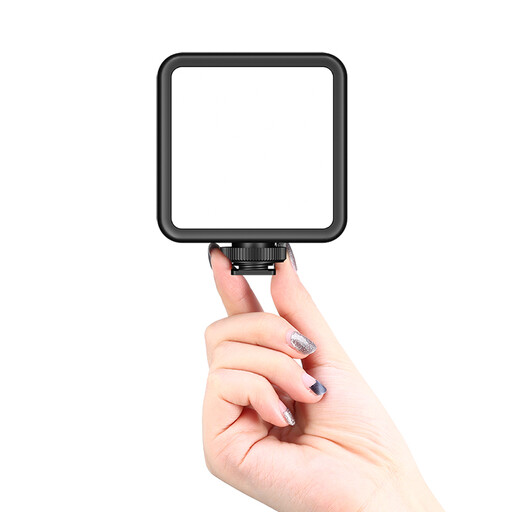
Ulanzi VL49 LED video light, 2000 mAh
Consider this compact light for nearby fill when photographing controls or other small details. Its stated features include a 2500–9500 K adjustment range, dimming, a 2000 mAh battery and a magnetic back. Check output at your working distance and how you would diffuse and mount the light before using it for reflective surfaces.
View on Joybuy
 No image available
ULANZI VL120 RGB video light, 3100 mAh
This compact option is relevant to portable close-up lighting when colour adjustment matters. Its stated features include a 2500–9000 K range, CRI of at least 95, RGB colours and an integrated 3100 mAh battery. Check output, mounting and diffusion options for your intended distance; the stated CRI does not guarantee the colour of a finished photograph.
View on Joybuy
Frequently asked questions
How can I reduce reflections on a vintage camera?
Control what the camera’s polished surfaces reflect, rather than just increasing brightness. Move the panel and camera to keep the photographer and room out of prominent reflections, and consider a broad diffuser or smooth-interior light tent; highly polished parts may also show the tent’s internal supports.
Can a small battery LED panel be my main light?
A small panel can serve as the main light only if its output and placement work for your subject, exposure and modifier. For context, SmallRig states 150 lux at 1 m for the P96, while SCAN UK lists 5070 lux at 1 m and 5600 K for the amaran P60x; these are published figures for different products under their stated conditions, not a like-for-like performance test.
Should I check for UKCA or CE marking on an LED light?
Yes, check the marking and accompanying product information that apply to the exact light and where it will be used. GOV.UK guidance for Great Britain says CE marking continues to be recognised alongside or instead of UKCA where the relevant product regulations meet UK needs; Northern Ireland follows different processes, so check its applicable guidance separately.
How should I dispose of an LED panel or removable battery?
Use an appropriate electrical or battery collection route rather than putting items bearing the crossed-out wheelie-bin symbol in household rubbish. GOV.UK also advises taping the terminals of removable lithium batteries before recycling to help reduce fire risk.


