
24/7 Customer Support

Free returns

Same-day & Next-day Delivery

Quality Guaranteed

Unlock Your Welcome Offers: FREE Delivery | Up to 80% OFF | Free 30-day JoyPlus trial
Download the APP
A torch can look suitable online yet disappoint when you need it most. A beam may be bright enough for a garden path but unsuitable for finding a fuse during a power cut. A compact body may fit a pocket, but the batteries could be difficult to replace. Some products also use impressive-sounding figures without explaining how long the light stays at that output.
Before buying an LED torch, look beyond the headline brightness. The right choice depends on where you will use it, how often you want to charge or replace batteries, and whether the torch needs to withstand rain, drops or frequent handling.
A lumen measures the total amount of visible light produced. It does not tell you how wide the beam is, how far it reaches or how long the torch can maintain that output. A high-lumen torch may offer strong illumination for a short period, while a lower-output model can be more practical around the home.
Check whether the listing separates maximum output, beam distance and runtime. For indoor tasks, sheds and short walks, 25–50 lumens may be adequate. Longer outdoor routes or large areas may benefit from a stronger floodlight, a focused spotlight or both.
Terms such as “weatherproof” and “water-resistant” are not interchangeable. Where an IP rating is provided, the second digit indicates protection against water. For example, IPX8 refers to a product tested for immersion under specified conditions, but it does not mean the torch should be used carelessly in every situation.
If you need a waterproof torch for wet camping or outdoor work, check the exact rating and charging-port design. For occasional household use, a dry-storage routine may matter more than a premium water-resistance claim.
A battery-powered torch may be ready to use immediately, but regular battery replacement adds cost and creates more waste. Conversely, a rechargeable torch is only convenient if its charging cable is compatible with equipment you already use and the battery can hold enough charge for your routine.
Check whether batteries are included, which type is required, and whether charging is via USB-C, magnetic charging or a proprietary connector. Also look for low-power modes that extend runtime during an emergency.
Choose the beam to match the task:
A product’s stated beam distance is a useful comparison point, but visibility also depends on weather, surrounding light and the surface being illuminated.
A mini torch or pocket torch should be light enough to carry without becoming a nuisance. Keyring loops, clips, lanyards and bicycle straps can make a practical difference. For children, look for a smooth, non-slip body and modest output rather than simply choosing the brightest model.
For household repairs or outdoor work, aluminium construction and a textured grip may offer more confidence than a very small plastic body. Remember that a larger battery and stronger light usually increase overall weight.
A USB-C rechargeable torch is convenient where you regularly have access to a plug, power bank or car charger. A traditional battery-powered torch can be a sensible backup for long-term emergency storage because spare batteries can be kept separately.
When comparing runtime, check the mode used to achieve it. “Up to” figures often refer to the lowest setting. Keep spare batteries or a charged backup torch in an accessible place, and remove disposable batteries before prolonged storage if the manufacturer recommends it.
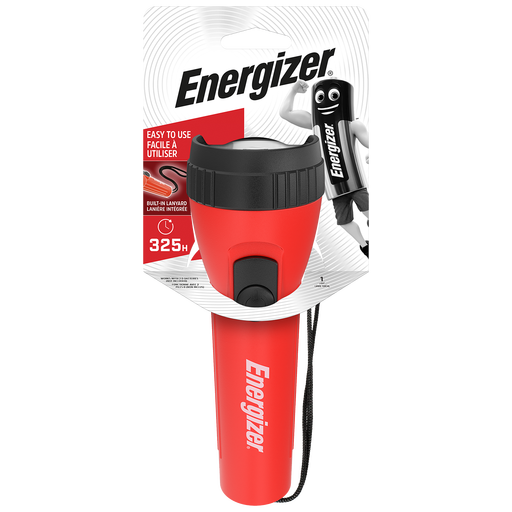
Why This Fits Their Persona: A straightforward option for cupboards, sheds, power cuts and occasional camping, using two D batteries rather than a charging system.
The listing specifies 25 lumens, a 45-metre beam distance and that batteries are not included, making the running requirements clear.
Push-button operation, ribbed grip and stated runtime of up to 325 hours on two D batteries.
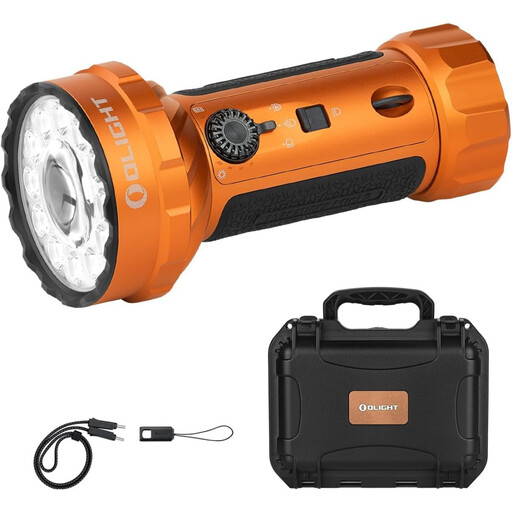
Why This Fits Their Persona: Designed for shoppers who want a durable, rechargeable torch for demanding outdoor use, night walks, emergencies and work tasks.
The listing separates its 10,000-lumen floodlight and 750-metre spotlight figures, while also stating the IPX8 rating and 1-metre drop resistance.
Five lighting configurations, a 7,500 mAh battery, USB-C and magnetic charging, plus a 133 mm aluminium body.
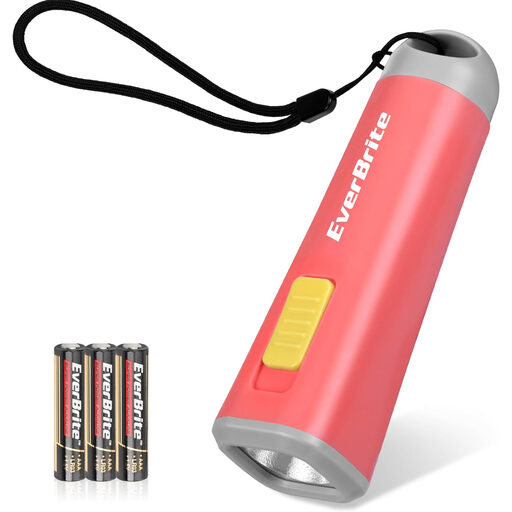
Why This Fits Their Persona: Its 46 g torch body and soft yellow light suit children’s reading, family camping and keeping a small emergency torch in a backpack.
The stated 25–30 lumens and battery-powered design make it a modest-output choice rather than an unnecessarily intense high-lumen torch.
Three AAA batteries are included, with a non-slip matte surface and no installation required.

Why This Fits Their Persona: A practical multipack for clubs, classroom activities, cycling groups, party bags, family camping or keeping several emergency lights around the home.
The listing gives per-torch figures of 30 lumens, approximately 20 metres and around three hours, rather than presenting pack totals as individual performance.
Eighteen aluminium torches, 54 AAA batteries and lanyards are supplied for immediate distribution.
We have compiled a complete, real-time list of products that fully satisfy these strict selection criteria and UK safety regulations.
They can be, particularly if used frequently, because you are not repeatedly buying disposable batteries. However, the purchase price, charging time and battery capacity affect the overall value. A battery-powered torch remains useful as a backup, especially when stored with spare batteries for a power cut.
For checking cupboards, corridors and small repairs, a modest output can be sufficient. A stronger light is more useful outdoors, on unlit paths or across larger gardens. Avoid pointing high-output lights at people or animals, and follow the product’s safety instructions.
Keep it in a cool, dry and easily accessible place. Test the switch periodically, recharge rechargeable models before storage and check disposable batteries for leakage or low charge. Remove batteries during prolonged storage where the manufacturer advises this.