
24/7 Customer Support

Free returns

Same-day & Next-day Delivery

Quality Guaranteed

Unlock Your Welcome Offers: FREE Delivery | Up to 80% OFF | Free 30-day JoyPlus trial
Download the APP
A torch can look impressive on a product page yet prove awkward, dim or expensive to maintain at home. UK shoppers often compare lumen figures first, but brightness is only one part of a useful torch. Beam distance, battery arrangements, water resistance and physical size can matter just as much.
Whether you need a rechargeable torch for a car, a pocket torch for dog walks, a camping torch for rural paths or a mini torch for children, avoid these common purchasing traps.
A high-lumen torch produces more light, but that does not automatically mean it is suitable for every task. A wide flood beam helps illuminate a campsite or shed, while a focused beam is more useful for spotting a distant gate or trail marker. High output can also create more heat and reduce runtime at the brightest setting.
Check whether the listing separates floodlight output, spotlight output and maximum runtime. A torch offering several brightness levels is generally more adaptable than one with a single intense setting.
The advertised throw distance normally refers to a specific maximum setting and measurement condition. It may not represent the practical range on a rainy footpath or in a built-up area. For household tasks, cycling or walking, a shorter but broader beam may be easier to use.
If you need a long-range torch for outdoor navigation, compare the stated beam distance with the torch’s size, weight and battery capacity rather than selecting the largest number in isolation.
Look for an IP rating, which describes protection against dust and water under defined test conditions. For example, IPX6 indicates protection against powerful water jets, while IPX7 and IPX8 relate to temporary or continuous immersion conditions specified by the manufacturer. These ratings do not mean a product should be used underwater without checking its instructions.
Also inspect the charging-port cover, seals and battery compartment. A rechargeable torch with an open USB port may require extra care in heavy rain.
Brightness is measured in lumens, while beam intensity is commonly expressed in candela. Lumens describe the total visible light output; they do not fully explain how that light is distributed.
For different UK uses:
A high-lumen torch should include a lower setting for indoor use. Never point a powerful beam at people, animals or aircraft.
Disposable AAA batteries can be convenient for emergency kits because replacements are widely available. They are also useful when a torch may remain unused for long periods, provided batteries are removed during extended storage where the instructions recommend it.
A rechargeable torch can reduce the need for repeated battery purchases. Check:
Integrated batteries are convenient, but replacement options may be more limited than with standard cells.
A tactical torch or heavy-duty EDC torch may offer stronger construction, but additional weight can become noticeable on a belt or in a rucksack. A mini torch, keyring torch or lightweight pocket torch is easier to carry every day, although it normally has a shorter beam and lower output.
For outdoor use, look for an aluminium body, textured grip, secure switch and a stated drop-resistance rating. IP ratings should be treated as a guide to water and dust protection, not as a guarantee against all damage.

Why This Fits Their Persona: An economical option for households, group camping trips, party bags, school activities or keeping several emergency lights in different rooms and vehicles.
The listing states the output, approximate 20-metre beam distance and estimated three-hour working time, rather than presenting the torches as a high-powered substitute for an outdoor search light.
The pack contains 18 aluminium mini torches, 54 pre-installed AAA batteries and lanyards. Each weighs approximately 30g and produces 30 lumens.

Why This Fits Their Persona: A compact everyday-carry choice for commuters, cyclists, dog walkers and anyone who wants a torch attached to keys, a belt or a backpack.
Its stated output is 80 lumens with a 28-metre throw, making its intended close-range role clear. The integrated USB-C plug also avoids searching for a proprietary charging lead.
The 20g body includes magnetic activation, a magnetic base, USB-C charging and IPX6 water resistance. It is rated for drops from up to 1.5 metres.
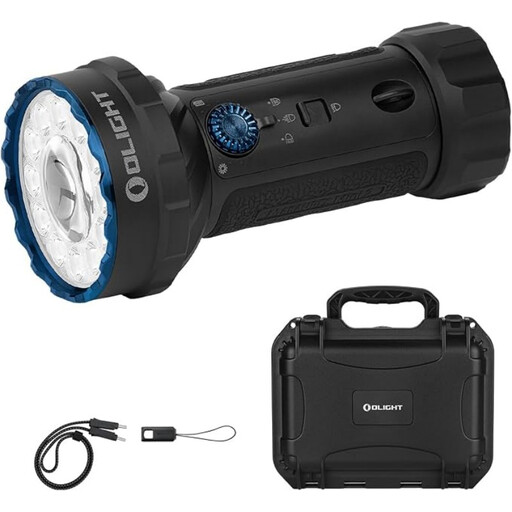
Why This Fits Their Persona: Suited to demanding outdoor users, property checks, vehicle emergencies, camping and tasks requiring both wide-area light and a focused long-range beam.
Instead of relying on one headline figure, it provides separate flood, spot and combined modes, plus lower red and side-light options. Its IPX8 rating and stated one-metre drop resistance are also specified.
The torch is rated at up to 10,000 lumens with a stated 750-metre spotlight range. It includes a 7,500mAh lithium-polymer battery, USB-C and magnetic charging, and weighs about 465g.
We have compiled a complete, real-time list of products that fully satisfy these strict selection criteria and UK safety regulations.
Before buying, confirm that the product includes clear operating instructions and suitable charging accessories. For children, choose a simple kids’ torch with a low output and keep button or AAA batteries away from young children because they can present a serious swallowing hazard.
For an emergency torch, test it periodically rather than leaving it unused in a drawer. Rechargeable models should be topped up according to the manual, while battery-powered models should be checked for leakage or corrosion. A lower brightness setting normally uses less energy, so using the right mode can reduce charging frequency or battery replacement.
Do not stare into an LED beam or aim it at someone’s eyes. If a high-output torch becomes hot, reduce the brightness and allow it to cool. Follow the supplied instructions and check the manufacturer’s guidance for charging, storage and water exposure.
LEDs generally use energy efficiently and can offer long service life, but the actual running cost depends on brightness, runtime, battery type and how often the torch is used. A rechargeable torch may reduce disposable battery purchases, while a low-use emergency torch with replaceable AAA cells can be convenient.
For familiar pavements and short evening walks, a modest output can be sufficient. Rural paths, cycling and poorly lit areas may benefit from a brighter model with adjustable settings. Prioritise a beam pattern that lights the ground evenly, not just a high maximum lumen number.
Choose a model with a stated water-resistance rating suitable for the conditions, keep charging ports closed and follow the instructions. Even a waterproof torch should not be submerged beyond its specified rating or charged while wet. Wipe the contacts and body dry before storage.