
24/7 Customer Support

Free returns

Same-day & Next-day Delivery

Quality Guaranteed

Unlock Your Welcome Offers: FREE Delivery | Up to 80% OFF | Free 30-day JoyPlus trial
Download the APP
A torch is easy to buy until you need it in a power cut, on a muddy path or beside a vehicle at night. Many LED torches look similar online, but their real usefulness depends on more than a large brightness figure.
The most common buying traps are:
Lumens indicate the total visible light output, but they do not tell the whole story. A high-lumen torch with a wide flood beam can illuminate a garden or room effectively. A focused spotlight sends light further, making it more suitable for fields, woodland or inspections.
Consider the type of beam you need:
A stated throw distance is normally measured under defined conditions. Fog, rain, trees and uneven ground can reduce practical visibility, so do not select a torch on throw distance alone.
A USB-C rechargeable torch can be topped up from a laptop, plug adaptor, power bank or vehicle charger. This is particularly convenient for commuting, travel and emergency kits. Magnetic charging can also reduce wear on a port, although you should check whether the supplied cable is proprietary.
Battery-powered torches remain useful for long-term storage. The Energizer model listed below uses two D batteries and states a runtime of up to 325 hours, although the batteries are not included. For stored emergency equipment, remove disposable batteries during prolonged storage if the manufacturer advises it, reducing the risk of leakage.
Always compare runtime at the brightness level you will actually use. A quoted maximum runtime may refer to a low setting rather than full output.
A compact torch is more likely to be carried regularly, while a larger tactical torch may offer a bigger battery, stronger grip or greater output. For everyday carry, check length, weight, pocket clip and accidental-activation protection.
IP ratings are useful when understood correctly:
A water-resistant torch still needs its charging cover closed and its contacts kept clean. Drop resistance is another practical specification, especially for outdoor work, vehicle repairs and professional inspections.
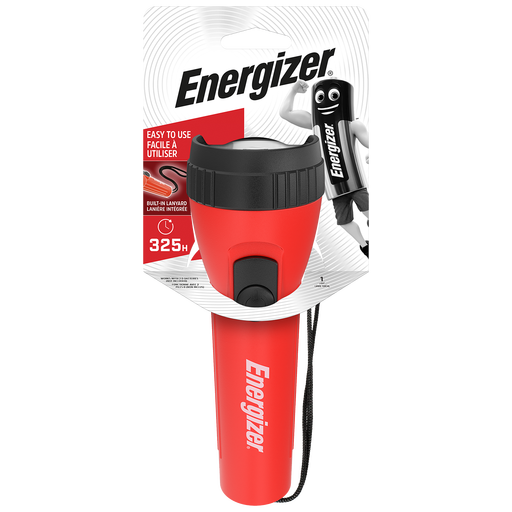
Why This Fits Their Persona: A straightforward option for cupboards, sheds, power cuts and occasional camping, particularly where long low-output runtime matters more than maximum brightness.
Its 25-lumen output sets a realistic expectation rather than implying high-output performance. The two D batteries are clearly specified and are not included.
Push-button operation, ribbed grip, 45-metre beam distance and stated runtime of up to 325 hours.

Why This Fits Their Persona: At 58.3 mm and 20 g, it suits keys, belts, backpacks and daily travel when a small emergency or keychain torch is more practical than a full-sized model.
It does not pretend to replace a high-output torch: its stated maximum is 80 lumens and its throw distance is 28 metres. Its integrated USB-C plug makes charging easier to plan.
Magnetic activation and base, USB-C charging, IPX6 water resistance and 1.5-metre drop resistance.

Why This Fits Their Persona: The slim 124 mm profile is suited to users wanting a capable EDC torch for commuting, outdoor trips, inspections and home maintenance without a cylindrical body.
Its modes are clearly separated: floodlight, spotlight, UV and green beam. This makes it easier to choose functionality rather than paying solely for a large lumen claim.
Up to 1,500 lumens, 205-metre stated throw, USB-C and magnetic charging, IPX7 rating and magnetic hands-free mounting.
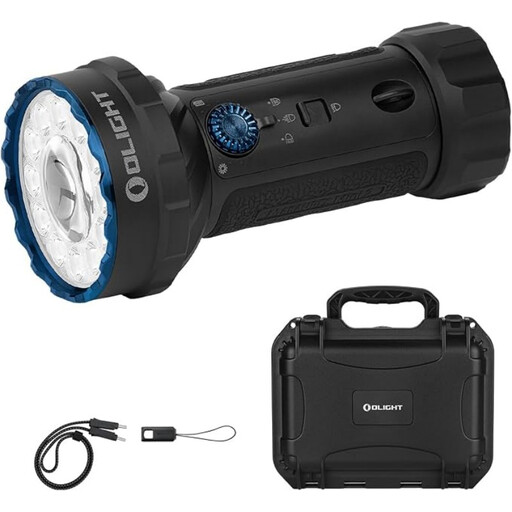
Why This Fits Their Persona: Its combination of flood, spot, red and side lighting suits camping, hunting, vehicle repairs, outdoor work and emergency preparation where one torch must cover several situations.
The five lighting configurations provide more control than a single high-output setting. Its 465 g weight should, however, be considered before choosing it for lightweight everyday carry.
Up to 10,000 lumens, 750-metre stated beam distance, IPX8 water resistance, USB-C and magnetic charging.
We have compiled a complete, real-time list of products that fully satisfy these strict selection criteria and UK safety regulations.
They can be, because one built-in battery can replace repeated purchases of disposable cells. The cost depends on charging frequency, electricity use, battery lifespan and whether the torch requires a proprietary cable. A battery-powered model may still be suitable for an emergency kit that is checked and maintained periodically.
For rooms, cupboards and basic household tasks, a modest output may be sufficient. A walking or camping torch generally benefits from adjustable brightness and a wider beam. A high-lumen torch is more suitable when you need strong outdoor illumination, but maximum output may create heat and reduce runtime.
Follow the product manual rather than assuming every rechargeable torch has identical charging controls. Use the specified cable and power source, keep the torch away from heat and stop using it if the battery or body becomes unusually hot, swollen or damaged.