Small-table candle sellers
If you photograph individual jars, tins or wax melts close up, the panel and its support need to fit around your shooting area while leaving room to change the light’s angle.


For close-up photographs of handmade candles on a small table, start by considering a bi-colour panel that fits beside the subject and can be used with diffusion. A compact panel suits close placement; consider a larger, higher-output setup if you need a bigger modifier or must work farther from the candle. Choose RGBWW controls when coloured accents are part of the images you plan to make, rather than treating them as essential for neutral product photos.
If you photograph individual jars, tins or wax melts close up, the panel and its support need to fit around your shooting area while leaving room to change the light’s angle.
If wax, labels and packaging need to look consistent across repeat shoots, adjustable colour temperature and the exact model’s stated colour-rendering specifications matter more to your shortlist than decorative effects.
If coloured backgrounds or accent lighting are part of your candle photos or short videos, RGBWW control may be useful. If your images are intended to show neutral product colours, it need not drive the purchase.
Decide where the light and any diffuser will fit before comparing output figures. Then check colour adjustment and the power arrangement against the way you shoot.
| Concern | What to check when buying | Who this matters to |
|---|---|---|
| Light shaping and reflections | Check whether diffusion is supplied or a softbox is compatible, and whether the assembled light fits beside the table. | Reflective jars and glossy labels make me want room to soften and reposition the light; around 36% of consumers put reflection control first. |
| Consistent product colour | Check the exact panel’s colour-temperature range and stated CRI or TLCI; test your camera white balance with the candle and surrounding light. | I need wax, labels and packaging to look consistent from one shoot to the next; for around 29% of consumers, colour consistency is the primary concern. |
| Space and power | Check the mount and available clearance, plus the battery or mains arrangement and any stated runtime at the brightness you need. | With little room for a stand and power accessories, I need a setup I can position and run conveniently; around 21% of consumers prioritise space and power. |
| Creative colour | Look for RGBWW and green/magenta controls only if you intend to use coloured backgrounds or accents. | My candle content calls for deliberate colour accents rather than only neutral product images; creative colour comes first for around 14% of consumers. |
For reflective jars and tins, the way you diffuse and position the light may matter more than its headline wattage. Godox describes removable diffusion panels for its LDX range, while amaran documents softbox installation for its P60 models.
Check what the exact package includes, which modifiers fit, and how much space the assembled setup needs beside your candle.
A compatible diffuser, softbox or grid may need to be obtained separately.
Manufacturers quote the amaran P60x at 1 m and 5600 K, the NEEWER AP150B at 1 m and 6500 K, and the SmallRig P96 Neo at 0.3 m. Those figures do not describe the same measurement conditions.
Compare distance and colour temperature before using an illuminance figure to shortlist panels. Allow for your actual light placement and any diffusion.
Godox states that NP-F batteries for the LDX50Bi are sold separately. amaran identifies a separately purchased D-tap-to-DC cable for a P60 power route, and NEEWER lists separate V-mount power accessories for the AP150B.
Check the exact package and plan how the panel, support and power supply will work together for a full shoot.
Depending on the model and package, batteries, cables, a charger or a suitable stand may be additional items.
An LED panel still needs to be positioned with regard to hot surfaces, flames and electrical cables. The amaran manuals instruct users to keep the fixture away from flammable objects and let it cool before storage.
Follow the purchased model’s instructions, keep its fixture and cables clear of flames and hot surfaces, and check the plug and applicable market information for the exact product.
The P60x is a bi-colour panel route; the P60c adds RGBWW controls for planned colour effects.
The LDX family offers bi-colour and RGB panel options, with documented removable diffusion.
The AP150B represents a higher-output bi-colour option to assess when a larger modifier or brighter surroundings change the setup.
The P96 Neo is a compact panel to consider when the light can sit close to a candle on a cramped tabletop.
These compact lights are choices to assess for close-up tabletop work. Compare each one’s light shaping, placement and power arrangement with your candle setup; colour controls alone do not establish how it will handle reflections.
 No image available
Consider this compact light if coloured accents are part of your candle images. Its product title states 2500–9000 K adjustment, 360° RGB colour control, an integrated 3100 mAh battery and CRI ≥ 95; the colour-rendering figure is a product claim, not a guarantee of finished image colour.
Check its dimensions, runtime and diffuser compatibility for your intended position. Keep the light ventilated and clear of flammable materials as directed by its listing.
 No image available
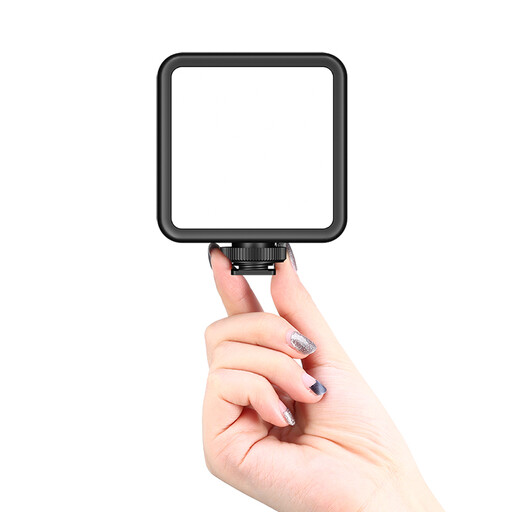
If you are considering this LED light for candle photography, check how it mounts and whether its light can be diffused within the space beside your table.
No image available
Consider this compact light for close-up product images when adjustable white light matters more than RGB effects. Its title states 2500–9500 K adjustment, dimming, a magnetic back and an integrated 2000 mAh battery.
Check its runtime and whether diffusion can be used in your tabletop arrangement before relying on it for a longer shoot or reflective jars.
Not for neutral catalogue-style photographs: a bi-colour panel with workable diffusion is a more direct starting point. Consider RGBWW if coloured backgrounds or accents are part of your intended images; the amaran P60c’s RGBWW and green/magenta controls are examples of those additional options.
Compare lux figures only after checking the measurement distance and colour temperature. Aputure quotes 5070 lux at 1 m and 5600 K for the amaran P60x, NEEWER quotes 17,200 lux at 1 m and 6500 K for the AP150B, and SmallRig quotes 1590 lux at 0.3 m for the P96 Neo. Your working distance and modifier also affect how useful a quoted figure is for your setup.
Check the exact package rather than assuming they are. Godox says NP-F batteries for the LDX50Bi are sold separately; Aputure identifies a separately purchased D-tap-to-DC cable for a P60 power route, while NEEWER says the AP150B’s V-mount battery and D-tap cable are sold separately.
For a product sold for use in England, Scotland or Wales, check the exact model’s applicable UKCA or CE marking and accompanying seller information. GOV.UK guidance states that Great Britain continues to recognise CE marking alongside or in place of UKCA marking where the relevant requirements apply; the marking alone does not establish the status of a particular listing. Northern Ireland has different market processes.
Follow the purchased light’s manual and keep its fixture and cables clear of flames and hot surfaces. The amaran P60 manuals instruct users to keep the fixture away from flammable objects and let it cool before storage; check the instructions for your exact model rather than assuming one separation distance applies to every light.